
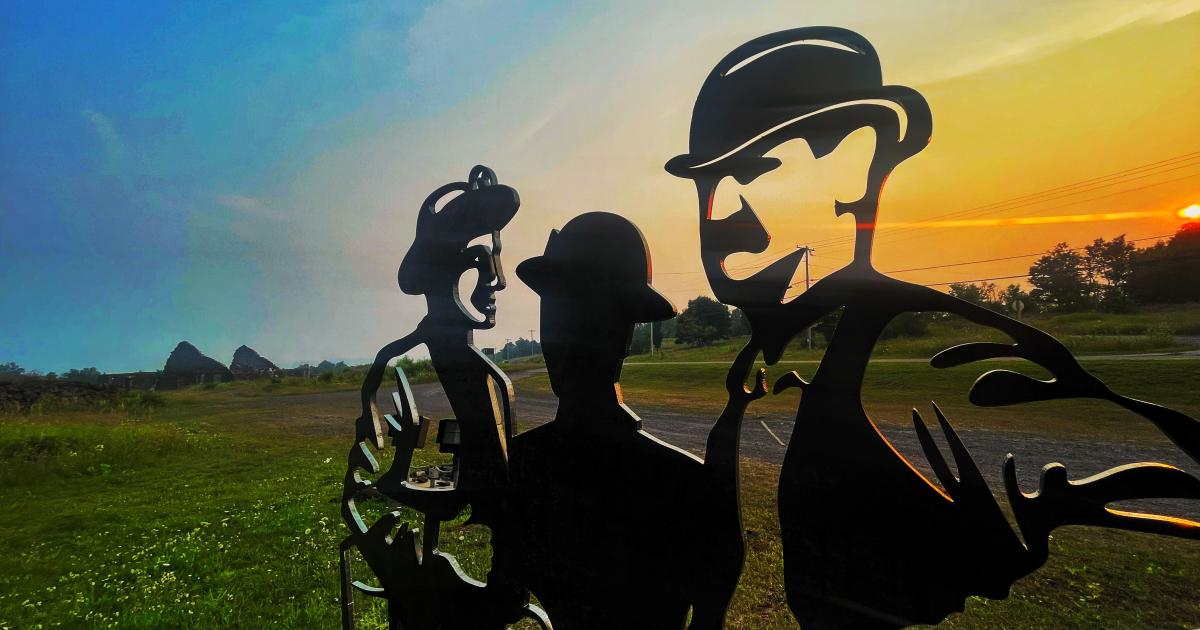
What if you could wander history, seeing it through the eyes and paths of people? You can! Head to Michigan’s Upper Peninsula, to the Keweenaw National Historic Park to see how artist Kasey Koski brought history to life in an outdoor exhibit called Repopulating the Past. Kasey Koski is an interdisciplinary artist, curator and educator living in Wenatchee, WA.
Koski’s public art, scattered like gems in the states of Michigan and Washington, brings the historic, the every day, the otherworldly to life.
Her site specific metal sculptures, located at historic sites in the Keweenaw National Historic Park, offer a vision of what it meant to work in the mines and live in these communities in the early 20th century. Art is such an important lens through which to view the world – and history. Koski’s extraordinary vision and talent are sights to behold, marvel at, dream with.
We were lucky enough to interview Kasey about her art, creative themes, Repopulating the past, and more. Here’s what she had to say…

I studied at Finlandia University in Upper Michigan and the Kuopio Academy of Craft and Design in Kuopio, Finland. After college I relocated to the Wenatchee Valley and became involved in community arts activism. I sat on the founding board of the Two Rivers Gallery art co-op and currently sit on the City of Wenatchee Arts Commission. I have coordinated and curated art shows within the community for many years and participate with the 220 Women’s group who show work regularly. I also co-produced the Wenatchee First Friday Artwalk event for 12 years.
In my personal work, I express myself frequently through paint and fiber, but have also worked in metal, wood, and landscape. My work has been shown throughout Washington and Northern Michigan. I have also worked with the City of Wenatchee, Mission Ridge Ski & Board Resort, Trust for Public Land, and the Keweenaw National Historical Park among others on various large, site-specific projects and continue to take an active interest in art opportunities at the public scale.
From 2015-2023, I worked for the Wenatchee Valley Museum & Cultural Center as curator of exhibits. In that time, I produced nearly 50 exhibits, including the award winning Beyond the Frame: Inland Bounty. In 2024, I began working with the Cashmere Museum & Pioneer Village and the Keweenaw National Historic Park. I have found my creative sweet spot in the intersection of art, history and culture.

Mother and Child
What first compelled you to become an artist, and when did you realize art would be a lifelong pursuit for you?
I was just a child and my mother and grandmother gave me drawing materials to keep me occupied in church. My grandmother worked as the church secretary, and I told her to bring my drawing to God. I was confused in only the way a child could be thinking that our Catholic priest or “father” was God of the trinity. Catholicism was confusing to a 3-year-old. When I graduated from high school, my grandmother gave me back this drawing and a reminder that my innocent gift to God was in fact God’s gift to me. I had wonderful support from my family throughout my creative education.
How would you describe your work to someone encountering it for the first time?
Well, I do and have done all sorts of work, but the current project “Repopulating the Past” for the Keweenaw National Historic Park is just that. I am creating site specific, cut metal people to help interpret outdoor ruins of an industrial site important to America’s History.

Man at Basin
What themes or ideas tend to surface repeatedly in your work, even when you’re not consciously planning them?
Family, history, blood lines, interconnectivity to nature, shared experience.
Can you walk us through your creative process, from the first spark of an idea to a finished piece?
Whew, that can be a doozy, some projects get dumped into my journal without ever seeing the light of day. I tend to call myself a creative compulsive – I see potential in everything! In the case of the current project, it was a call to art that I saw immediately how to solve. The process started with research into correct historical details, then the design evolved to positions that would best interpret each location. The designs are done on my computer and then processed to be read by cad programs to be laser cut at a local fabricator.

Waving miner at Quincy Shaft
What materials or techniques are essential to your work, and why do they matter to you?
I studied graphic design in college and the work that I am doing now with the Keweenaw National Historical Park originates in computer design software. However, I have always loved working with my hands and experimenting with anything I can get my hands on. Parallel to the site-specific work I love to travel with my watercolors. I think that the watercolors are the opposite end of the spectrum as far as materials. Nature based and in the moment.
Is there a personal story, memory, or lived experience that strongly informs the work you’re showing now?
I would say that there is a parallel: My own immigrant ancestors came to the US looking for a better life and settled in the Keweenaw Peninsula of Michigan to mine copper. I have been going down the rabbit hole of my own genealogy at the same time as telling the story of the immigrant miners and their families.

Coal shoveler in #7 boiler
What do you hope viewers feel, question, or take with them after experiencing your art?
The similarity of our ancestral experience. Every immigrant who has ever come to America of their own accord has only wanted a better life for their family. It is the same now as it was throughout history. We are all immigrants or descendants of immigrants. Every person I have represented in the landscape is working hard to make a better life. We need to keep that in mind in this era of divisive politics.
How has your work evolved over time, and what do you think caused that evolution?
I feel like my work has a cyclical nature. I return to ideas and techniques and try to, not repeat, but grow with what I have learned over time. The style that I have developed for cut steel people started when I learned to use a vinyl cutting machine while working for a sign shop two decades ago. This style’s next manifestation was a series of t-shirt designs. It all came together in a new way when I read the call for art from KNHP. I also have more casual hobbies that certainly fall into seasons of the year.
What role do you believe artists play in today’s culture or community?
I think that art does wonders for bringing people together and inducing pride in communities. I’ve worked in public art for a long time in one way or another, and there’s something about an art project that can bring people together around a common goal or value.

Spruing
What’s next for you, either creatively, conceptually, or in terms of upcoming projects?
Well, there is a chance that the “Repopulating the Past” could continue for some time yet. The Keweenaw National Historical Park consists of 24 partner sites. So far, I’ve worked with 3. My adult kids don’t need as much from me these days, so that is kind of liberating. I’ve been thinking about how nice it would be if my day job wasn’t so much a report to work at 8 am kind of thing and that I could do art full time. We’ll see how that goes. I’d like to live up to the title of free-range artist.
Find Kasey online:
https://www.kaseykoskiart.com/
https://Facebook.com/kasey.koski/
https://www.instagram.com/mymaximalistheart/
Explore the sculptures!
https://www.kaseykoskiart.com/keweenaw-national-historical-park
https://www.nps.gov/kewe/getinvolved/commissioned-artist-program.htm
https://www.visitkeweenaw.com/the-crossing-place/quincy-mine-haunted-to…
All photos courtesy Kasey Koski, republished with permission