

When we think about the Middle Ages, most of us picture something impossibly far away. Castles, plague, Robin Hood, people who died at forty. Nothing to do with us. (Reader, no.)
And then December arrives and we still do almost exactly what they did.
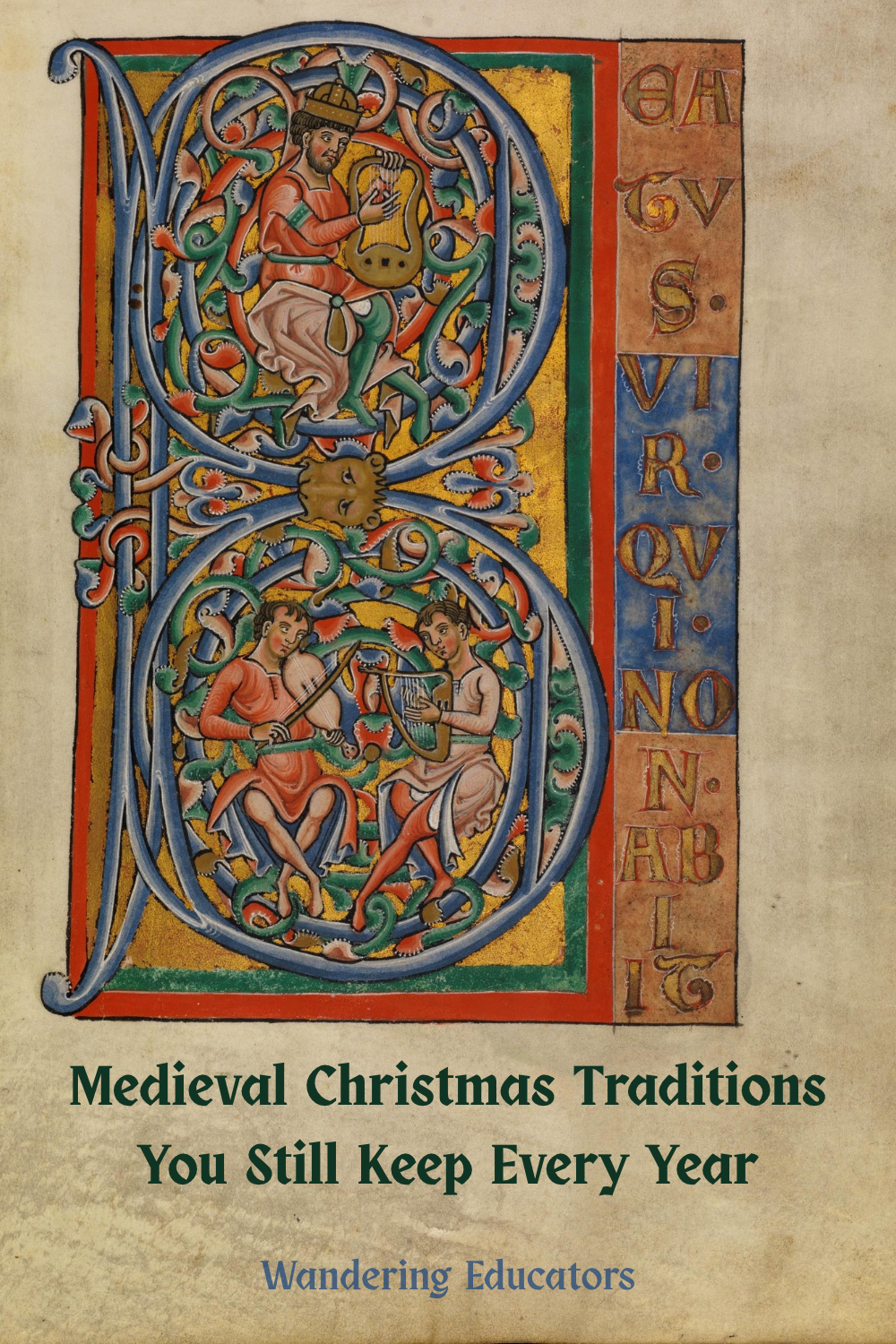
King David with his harp, and two musicians below him with a fiddle and a lyre. Folio 10r of the Bamberg Psalter, painted around 1220. Staatsbibliothek Bamberg, Msc.Bibl.48, via Wikimedia Commons.
We sing songs with a repeating chorus. We knock on doors in the cold and expect to be fed for it. We eat small spiced pies that used to have meat in them, and some of us still call the filling mincemeat without ever once wondering why. We put children in charge of things for one strange afternoon. We hold a party where the ordinary rules of who outranks whom get suspended for an evening, and then we all go back to work.
Your Christmas is a medieval Christmas in modern clothes, and once you can see the stitching you cannot unsee it. Here are five traditions that made the journey, what they actually were, and what happened to them on the way.
Carols were dances, and most of them were not for church
Start with the biggest surprise (it's a total reframe!).
A carol was originally a dance. English Heritage, writing about a carol found in a Battle Abbey prayer book, traces the word to the French carole, a ring dance. By the early fifteenth century it had come to mean a song "with or without a dance," and by the early sixteenth, it simply meant a song. The dancing fell away. The name stayed.
Did you know? A carol is defined by its shape rather than its subject. It has an opening chorus that comes back after every verse, and that structure is the whole definition. A carol could be about anything at all. Some of the surviving ones are extremely bawdy. (Medieval people were not solemn, but hilarious. See: Chaucer.)
Roughly five hundred English medieval carols survive, and over half of them have Christmas as their subject, which shows us where the form eventually settled. But as Christopher Hodkinson puts it, "Even when carols' subject matter was religious, they were intended for performance in a secular context." The likely venue for the Battle Abbey carol was not the church at all, but the great hall in the abbot's lodging, where the feasts happened.
So the next time somebody tells you that carol singing belongs in a church and not in a pub, you may inform them, politely, that they have it precisely backward!
The Battle Abbey carol itself was scribbled in the back of a breviary around 1500, in among other jottings, the way you might write a phone number inside a cookbook. That is how a great deal of medieval music reaches us. Somebody wanted to remember a tune, so they wrote it in the only blank space they had, and six hundred years later we are still singing it.

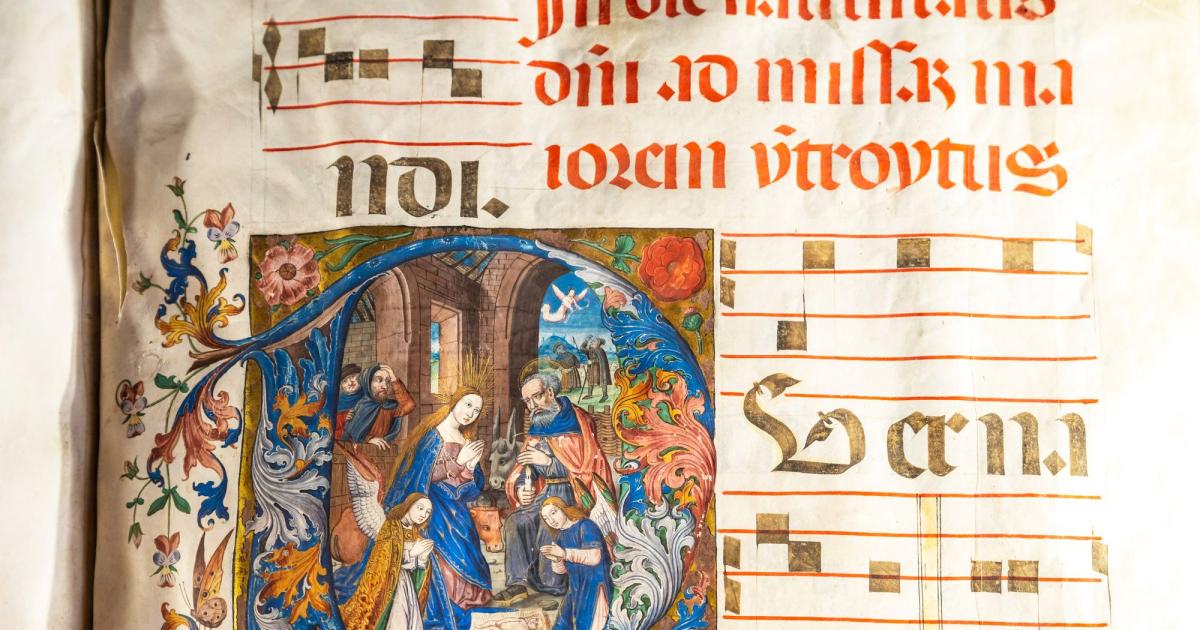
Manuscript Leaf with Initial A, from a Gradual MET Wikimedia commons
Wassailing became carol singing, and was never only about singing
If you have ever stood on a doorstep in December singing at strangers who then handed you something warm, you were wassailing, and the custom is older than every carol you were singing.
The Weald and Downland Living Museum traces the word to the Old English toast waes hael, meaning be well, or be in good health. The correct reply was drink hael, drink well. Lords of the manor shared the greeting with their followers at the turn of the year, which is to say the whole thing began as a toast between people of very different rank, offered downward.
There were two kinds, and only one of them yas survived into your December.
House-visiting wassailing is the ancestor of carol singing. Groups moved from house to house carrying a bowl of warm spiced drink made from ale or wine or cider with honey and eggs, sang blessings at each door, and were given food or money in return. The museum notes that the custom evolved into modern Christmas carolling. The singing was the easy part to keep. The shared bowl and the expectation of payment fell away, which is probably for the best, though it does make the modern version significantly less fun. (A bowl! Of hot spiced ale! Carried door to door! We gave this up voluntarily, alas.)
Orchard wassailing is the one most people have never heard of, and it is still happening. It takes place on "Old Twelvey," the Sunday closest to January 17, which is Twelfth Night by the old calendar. Villagers gather in the orchards behind a Wassail King and Queen. The Queen places cider-soaked toast in the branches of a tree as an offering to its spirits. Everybody bangs pots and pans and sings to wake the trees and drive off anything unwelcome, and the point of all of it is next year's harvest. In Sussex and Kent the noise earned the ceremony a better name: Apple Howling.
Toast in a tree. Apple Howling. I would go a very long way to see this, and if you find yourself in the south of England in mid-January, so should you!

toast in the branches, pots and pans, January
Mince pies had meat in them for about six hundred years
The name is not a metaphor and it never was.
Mince pies most likely arrived with the Crusades, when English cooks encountered the Middle Eastern habit of cooking meat with spices and fruit together. By the late fourteenth century the idea had taken root at home. The Forme of Cury, one of the oldest surviving English cookbooks, gives a recipe for "tarts of flesh" calling for boiled pork, stewed bird and rabbit, eggs, cheese, sugar, saffron, and salt.
Saffron. In a pie. The historian Katherine Clements, quoted by Smithsonian Magazine, calls it "an extravagant dish, surely meant to be eaten at times of celebration." That is the reality of a medieval mince pie - not comfort food, but a display of wealth you could eat, because every expensive thing available to a fourteenth-century kitchen went into it at once.
Then the pies got political. The Puritan-led parliament of the sixteen hundreds came after Christmas feasting, mince pies very much included, on the grounds that they were gluttonous. (The popular story pins this on Cromwell personally. Clements is skeptical, and so am I. Banning a pie takes a committee!) The restrictions lifted when Charles II came in.
The meat held on for centuries after that, and it was the Victorians who finally dropped it. The filling turned fruity, the pies shrank from one large shared dish into individual portions, and the thing on the supermarket shelf today is the end of that long retreat. The suet in a traditional mincemeat jar is the last trace of the animal, seen on a supermarket shelf.
Tip: if you want to taste what your ancestors actually ate at Christmas, look up a mincemeat recipe that still calls for beef suet rather than vegetable shortening. It is not strange. It is just older than you are.

there used to be rabbit in these (!!)
For three weeks, children ran the church
This is my favorite of the five, and the one I would most like somebody to bring back.
From St. Nicholas Day on December 6 until Holy Innocents Day on December 28, cathedrals across medieval Europe handed real authority to a child. The choristers elected one of their own as the boy bishop. He was dressed in full episcopal regalia, led processions, sat in the bishop's or the dean's own seat, and gave out sweets and gifts. He could declare holidays. In York he rode out on horseback to visit the parishes.
On Holy Innocents Day, he preached a sermon. Then he went from house to house singing and giving blessings in exchange for money and entertainment, which is wassailing again, wearing a mitre. (Everything in this article turns out to be connected to everything else. How cool is that?)
The custom was not a one-off at one grand cathedral. It spread through England from the cathedrals and collegiate churches and schools to every parish church with enough choristers to spare one, and it ran across Western Europe, strongest in England, Germany, France, and Spain. It peaked in the sixteenth century, which is also when it died: Henry VIII ended it, Mary revived it, and Elizabeth I ended it for good.
It hung on longer elsewhere. Germany kept a version until 1799. Eton's descendant of the custom, the Montem, survived until 1844 and needed an Act of Parliament in 1847 to finish it off, which tells you something about how hard schoolboys will fight for a tradition that benefits schoolboys!
And it is back. Hereford, Salisbury, and Norwich have all revived boy bishops, along with churches in the United States, Australia, Austria, France, Germany, Scotland, and Spain. If you can get to a cathedral that still does it, take a child with you. Watching a ten-year-old give the sermon rearranges something in a young person's head about who is allowed to be in charge.

his chair in Salisbury Cathedral, for three weeks a year
The Lord of Misrule, and the thing we genuinely lost
Not everything made the trip, and the most interesting casualty is the biggest one.
For the Twelve Days, a great household would appoint a Lord of Misrule, and English Heritage is specific about who got the job: usually a household servant or a minor court official. A nobody, in the ordinary run of things. For twelve days, he presided over the festivities of people who outranked him enormously.
He came equipped. A jester, and a gibbet for the mock execution of anyone who had offended him. Henry VII revived the office when he took the throne, and before that the same idea had run under Edward II and Edward III in the form of a bean king, chosen by whoever found the bean in the cake. (This is also why there is a trinket in a king cake. It has been the same joke for seven hundred years, and across several holidays.)
The purpose was release. It let kings, courtiers, and servants all let off steam inside a hierarchy everyone understood, with limits on how far the rowdiness could actually go. For twelve days of the year, the order of things was turned upside down on purpose, by agreement, and then it was turned back, on schedule, also by agreement.
The Reformation finished the boy bishops. The Civil Wars, roughly a century later, were what English Heritage calls the death knell for festive misrule in secular households and schools. Nothing has really replaced it.
You can see the ghost of it in the office Christmas party, where the usual hierarchy is supposedly suspended for one evening. But the office party has no agreed rules, no appointed figure, no fixed end, and no mutual understanding that normal order resumes at a stated hour. The medieval version was safer precisely because everybody knew it was a performance. Ours is improvised, and we have all seen how that goes.

Romances (Sir Isenbras, Sir Degore, The Jest of Sir Gawayne, Sir Eglamour of Artois). Coloured drawings in a late transcript. Colophon on fol. 48v. 1564. Bodleian Libraries, University of Oxford. Oxford, Bodleian Library MS. Douce 261.
What to do with all this
Here are three easy things to include medieval traditions into your holiday celebrations:
Sing something with a chorus that comes back. That repeating refrain is the last surviving piece of a dance, and it is in your Christmas music because people wanted to keep dancing.
Tell a child about the boy bishop. History is so cool! This is a thing that happened, for centuries, in enormous stone buildings, where a ten-year-old sat in the archbishop's chair and everybody did what he said. Heh.
Make the pie. Buy the jar with the suet in it, or make a batch with beef suet from an actual butcher, and tell whoever eats it what mincemeat used to mean. In our family, holiday baking includes a cookie recipe that has been handed down for generations, and my mom's fruitcake (which is delicious, and perhaps a medieval recipe?).
None of this is nostalgia. These customs lasted because they were useful: they fed people in the lean part of the year, gave the powerless a turn, and made a long dark month into a season with meaning, purpose, and joy. We've kept the parts we still needed.
Go find out which bits of your own December are six hundred years old. There will be far more of them than you expect.

final pages showing part of stanza 3 and stanzas 4 to 6 of the hymn for Nocturn on the Feast of All Saints, Christe redemptor omnium conserva. Musical notation. There are only three complete copies of this edition now extant, and all three are in the Bodleian Library. Oxford, Bodleian Library B 21.15 Linc.
More from Wandering Educators on Christmas history and traditions
Keep going:
- Where to Spend Christmas: 16 Places We Have Been
- Cultural Holidays: From St. Nicholas to La Befana and everything in between
- Visiting Demre, Turkey: More than Santa Claus
- Celebrate the Traditions of Christmas at Scotland's Best-loved Castles
- 5 Surprising Czech Christmas Celebrations
- A Moose Goes a-Mummering: Newfoundland's Twelve Days of Christmas
- Celtic at Christmas: Music
- Music for the Winter Solstice Holidays
- Shipwrecks of the Great Lakes: The Rouse Simmons, the Christmas Tree Ship
Sources referenced in this article
- English Heritage, "Be Merry All: The Battle Abbey Carol," with commentary by Michael Carter and Christopher Hodkinson, on the carol form and its secular performance context.
- English Heritage Members' Magazine, "Medieval Misrule and Mayhem," on the Lord of Misrule, the bean king, and the end of festive misrule.
- Weald and Downland Living Museum, "Wassailing: an introduction," on the etymology of waes hael, house-visiting wassailing, and orchard wassailing on Old Twelvey.
- St. Nicholas Center, "Boy and Youth Bishops," on the dates, duties, spread, suppression, and modern revival of the custom.
- Smithsonian Magazine, "The History of Mincemeat Pies, from the Crusades to Christmas," October 26, 2017, quoting historian Katherine Clements, and The Forme of Cury for the tarts of flesh recipe.
Jessie Voigts is the founder and publisher of Wandering Educators. She has a PhD in International Education, has lived and worked in Japan and London, and traveled around the world. She is constantly looking for ways to increase intercultural understanding, and is passionate about study abroad and international education.
This article replaces a short 2008 post on the same subject.