
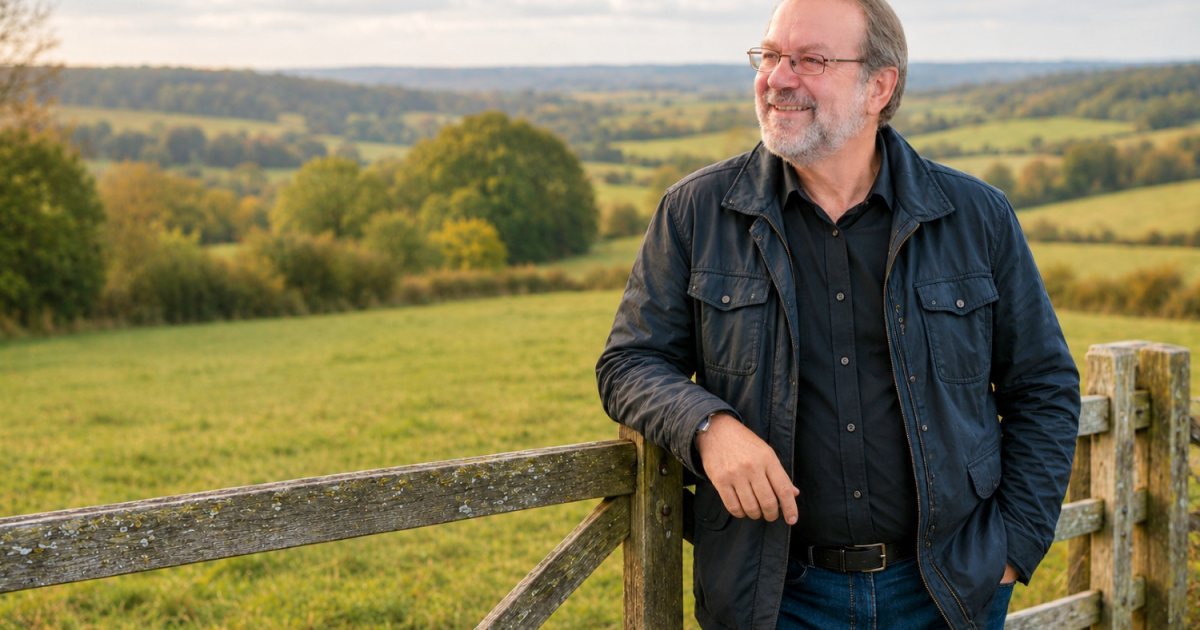

I have lived in three countries: Australia, South Africa, and Britain. Each has been part of my life at a different time, and each has given me something different to think about. I have also travelled through some remarkable landscapes, met interesting people, and found myself in situations that I could not have planned, even if I had tried.
Looking back, I realise that travel has taught me rather a lot. Not always in the way I expected, and not always at the time.
I have written about many of these experiences in my book, Memories Are Made of This, a collection of 51 true stories from my life. Some involve adventures, some involve the natural world, and others concern the unexpected things that happen when you set off somewhere with a plan and discover that the world has its own ideas.

What interests me most is how much we learn when we step outside the familiar. Travel can teach us curiosity, resilience, and perspective. These are lessons that are useful long after we have returned home.
Curiosity: Learning to Look Beyond the Familiar
I have always been interested in finding out how things work and discovering what lies beyond the next hill, bend in the road, or unfamiliar town. Living in different countries has given me plenty of opportunities to indulge that curiosity.
South Africa, in particular, provided me with a wonderful playground for exploration. The Eastern Transvaal, now known as Mpumalanga, was one of my favourite areas for many years. It offered dramatic mountain scenery, deep river canyons, waterfalls, unusual rock formations, and an extraordinary variety of wildlife and vegetation.
In my book, I devote a story to this part of the world. I describe places such as God's Window, the Blyde River Canyon, and Bourke's Luck Potholes. Each has its own character, and each offers something different to the curious traveller.
But there is more to discovering a place than looking at its scenery.
The people, their customs, the sounds of the countryside and the history of a settlement can be just as interesting as the landscape. A place becomes more meaningful when we start asking questions about it. Why did a town develop here? How have people adapted to the environment? What happened before the road, the railway or the modern buildings arrived?
These questions turn sightseeing into learning.
I was reminded of this when I travelled to Paris in 2002. I had won a week-long trip through a scratch card, and the cost to me was just twelve pounds. The hotel and return bus journey were included. It was an excellent bargain, even if the promotional company probably had a perfectly sensible business reason for offering it.
Once in Paris, a fellow traveller and I decided to explore the city ourselves rather than pay for organised excursions. We used the trains and metro, consulted a street map, and made our own way around.
There is something satisfying about working out a place for yourself. You become more observant because you have to pay attention to where you are, what is around you and how everything fits together.
Of course, a map does not tell you everything. You still have to go out and look.
For educators, this is one of the great opportunities travel offers. It encourages people to ask questions before they assume they know the answers. It also reminds us that a photograph, a textbook or a classroom presentation can introduce a place, but it cannot reproduce the full experience of being there.
Curiosity begins when we stop being satisfied with what we already know.
Resilience: When the Journey Does Not Go to Plan
Travel is an excellent way of discovering how well we cope when things go wrong.
I have had a few opportunities to test this.
One of the more memorable examples appears in my story about a trip to the mountains and the falls in South Africa. My girlfriend and I had planned a hiking expedition to the Tugela Falls in the Drakensberg. I had spent months preparing for it, including studying weather forecasts and working out how we might get through an approaching cold front.
There was one small complication. My car had no working windscreen wipers.
I found a water-repellent product that promised to make rain run off the windscreen. It helped, but it did not solve every problem. The rain continued, the inside of the windscreen misted up, and my spectacles became wet and fogged over as well. At times, I resorted to driving with my head out of the window.
We eventually reached the sunshine. Then the car battery began to fail because the alternator was not charging properly.
The problems continued, and we ended up spending the night in the car outside a police station in the town of Vrede. The next morning, we found a repair shop, made do with a temporary repair and continued our journey. We still had to get ourselves to the mountains.
It was hardly the smooth, carefully organised expedition I had imagined.
Yet we kept going, adjusted our plans when necessary and eventually reached our destination.
I learned that resilience is not simply about being determined to finish something. Sometimes it means finding another way forward. Sometimes it means accepting that a problem cannot be solved immediately and making the best decision with the resources available.
It also helps to retain a sense of humour. There is little point in getting angry with a car that refuses to cooperate. It has no appreciation of your carefully prepared itinerary.
Travel provides countless opportunities to practise these skills. A missed connection, an unfamiliar transport system, a change in the weather or a misunderstanding can all require patience and practical thinking.
For young people, these experiences can build confidence. They discover that uncertainty does not necessarily mean failure, and that they are often more capable of dealing with difficulties than they first imagined.
The important lesson is not to seek out trouble for its own sake. It is to learn how to respond when trouble finds you.
Perspective: Understanding That the World Is Bigger Than Our Own Experience
Living in different countries has made me more aware of how much our surroundings influence the way we see the world.
We become accustomed to particular ways of doing things. We learn the local habits, recognise familiar landscapes, and develop expectations about how people will behave. These expectations are useful, but they can also limit our understanding.
Travel gives us the chance to question them.
When I visited Lesotho, I experienced a country whose mountainous terrain and high elevation gave it a distinctive character. It was not simply another part of South Africa with a different name. Its landscape, history, and national identity were different, and understanding those differences made the journey more interesting.
One encounter particularly stayed with me. While travelling through the mountains, we met people with whom we could not communicate in English. We resorted to gestures and a form of sign language to get by.
It was a simple interaction, but it reminded me that communication does not always depend on sharing a language. A willingness to engage, a little patience and an effort to understand one another can take us a surprisingly long way.
That is an important lesson in a world where it is easy to mistake our own habits for universal rules.
Cross-cultural travel does not automatically make us more understanding. We can travel widely and still see everything through the assumptions we brought with us. The difference comes when we pay attention, listen, and remain willing to learn.
I have also come to appreciate how much natural environments can teach us about perspective.
My experiences hiking the Fish River Canyon in Namibia, on three separate occasions in 1989, 1992, and 1994, taught me to respect the demands of the landscape. The heat, thick sand, boulders, and physical challenges made the experience about much more than reaching the end of a route.
Preparation mattered. Judgement mattered. So did recognising the limits of what I could safely do.
A dramatic landscape can make us feel small, but that is not necessarily a bad thing. It can remind us that the natural world does not exist merely as a backdrop for our activities. We are visitors in it, and we have a responsibility to treat it with respect.
For educators, travel offers a way to connect geography, history, culture, and the environment with lived experience. These subjects are not separate boxes on a curriculum. They meet in the real world, often in ways that are impossible to appreciate fully until we see them for ourselves.
The Best Lessons Are Not Always the Ones We Expect
When I began putting together Memories Are Made of This, I was looking back over experiences that had stayed with me for years. Some were major adventures. Others seemed fairly ordinary at the time.
What surprised me was how many of those experiences had something to teach me, even when I had not recognised it immediately.
A journey might begin because I wanted to see a particular place. Along the way, I might learn something about planning, patience, friendship, or my own ability to cope with an unexpected situation. Sometimes the most memorable part would have very little to do with the destination.
That is one reason I think travel is such a valuable form of education. It gives us experiences to reflect on later. We can revisit them, consider what happened, and understand them differently as we get older.
It also teaches us that learning is not confined to formal lessons. We learn while finding our way around an unfamiliar city, talking to someone whose background differs from our own, observing wildlife, or working out what to do when our plans fall apart.
We do not need an expensive expedition or a journey to the other side of the world to benefit. A visit to a neighbouring town, a walk through an unfamiliar landscape, or a conversation with someone from a different culture can open up new ways of thinking.
The important thing is to remain interested in what is around us.
Bringing the Lessons Home
I have travelled through three countries that I have called home, and I have explored places much further afield. Each journey has added something to my understanding of the world, although I would not claim to have finished learning.
That is probably the point.
Travel encourages us to be curious about what we do not know, resilient when circumstances change, and more thoughtful about perspectives different from our own. It can also remind us to appreciate the places we already know and the people who share our lives.
For me, the value of travel is not measured simply by the number of countries visited, the distance covered or the photographs collected. It lies in what we notice, what we learn and what stays with us afterwards.
Sometimes we return with a better understanding of another culture. Sometimes we return with a new respect for the natural world. And sometimes we return with a story about a troublesome car, a wet pair of spectacles, and an unplanned night outside a police station.
All of them have their place.
The journey ends, but the learning often continues. And every so often, years later, we discover that we have a story worth telling.
About the author
Gregory Mark Haynes is a British-Australian author who has lived in Australia, South Africa, and Britain. His book, Memories Are Made of This, brings together 51 true stories about the people, places, adventures, and unexpected experiences that have shaped his life. He writes about travel, nature, music, memories, and the lessons we discover in everyday experiences.
Find him online at https://gregorymarkhaynesauthor.com