
Many cruise passengers who dock in Panama visit the locks, take a few photos, buy a souvenir, and reboard the ship thinking they've seen everything worth seeing. That couldn’t be more untrue! Just ten minutes from the terminal is the Biomuseo, which is more than worth a few hours of your time exploring.
If your Panama itinerary begins and ends with the canal, then you’re missing out. This gorgeous museum explains why the canal exists and sits right at the Pacific entrance. And, once you board your cruise ship again, you’ll see your trip through the canal with a brand new perspective.

The Isthmus That Reshaped Life on Earth
Panama’s real claim to fame came around three million years before the canal. That’s when the isthmus connecting North and South America finally broke the surface of the sea, and the consequences were incredibly unexpected.
Ocean currents were rerouted, and global temperatures began to change. But the biggest change was that two continents with wildly different species suddenly had a direct route into each other’s territory via Panama.
Although this was a major event, it’s often overlooked by tourists and visitors. But the history is just too interesting to ignore if you really want to learn more about your vacation spot.
The Wildlife Crossing That Changed Two Continents
What happened next is known as the Great American Biotic Interchange. During this time, predators followed prey into areas they’d never encountered before, and armadillos headed north. Some species eventually adapted and spread, while others hit a wall and unfortunately died out.
The animals you see across North and South America today are the descendants of all the species that survived the crossing.

Illustration: Andrew Z. Colvin, Wikimedia Commons
Inside Frank Gehry’s Tribute to Panama’s Natural History
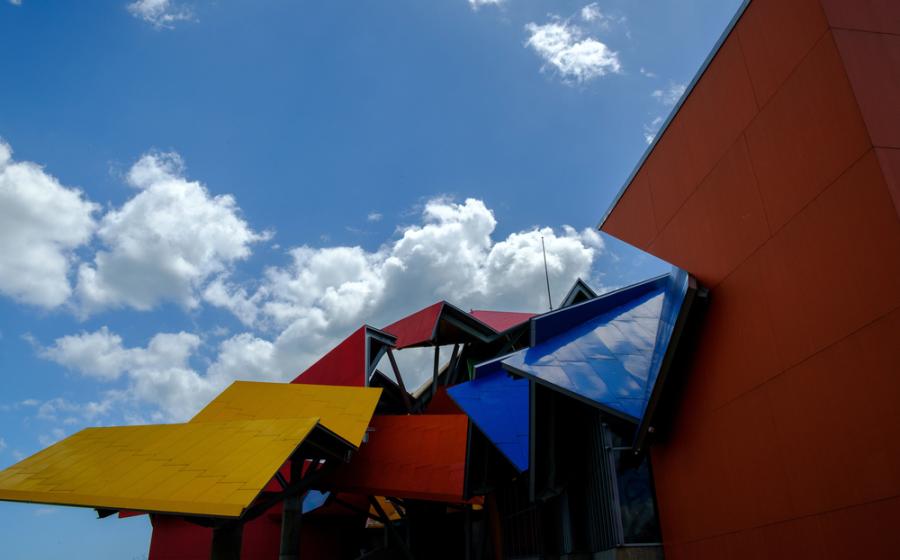
Frank Gehry is one architect who doesn’t do subtle, and his work on the Biomuseo is no exception. The building is breathtaking, with overlapping panels of rust, cobalt, gold, and green. And it sits on the reclaimed land right at the Pacific entrance to the canal.
So, rather than going to a museum that merely talks about history from behind glass cases, you can experience it right at the center of all the action at the Biommuseo.
The Biomuseo’s Galleries
Inside, you’ll find nine permanent exhibits that take you from the geological event that caused the isthmus all the way through to the living ecosystems it created.
The exhibits are all built around reconstructions and models rather than walls of text. So, if you want something completely immersive, there’s no better museum than this. It also makes for an amazing trip for families exploring Panama City.
Panama City Itinerary
You don’t have to keep hanging around the canal, wondering where to go or what to do. Instead, there is plenty for you to explore in both Panama City and the surrounding countryside. From rainforest wildlife to neighborhoods that are full of life and excitement, no day in Panama is boring.
But a few hours at the Biomuseo will totally change your itinerary. Plus, the logistics work in your favor! The Biomuseo is close enough to the terminal that you can take your time on your visit before boarding a Panama Canal cruise.
Why the Story of the Isthmus Still Matters Today
The isthmus is 80 kilometers (around 50 miles) wide at its narrowest point. But most cruise passengers never think to add anything more than the canal to their “must-see” list on their stop.
The Biomuseo gives you a reason to get excited when you step off at the port. And, once you understand what happened on the canal all those years ago, you’ll realize it’s the most interesting thing you’ll see in Panama.
