
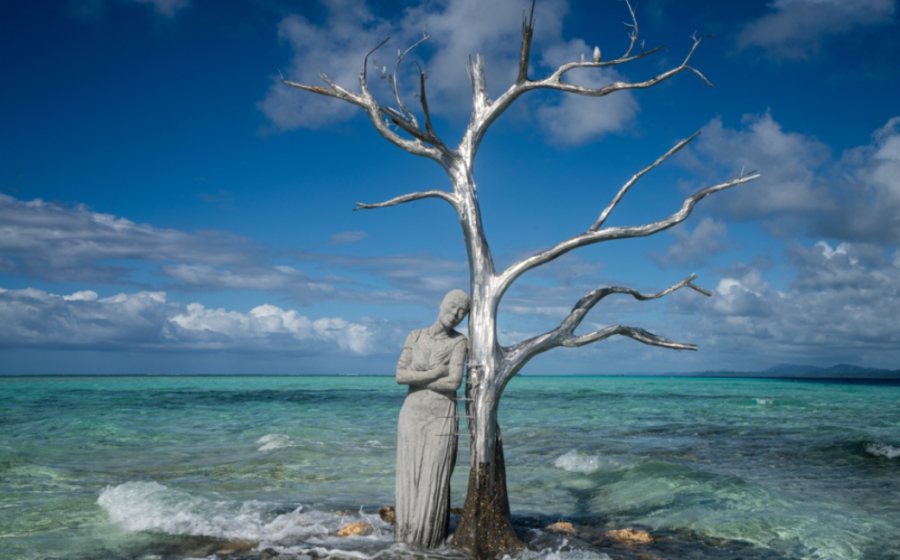

Rising from the Solomon Islands, in one of the most remotes places on earth, a new sculpture by Jason deCaires Taylor continues the artist’s ongoing Siren series, works that give form to environmental warnings that are often unseen or ignored. deCaires Taylor is one of our favorite artists (read our articles about his global underwater art here).

The Solomon Siren tells the story of passionate climate activist, Gladys Habu Bartlett, whose ancestral land on Kale Island has gradually disappeared beneath the sea. Over the past two decades, rising sea levels have inundated the island, forcing her grandparents' family to relocate to the mainland. What was once approximately 50,000 square metres of land now lies beneath the water. A new assessment by the United Nations indicates that global sea level rise is now occurring at twice the rate recorded a decade ago.

Taylor’s sculpture serves as a memorial to that vanished landscape. At its centre is a life-size figure of Gladys, symbolic of women in her local community, with her head resting reflectively against a stainless-steel tree. The tree evokes the forests and biodiversity that once flourished on the island, serving as both memorial and reminder of what has been lost. More than a monument to disappearance, the sculpture translates an often abstract environmental phenomenon into a tangible human story. Designed to endure across generations, it becomes a focal point for cultural remembrance and climate advocacy, making visible the slow, often imperceptible advance of climate change.

The figure and tree are inscribed with a series of dates that mark the island’s fate: 2006, when rising sea waters became alarming; 2016, when scientists confirmed the complete loss of Kale Island among others to sea level rise; and 2026, the year the sculpture is installed, by which time the island has been fully submerged for over a decade. Additional markings — 2036 and 2046 — project forward, referencing the current rate of sea-level rise, estimated at roughly one centimetre per year in the region.

The Solomon Islands sit in a particularly vulnerable position in the Pacific Ocean. Ocean currents and regional geography combine to amplify sea-level rise, making low-lying islands among the first places where the realities of climate change are felt. Installed in the intertidal zone, The Solomon Siren is designed to look part of the environment and to evolve with its surroundings. The tree offers a resting place for seabirds, while the sculpture’s base, constructed with carbon-captured materials and biochar, is textured to encourage colonisation by marine life. Over time, algae, corals and invertebrates will claim its surfaces, transforming the sculpture into a living artwork both below and above the waterline.

Like the mythic sirens that warned sailors of hidden dangers, Taylor’s sculpture issues a quiet but urgent call: a reminder of a place that once existed and of the coastlines around the world that may follow.
Opening event on Kale Island
All photos courtesy and copyright Jason deCaires Taylor, published with permission