
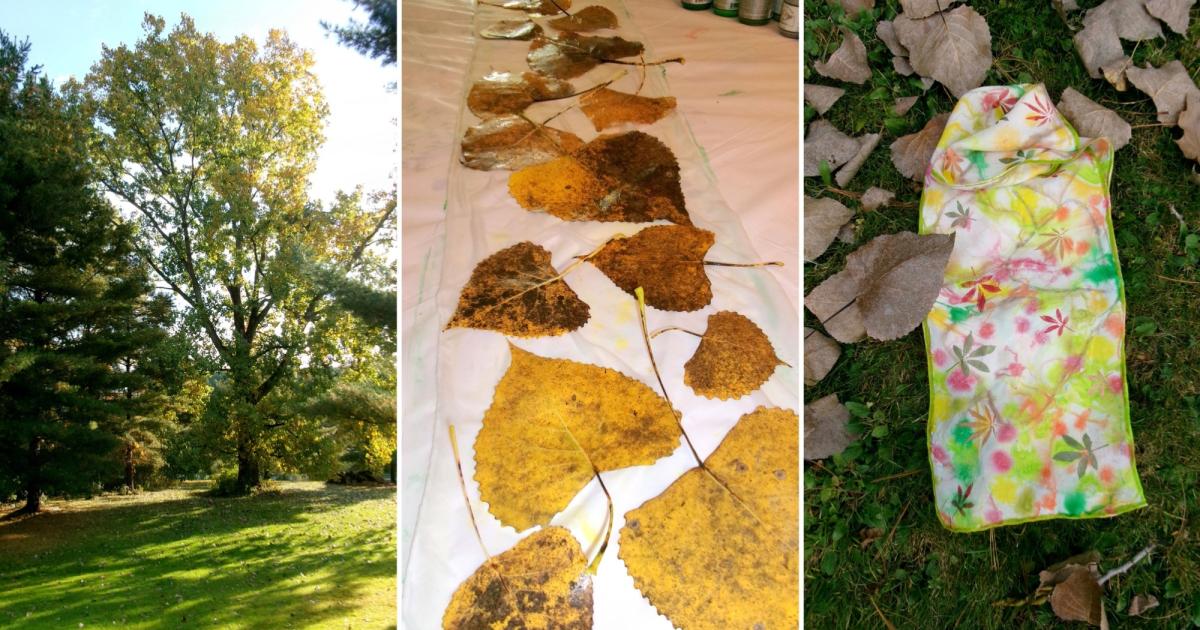

The scarf in the third frame above is lying on the ground among fallen cottonwood leaves, and it is the brightest, most beautiful thing in the picture. Chartreuse, coral, lemon, a green that belongs in April. The brown leaves beside it are the ones that made it.
That is roughly how artist Pat Rullo works. She carries the silk outdoors, lays down whatever the season is offering, and lets the weather take a share of the painting. No stretching frame. No gutta, no wax resist. Most silk painters would tell you those two things are not optional. What she has in spades? Imagination, a love of nature, extraordinary creativity.
A scarf made this way cannot be made twice, not because she couldn’t repeat it but because the moment is gone. The particular rain, the particular stones, the goldenrod cut in that particular week, the one leaf lying exactly where it fell. All of it went into the silk, and all of it has already passed by. Her scarves defy patterns, and you end up wearing a singular day of art and nature and serendipity. That is the congruence of nature and art, and it happens because Pat expects the unexpected and then makes room for it to breathe. In this partnership, she brings the intention and the skill and wonder, nature brings the weather and the color, and between them, they arrive somewhere neither of them could have reached alone.
She is also an author, a broadcaster, a former gallery owner, and the person responsible for two mannequins named Dressika and Dramona. We asked about all of it in this marvelous interview, where her words are as beautiful as her scarves.

Patricia J. Rullo is an author of healthcare books, a speaker, and a trainer specializing in patient safety. Her broadcasting career has included producing and hosting three syndicated radio programs and continues today with Firebird Radio and the Authors on Fire podcast. She is also the founder of the International Firebird Book Awards and the Positive Change Podcast Awards, which recognize exceptional work through quarterly competitions.
Outside of broadcasting and publishing, Pat has found another creative outlet in painting on silk, where nature, color, and spontaneity influence each one-of-a-kind piece.
But best of all, rescued by thirteen cats, Pat is quite an accomplished litter box scooper.

Years before she painted a single one of her own, she never went into the station without one.
You opened your first art gallery in 1987, full of Native American art and jewelry, and spent years buying directly from the artists who made it. Somewhere along the way you crossed over from selling other people's work to making your own. What happened in between, and what finally made you pick up the silk?
I don't think I ever stopped being an art appreciator; I just changed my relationship with art. Over the years, I've created several exciting ventures, each taking me in a different direction.
One of those journeys began when my mother suffered a series of life-altering hospital errors, and I became her advocate. These experiences eventually led me to write several books on patient safety, then host and produce a nationally syndicated radio show called Speak Up and Stay Alive, dedicated to helping others avoid what my mother and I endured.
One little detail from those radio days seems especially fitting now. Even though terrestrial radio is audio-only and my guests were remote call-ins, I always arrived at the station wearing a silk scarf — one made by someone else!
I had such an affinity for painting on silk, and can't explain why, but it called to me. I knew that someday I would explore that creative process myself. Unlike writing and radio, working with silk offers a completely different kind of canvas, one that is unpredictable and full of possibilities and surprises.
Fast-forward to more recently. After my husband died, I spent a year sitting with my grief. Eventually, I realized that grief was not my companion of choice. The time came to connect with the creative relationship with silk that had quietly waited on my back burner.
The time was now.
Most silk painters reach for gutta or wax resist to hold a line, and a stretching frame to hold the cloth taut. You use neither. What did you have to unlearn in order to work that way, and what does a piece look like when it surprises you?
Traditional silk painting usually involves establishing boundaries and controlling where the color goes. Gutta, resist, and stretching frames all serve a purpose. But for me, the process felt more like making the silk behave than letting it express itself.
After setting up the frame and adjusting the silk with pins and clamps until unrecognizably taut, I felt as though I'd just tortured the fabric! By the time I had carefully drawn my images on the silk and applied the wax resist, I was worn out. I sensed something was missing creatively. So much of the preparation seemed designed to control the outcome, and I wondered what would happen if I stopped imposing those boundaries. What if I gave the silk room to respond?
That doesn't mean there isn't intention. There is always a direction or a feeling I want to explore. But intention and control aren't the same thing.
By letting go of that control, I leave room for the unexpected. A color travels somewhere I hadn't anticipated. Two botanical elements interact in unexpected ways. A shape emerges that I couldn't have planned. And I must admit, sometimes it surprises me by being downright ugly! I've tossed out a few pieces that have since become test fabrics.
My process might make silk artists clutch their pearls! I wash, dry, and press the silk, then begin working on it. I don't stretch it on a frame or use gutta or resist dictating where the color must go. From there, I let the silk and the process guide me. Whatever happens after that, happens.
Sometimes, the most beautiful part of a piece is the part I never intended to create.
I suppose, much like a radio interview, I just wanted to have a conversation with the silk.

Where the River Turns, photographed against the water that named it.
Will you walk us through one scarf from beginning to end, a real one, start to finish? Where you laid the silk out, what the weather was doing, what you thought you were making when you started, and what you actually lifted off the stones.
The piece is called Zuni Nights, and it has since found a happy home. It began with a coral ring I purchased at the Zuni Reservation back in the 1980s. Seven rounded stones formed a circle, and the curved design drew me in. I knew I wanted the scarf to capture the feeling of the coral stones.
So I went literal! I took a 20-by-20-inch silk scarf outside and laid it over the small river rocks that make up my Serenity Garden, using my rain-on-the-rocks technique. Before my brush ever touched the silk, nature had already begun the painting. The river stones shaped the surface, and a brief rain awakened the fibers. Then the color arrived. Some of the orange hues came from jewelweed I had harvested on my property, which helped create an especially interesting shade. Drips and flicks of dark botanical dye and black paint met the damp silk, allowing the colors to follow the paths created by the rocks and rainwater.
Once nearly dry, I lifted the silk from the stones and realized I had captured far more than the mere image of rocks. It held the patterns, textures, and unexpected marks of that bit of time outdoors. It was an interpretation of a particular moment that will never happen quite this way again.
The finished scarf was eventually paired with the vintage Zuni coral ring that inspired its creation. The ring became both a beautiful scarf clasp and a piece of wearable history. Two handcrafted art forms, created in very different ways, times, and places, had found their way together.
It just felt right.

Twenty inches square, and every mark on it happened outdoors.

The ring came from the Zuni Reservation in the 1980s. The scarf was made for it about forty years later.
Your color comes out of goldenrod, black walnut, elderberry, chokecherry, mulberries, beets from a local farm. Which plant has surprised you most? And what does a person come to know about a place by dyeing with what grows there?
Several years ago, my husband and I decided to learn more about the plants on our property, initially thinking in terms of survival. What was safe to eat? Which plants had poisonous look-alikes? We developed a small library of books on plant identification, particularly edible plants. So when I began working with the surrounding plants, I already knew something about them.
One of the most fascinating things about using botanicals for dyeing is that they rarely give you exactly what you expect. You can gather the same plant at different times, under different conditions, and discover that the results aren't necessarily the same. There are so many variables: the season, the plant's maturity, the weather, the growing conditions, and how the plant interacts with the silk.
I'm surrounded by an environment that offers an incredible palette. Goldenrod, echinacea, cottonwoods, pokeberry, chokecherry, dandelions, and even beets from a local farm have all become part of my exploration. But black hollyhock petals have probably surprised me the most. I tried using them once, hoping to produce a black dye, and instead got an interesting periwinkle and lavender. I mordanted the silk in a bath of alum and cream of tartar, then experimented with shifting the light purple toward green. An alkaline afterbath with soda ash helped push the color further, although I was never able to coax it all the way to black!
But the colors are only part of what I discover by working with the plants around me. There's a heightened awareness of what's blooming, what's ripening, what's changing with the seasons. The surroundings become more than scenery; they become a source of creative possibility. Over time, a relationship develops with the very place that inspires the work.
I don't think you can separate the finished piece entirely from the environment that helped create it.
side pink purple coneflowers." width="1024" height="1024">

Goldenrod and echinacea, growing where she can reach them. The palette starts here rather than in a jar.
The vintage Zuni and Navajo rings you pair with the scarves came from artists you bought from directly, and you've said you know the history of every one in your collection. Will you tell us about a single ring: who made it, how it came to you, and how you knew which silk it belonged with?
My relationship with Native American art and jewelry goes back to my gallery days. Over the years, I was fortunate to purchase directly from artists, and those experiences gave me a deep appreciation for the individuality and craftsmanship behind each piece.
When I pair a ring with one of my scarves, I'm looking for a connection. Sometimes, it's the colors or the character of the stone, and sometimes it's an unexpected sense that the two pieces belong together. I enjoy bringing the old and the new together—a vintage piece of jewelry with a history of its own alongside newly created silk. It's a meeting of two very different forms of artistic expression, each with its own personality and story.
This particular butterfly ring has a fun story. While on a buying trip in New Mexico, we met a silversmith early one morning at the Palace of the Governors. As I admired his jewelry and told him a little about our shop, he invited me and my family to his home for dinner. He told us he lived on the Laguna Reservation, to be there around six, and to just look for a sheepdog named Malcolm.
We knew where Laguna was and figured it might be a sparse enough area that we'd surely spot his sheepdog. That evening, when we arrived, we found several houses scattered across the desert landscape, but no dogs in sight. So my young daughters rolled down the car windows and called out, "Malcolm! Come here, Malcolm!"
After about fifteen minutes of driving around and calling for Malcolm, our new silversmith friend and his wife finally appeared, waving to us from their doorstep.
It was a lovely evening. The girls played on the swing set with his children while we browsed the couple's inventory for goodies. This special inlaid-stone butterfly ring was among my new treasures.
And now, years later, the ring has found another artistic companion in one of my silk scarves. It inspired me to create a little conversation between the two, with the ring serving as a scarf clasp and two small, freshly emerged butterflies in each corner.
I love the idea of art finding a connection with other art—not competing, but complementing one another, each bringing something to the relationship that wasn't there before.

Bought on the Laguna Reservation, at the end of an evening spent driving around calling for a sheepdog named Malcolm.

Ring and scarf, made by different hands in different decades, doing one job together.

Where it all began
"The Beet Goes On." "Frisky Little Flames." "Where Dragonflies Wander." When does a piece tell you its name...while you're still painting it, or after you've lifted it and seen what it turned into?
I rarely name the scarf I intend to make. I name the one that actually shows up.
Yes, sometimes I approach a new scarf with a name already in mind. The Beet Goes On is an example. I knew I was going to use beet dye and place pieces of beet right on the fabric. So, The Beet Goes On did just that! A little wordplay is always irresistible.
I might begin with an intention, but the finished piece can take quite a different direction. Once I see the colors, shapes, and unexpected interactions, I look at it differently. And working outdoors, whether on rocks, in the rain, among the leaves, or next to the river, can really mess with the design in my head. All those variables shape what the scarf eventually becomes and what I call it.
Each scarf is a response to a particular moment in time, shaped by what nature offers and what I am willing to let go of. I want the name to feel like it belongs. Usually, the moment informs the message.

Beet dye for the ground, the vegetables themselves for the printing. The pun arrived before the scarf did.

The beets do both jobs here. They make the color in the pot, then lie down on the silk and leave their own shape behind.
Your whole practice rests on setting an intention and then surrendering to whatever the silk and the weather decide, and you've written about choosing to be a little uncomfortable. That's a hard thing for most of us. For a reader who wants more of that in their own work (a teacher, a writer, anyone who plans everything), where would you tell them to start?
Life often unfolds with unexpected twists, not always matching our plans. There's nothing wrong with having a plan, setting goals, or knowing what you want to accomplish. I do those things, too. But becoming too attached to the plan leaves plenty of room for disappointment.
Working with silk puts me smack dab in the middle of this kind of situation. My plant-based dyes are ready to go. The design is clear in my mind. And halfway through what I thought would be an amazing creation, the paint bleeds in unexpected directions, leaving me wondering what to do now. And I only have myself to blame. Why, oh why, didn't I choose to work with predictable colored pencils on paper?
You don't have to make enormous changes or deliberately put yourself in uncomfortable situations like this. Start small. Try something a little different. Take a path you wouldn't normally take. Let a thought develop before quickly judging it as right or wrong. And perhaps most importantly, resist the urge to fix everything that doesn't go according to plan.
These days, I am learning to appreciate the wabi-sabi of life—and silk. Grief has taught me that being uncomfortable doesn't necessarily mean something is wrong. Sometimes, it simply means you're somewhere you haven't been before. That's where discovery happens if you let it.
I suppose that's what I want my art to do, too—to imitate life and leave room for the unexpected, even when it takes me somewhere I hadn't planned to go.

Stencils, metallic paint, botanical dye. The range is wider than any single scarf suggests.
We have to ask about Dressika and Dramona. How did two mannequins end up with names, opinions, and a shared byline?
Thankfully not every lesson arrives in a solemn form. I suppose every creative enterprise needs a little nonsense!
Once I finished a few scarves, I wanted to photograph them, so I thought I'd buy one of those foam display necks. And then I saw Dressika. A full-sized mannequin. There was just one small problem. She arrived without the base that was supposed to make her stand.
Apparently, standing was going to be optional.
After contacting the seller to ask for just the stand, they sent an entire replacement mannequin. At that point, it seemed rather wasteful not to give her a personality. That is how the second mannequin became Dramona. And suddenly, I had the Scarfoni sisters.
Dressika is the more sophisticated, mysterious one. Usually clad in black, she sports a brown nine-dollar bob, Jackie O glasses, and occasionally tops it off with a hat. She has a certain air about her.
Dramona is quite another story. She's blonde, bright, playful, and not afraid of hot pink or making a statement.
I think they let me bring humor and my own personality into the mix while letting them take the fall! (Sometimes literally.) I guess not everything has to be serious to be meaningful.
For added fun, each scarf has its own one-minute video, complete with plenty of adventures featuring the scarf-wearing models. They've even earned a shared byline because apparently two sisters with opinions need to have their say!
I'm hoping to create an experience that brings the scarves to life, and the Scarfoni sisters are part of that experience. As I have learned, creativity doesn't necessarily follow a straight line. Sometimes, it takes a detour, introduces you to a few unexpected characters, and leads you to places beyond your imagination.

Dressika on the left, Dramona on the right. They share a byline.
Find Pat online:
Scarves at zapnzen.com
Author/podcast services at speakuptalkradio.com
https://www.instagram.com/patriciajrullo/
https://www.linkedin.com/in/patrullo/
More Artist Spotlights from Wandering Educators
- Artist Spotlight: Mark Taylor
- Artist Spotlight: Lara Jean
- Artist Spotlight: Jessica Laughlin
- All of our Artist Spotlights
All photos courtesy and copyright Pat Rullo, published with permission