
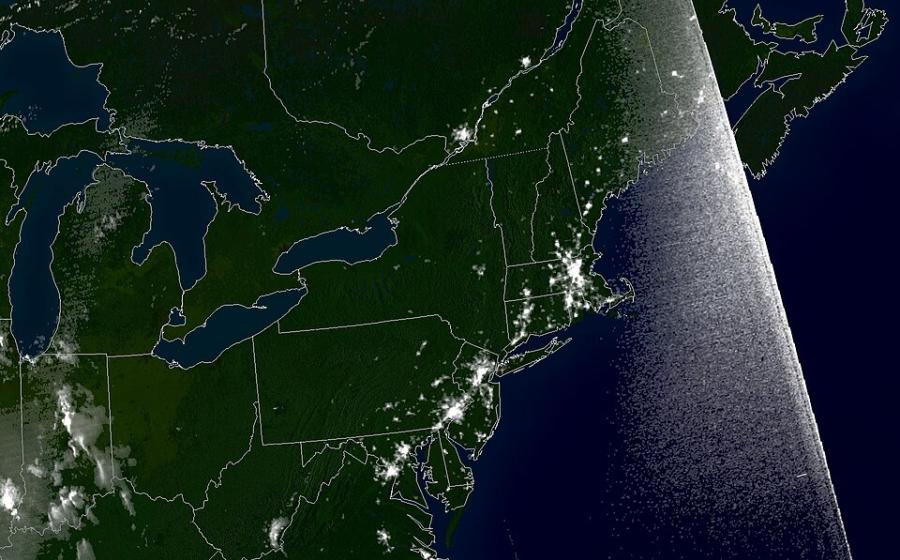

Throughout their lifetime, many people will have experienced at least one power outage. Blackouts are not uncommon; they usually only last a few hours (Gorski, 2024), and power is returned quickly enough to prevent long-lasting consequences. If people know a big storm is coming, they may even get the chance to prepare for a blackout by stocking up on supplies or finding alternative power sources. The Northeast Blackout of 2003 was very different.
On the evening of Thursday, August 14, 2003, seven American states and one Canadian province went dark. While power was restored for some within hours, over 50 million people lost access to power for up to four days. While many people experienced a greater sense of community in the wake of the outage, many also suffered greatly from the limitations caused by lack of electricity; almost 100 people died from these limitations.
The Northeast Blackout of 2003 was a highly impactful event in the lives of many, and it had a variety of impacts on people, depending on their circumstances and location.

Flickr CC Brendan Loy: The Empire State Building in the dark during the Great Northeast Blackout of 2003.
Considering how massive this blackout was, it is hard to believe that it can be traced back to one single power line. On the day of the blackout at a FirstEnergy power plant in Eastlake, Ohio, a power cable began to sag due to the high amounts of electric heat flowing through. When the cable made contact with overgrown trees nearby, it was automatically shut down as a safety precaution, with its power load being transferred to other cables. However, these cables experienced the same issue: heating up due to the higher amounts of electricity, sagging and brushing against the tree branches, and shutting down.
Normally, the plant would have been notified and made to take action, but the plant itself was malfunctioning, too; the workers at the plant were not notified that power cables were shutting down, and were not able to reroute power. As a result of this, the entire power grid collapsed, causing “a cascading series of outages throughout eight northeastern US states as well as southeastern Canada” (Burke, 2025).

Wikimedia Commons Jason Pang 2003: Blackout: volunteer traffic cop on Bay and Adelaide Streets, Toronto
Things weren’t all bad during the blackout.
For example, in Toronto, some residents felt a greater sense of community due to the power outage. Canadian writer Brad Moon wrote that after driving home from Toronto, he experienced hardships such as having to feed his young children without a microwave or a refrigerator, but he also experienced some positives. Moon noted the lack of light pollution, saying that the sky was “as star-filled as a northern camping vista” (Moon, 2008.) Neighbors were able to spend time together, people offered to cook for those without outdoor appliances, and people stood in intersections to safely direct the flow of traffic.
Despite some of these positive experiences, many people were negatively affected by the blackout.
In New York City, a city that is highly reliant on public transportation, many residents were not able to get back home, as the subway was not working and buses were packed to the brim. Many of these people were forced to sleep outside, and BBC writer Nick Bryant described it as “the longest of nights” (Burke, 2025.)
People were trapped in elevators, some had their food go bad in the heat, and others feared the outage was related to the terrorist attacks two years earlier on September 11, 2001. Fires broke out throughout the city as New Yorkers lit candles in their homes to attempt to see in the dark, accidentally lighting furniture or curtains on fire.

Wikimedia Commons Glitch010101: New York City during the 2003 North America blackout.
Nearly 100 people died due to the blackout. While some of these deaths were due to accidents, most had something to do with health issues caused or exacerbated by the blackout (Grens, 2012). People experienced respiratory conditions due to air pollution coming from the increased number of buses running as a result of the subway shutdown. Stress may have aggravated or caused conditions such as asthma and heart attacks. Many people did not have access to food or water. Those with existing health conditions, including diabetes, could not use medical equipment that required electricity, and may not have been able to access a pharmacy for medicine.
The majority of people who died during the blackout suffered from underlying conditions, showing that these individuals were much more negatively affected by the blackout than those with no health concerns and that blackouts affect different groups of people in very different ways.
The blackout of 2003 was a very important event for people across the Northeast. Some people had the ability and resources to create positives from the outage, but others did not have the same resources, especially those who did not have access to their own vehicles and those who suffered from preexisting health conditions.
The Northeast Blackout of 2003 is a clear example of how disasters affect different groups of people; while it was certainly both unexpected and unprecedented, it shows that taking marginalized groups into account when dealing with disaster prevention, aid, and recovery is paramount to keeping people safe. By using this blackout as a reference point, areas that are prone to blackouts/are anticipating one can prioritize communication with higher-risk residents before blackouts, or can try and get aid to them early through mobile medical clinics or power generators (Levite et al., 2023). The 2003 blackout shows just how impactful widespread and long-lasting blackouts can be, and illustrates the importance of community, preparedness, and aid in times of crisis.

Wikimedia Commons Camerafiend: Toronto skyline during the 2003 Northeast blackout.
Bibliography
Burke, Myles. “‘Whether Rich or Poor, It Was the Longest of Nights’: How a 2003 Blackout Brought New York City to a Standstill.” bbc.com. BBC, August 11, 2025. https://www.bbc.com/culture/article/20250807-how-a-2003-blackout-brough…;
Gorski, Alex. “U.S. Electricity Customers Averaged Five and One-Half Hours of Power Interruptions in 2022 - U.S. Energy Information Administration (EIA).” www.eia.gov. U.S. Energy Information Administration, January 25, 2024. https://www.eia.gov/todayinenergy/detail.php?id=61303.
Levite, Brian, Claire Phillips, D’Arcy Carlson, William Prindle, Rosemarie Bartlett, Adam Parris, Chitra Nambiar, and Bahareh van Boekhold. “Community Energy Resilience Planning for Extended Power Outages.” Inner City Fund, March 27, 2023. https://www.energycodes.gov/sites/default/files/2023-09/PNNL_Energy_Res…;
Moon, Brad. “August 14, 2003: Remembering the Great Blackout.” WIRED, August 14, 2008. https://www.wired.com/2008/08/august-14-2003/.
Reuters Staff. “Spike in Deaths Blamed on 2003 New York Blackout.” Edited by Elaine Lies. Reuters, January 27, 2012. https://www.reuters.com/article/business/healthcare-pharmaceuticals/spi….
Noor Mustafa George is a sophomore at Nazareth University, and is double majoring in History and Museums, Archives, and Public History. They are from Rochester, New York. They enjoy studying Asian history, and in their free time, you can probably find them watching old Bollywood films or spending time with their cat, Moose.
Feature photo Wikimedia Commons: Satellite imagery from the Northeast blackout of 2003. This image shows light activity from the night of the blackout, August 14, at 9:03 p.m. EDT (081503-0103z). Imagery data provided by the National Oceanic and Atmospheric Administration and the Defense Meteorological Satellite Program.