
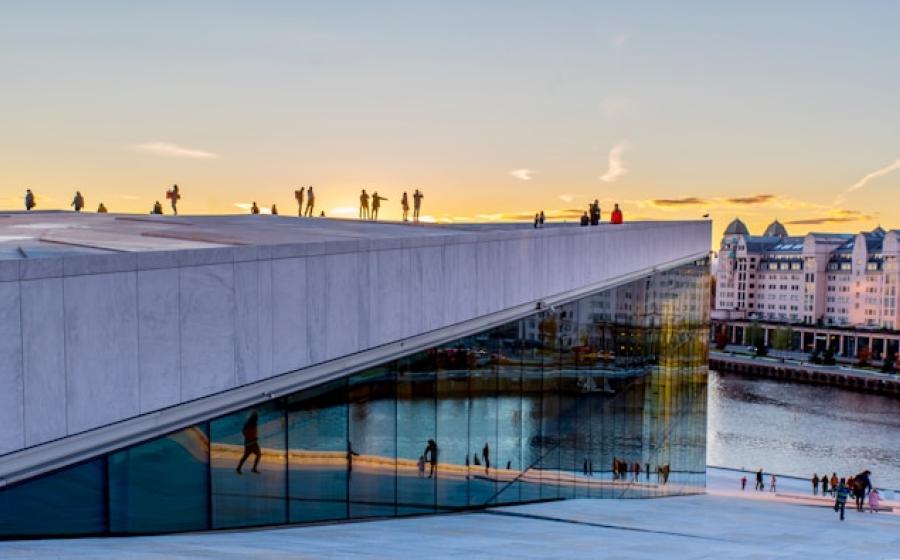

Oslo has a reputation problem — and it's entirely undeserved. The moment you say "Scandinavian design," most people picture pale wood, white walls, and an IKEA catalogue. But Norway's capital has quietly grown into one of Europe's most daring destinations for contemporary art and urban architecture. Beneath the polished surface of a wealthy Nordic city pulses something genuinely radical: a design culture that treats fjords, timber, brutalist concrete, and light itself as raw creative material. If you're willing to look past the postcard version, Oslo will reward you with a lifetime of visual discovery.
1. The Floating Saunas of Oslofjord
Where Brutalist Design Meets the Sea
Most visitors scan Oslofjord from a distance. Art and design lovers should get into it — literally. The SALT art project transforms the waterfront with raw timber frames, fire pits, and floating sauna barges that read less as a wellness retreat and more as a large-scale installation. The Oslo Fjord Sauna takes the concept further: a geometric structure sitting directly on the water, where the architectural contrast between sharp angles and the organic fjord creates a tension you feel in your chest. This is Norwegian culture at its most elemental — the designed and the wild in deliberate conversation. For those who want to experience this contrast beyond Oslo, Norway escorted tours offer a curated way to follow that same design-meets-nature thread all the way up the coast.

2. Emanuel Vigeland Museum: The Dark Secret
A Haunting Masterpiece of Light and Shadow
Everyone goes to Vigeland Park. Almost no one visits his brother's mausoleum. The Emanuel Vigeland Museum — known as Tomba Emmanuelle — is one of the most visceral art experiences in all of Scandinavia. The entire interior is covered by "Vita," an 800-square-meter fresco depicting the human life cycle in unflinching, often erotic detail. But the detail that stops visitors cold: the acoustics. Sound lingers for 20 seconds. Every footstep, every whisper becomes part of the work. Emanuel designed it this way intentionally. Norwegian culture rarely gets stranger or more profound than this room.

Interior of the Mausoleum of Emanuel Vigeland in Oslo, Norway. Flickr cc: Harald Groven
3. Damstredet & Telthusbakken: The Living Canvas
Oslo's 18th-Century Design Time Capsule
In a city of glass towers and award-winning contemporary architecture, these two quiet streets feel like a tear in the fabric of time. Preserved wooden houses in ochre, rust, and faded blue line cobblestone paths that climb toward the Akerselva river. For anyone studying Scandinavian design history, this is essential fieldwork — a demonstration that Norwegian design sensibility didn't begin with modernism. It has roots in timber, in colour, in a relationship with topography that no flat-pack furniture catalogue can capture.

4. The Astrup Fearnley Museum: Renzo Piano's Sail
Art Under the Sails of Tjuvholmen
The Astrup Fearnley Museum of Modern Art contains a world-class collection of contemporary art — but the building is arguably the masterwork. Renzo Piano designed the structure as a series of glass sails anchored to the Tjuvholmen waterfront, drawing a direct visual dialogue with Oslo's maritime history. Walk through the sculpture park that spills out toward the fjord, and the boundary between urban architecture and landscape dissolves completely. This is the kind of space that makes you reconsider how buildings can function as art — and vice versa.

5. Grünerløkka's Street Art & Independent Galleries
The Industrial-Chic Heart of the City
Oslo's most creative neighbourhood didn't arrive fully formed. Grünerløkka was a working-class industrial zone before artists, printmakers, and designers moved into its brick warehouses. Today, the area around Ingens gate is scattered with independent galleries showcasing emerging Norwegian designers working across textiles, ceramics, and graphic arts. The street art here isn't decorative — it's argumentative, rooted in a local visual language that responds to the specific texture of these walls and streets. Allow at least half a day to drift, and resist the urge to plan it too tightly.

Wikimedia Commons: Øyvind Holmstad
6. The New Munch Museum (MUNCH): A Vertical Journey
Edvard Munch in a New Light
The Lambda building — named for its tilted, asymmetrical silhouette — is itself a statement about how we experience art. The slight lean of the tower over Oslofjord is not accidental: it mirrors the disorientation and emotional instability that runs through Munch's entire body of work. Inside, the curatorial design takes you through the emotional stages of his life rather than strict chronology. You're not just looking at paintings; the interior architecture is guiding your nervous system. The Scream lands differently when you've been prepared for it this way.

7. Exploring Beyond the City Limits
The Kistefos Museum and The Twist
Roughly 90 minutes north of Oslo, near Jevnaker, sits one of the most extraordinary architectural objects in Norway: The Twist. Designed by BIG (Bjarke Ingels Group), it is simultaneously a gallery, a pedestrian bridge crossing the Randselva river, and a sculpture. The building literally twists 90 degrees along its length, rotating from landscape to portrait orientation mid-span. Inside, the exhibition program matches the ambition of the structure. The surrounding Kistefos sculpture park adds further context, placing contemporary art directly into the Norwegian landscape.
While Oslo offers a lifetime of inspiration, the true magic of Norway lies in how its design culture blends into the wild landscapes of the north. To seamlessly connect these urban art hubs with the majestic fjords and Arctic reaches, many travelers opt for specialized itineraries. Planning a trip through Nordicsaga Tours allows you to transition from the galleries of Oslo to the natural masterpieces of the Norwegian coastline without losing the thread of a well-curated experience.

Finding Your Own Oslo
Oslo is a city that rewards the curious eye. The real art here is not contained in any single museum — it lives in the relationship between the city and the sea, in the way morning light falls across a preserved wooden facade in Damstredet, in the 20-second echo of a footstep inside a mausoleum that was designed to make you feel mortal.
Look for it in the door handles. In the street lamps. In the way a floating sauna sits on water like a question mark. Oslo is asking what design is for — and everywhere you look, it's already answered.