

Real talk on money, safety, and finding your people when you're always moving.
So, This Is Life Without an Address
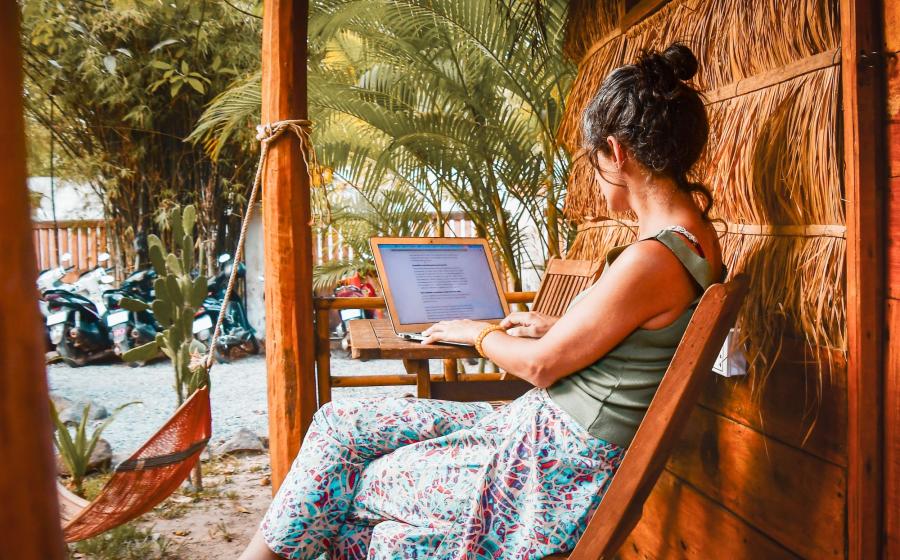
Let's be honest: 10 years ago, telling someone you were going to work from Bali, Lisbon, and Buenos Aires all in the same year would've gotten you a side-eye. Work meant a cubicle. It meant rush hour and the same view every single day. Man, how things have changed. Now, if the Wi-Fi's strong enough, you're in business. Your office is a hammock, a hostel common room, or that perfect café corner no tourist has found yet.
You work when you're sharpest, and you explore when the world calls. It's absolute freedom, but it comes with a catch. Suddenly, "adulting" things like paying bills or not getting your card blocked feel like solving a Rubik's Cube blindfolded.

The Real Work Begins After You Land
Packing light is easy. The hard part? Making your money make sense when you're bouncing between currencies and time zones. You're not just a traveler; you're your own CFO, security guard, and happiness manager all at once. You have to keep your income flowing, your passwords locked down, and still remember to actually "look up" from your screen and enjoy that sunset over the Med. And on this path, you discover your regular, high-street bank back home. It becomes your worst enemy. Those "small" foreign transaction fees add up to the cost of a flight ticket by December. Get flagged for "suspicious activity" because you bought a coffee in Bangkok? Enjoy an hour on hold with customer service.
It's beyond frustrating. That's why we've all quietly migrated to the digital finance world – wallets, crypto, apps that don't ask questions. Here, convenience isn't just nice; it's the only thing keeping you afloat.

When Your Bank Fails You (And It Will)
It's a rite of passage. Your card will get declined at a critical moment. You learn fast that "travel notices" are a joke and that you need a backup for your backup. This is where embracing a bit of tech isn't just smart; it's survival. The nomads who thrive are the ones who've woven tools like Revolut, Wise, or even crypto into their daily grind. It's not about being a finance bro; it's about the sheer relief of sending money home or paying a freelancer without losing half of it to fees or waiting three business days. It gives you a sense of control that traditional banks stripped away years ago.
Your New Neighborhood is Pixelated
For many, this is the best part of the digital nomad life. After a day of focused, solitary work, the digital space is where they reconnect and recharge. They might jump into a Discord chat with a friend coding from Mexico, fire off a meme in a Telegram group full of nomads based in Serbia, or just tune into an online space discussing the intricacies of remote work visas. The traditional "third place" – the local pub or café – has been replaced. Now, it's a digital living room, spanning continents and time zones. There's a shared hunger for real conversation and spontaneous laughter, even if it's sometimes delivered through a glitchy, lagging video call or threads upon threads in reddit.
And this craving for connection is reshaping how we have fun, too. Look at the rise of places like crypto social casinos. On the surface, yeah, they're for playing games. But dig a little, and they're buzzing chat rooms, friendly leaderboard rivalries, and a way to hang out without the pressure of a "networking event." When your friends are scattered across ten countries, hopping into a casual game with a built-in chat feels as normal as meeting for a beer used to. It's downtime that finally fits our reality – no reservations needed, works in any time zone.
The Rules That Actually Keep You Going
Want to do this for more than a glamorous Instagram month? You need systems. Boring, bulletproof systems.
• Diversify Your Money, Period. One bank account is a single point of failure. Keep a local account, a Wise borderless account, and a crypto wallet. If one fails, you're not panicking.
• Seek Depth, Not Just Scrolling. Comment on a blog. Join a weekly virtual co-working session. Actually, talk to people. Loneliness is the real pandemic on the road, and a Like button won't cure it.
• Security Isn't Paranoid; It's Prudent. Using a VPN on public Wi-Fi is as basic as locking your door. 2FA is your guardian angel.
It's not nerdy; it's necessary. Once these habits are automatic, the anxiety fades, and you're just living.

The Lessons You Can't Google
At its core, the digital nomad life is one long, incredible lesson. You're not just visiting places; you're decoding how they work: the local hacks, the unspoken etiquette, the apps everyone uses. Curiosity morphs from something you "have" to something you "need." Stay loose. Protect your digital self like it's your physical self. And most importantly, just keep going. The next view, the next lesson, the next connection is always out there. Isn't it marvelous?
