
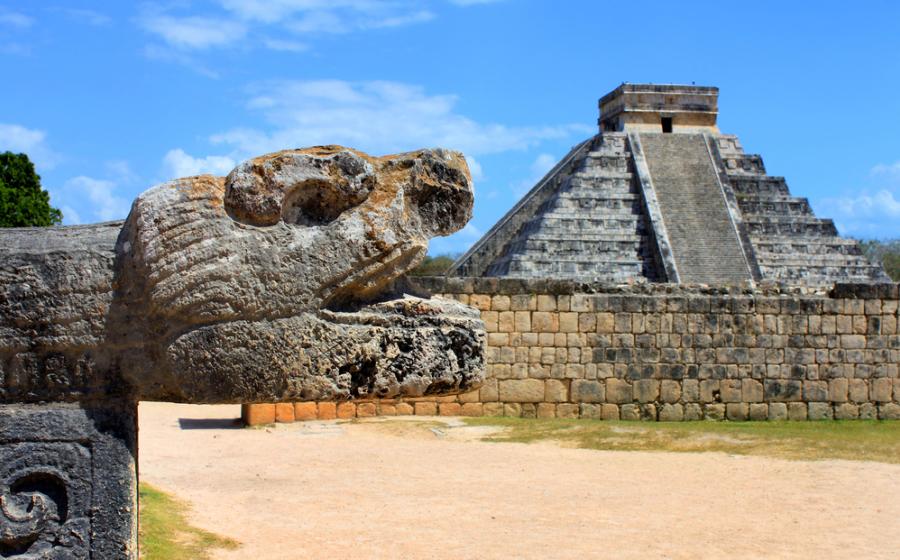
The first lesson at Chichén Itzá is not written on a sign. It is in the way people slow down when El Castillo comes into view.
People do not all stop at once. Someone is still adjusting a hat, someone is reaching for a water bottle, and a guide is talking over the low buzz of the plaza. Then El Castillo clears the crowd, and the mood shifts in that quiet way old places sometimes manage. A finger goes up toward the steps, then toward the shadow line, then toward the pyramid itself, sitting calmly in all that open space.

Before history comes in
Ancient sites are often introduced through dates, rulers, and timelines. Those things matter, of course. UNESCO describes Chichén Itzá as one of the great Maya centers of the Yucatán Peninsula, shaped over many centuries by different peoples and ideas. That history gives the city its weight.
But standing in front of the ruins, students also notice simpler things first. Stairs. Shadows. Corners. Repeated shapes. A plaza that feels larger once they start crossing it. A temple that seems to change as the sun moves.
And here begins the quiet math.
The math is not waiting neatly in the margins here. It appears when the sun slides a little farther down the stone, when the plaza suddenly feels wider halfway across, when the steps pull your gaze up before you have decided to climb. A student may call it distance, shadow, slope, or simply “that looks farther than I thought.” Any of those is a good beginning.
First sight of El Castillo
El Castillo is usually the structure people remember first. Its symmetry is easy to admire even before you know much about it. Four sides. Strong lines. Steps rising toward the small temple at the top. From a distance, the whole shape seems simple. The longer you look, the less simple it becomes.
A teacher or parent does not have to turn that moment into a formal lesson. A single question is enough: What do you notice repeating?
Students might count levels, compare sides, sketch the outline, or talk about why the pyramid looks balanced from one angle and more imposing from another. Younger children may simply see triangles. Older students may start thinking about scale, slope, and proportion.
That is the nice thing about place-based learning. The same stone can meet different ages in different ways.
When the plaza becomes a map
A walk through Chichén Itzá also turns distance into something felt. On a phone map, a path looks clean. At the site, the distance has weather in it. The sun presses down. Dust lifts under shoes. A guide’s voice carries from one group to another. What looked like a short crossing suddenly has a pace, a temperature, and a little negotiation: do we go straight across, or follow the path around?
That sort of question gives geometry a reason to exist.
Say the class has paced out two sides of an open space. One student wonders whether cutting across would really save much walking. That is when the old triangle from class suddenly earns its keep. After the guessing, the pacing, and the argument over which way is shorter, a Pythagorean theorem calculator can check the distance across the middle without taking up the moment.
By then, the math has picked up dust from the ground.

More than one subject at a time
At Chichén Itzá, one subject is rarely enough. A carved wall sends the conversation toward history; the shape of a temple brings in architecture. From there, the conversation usually drifts upward: where the sun falls, when the seasons turn, how people knew when to plant, and what it meant to watch the sky that closely.
That may be why the place follows people home. In visiting Chichén Itzá, the memory of the ruins comes through family, movement, heat, and wonder. In our review of Maya Ruins of Mexico, the learning goes another way, through maps, timelines, cosmology, and carved details.
Students need both. The facts keep the story honest. The noticing (the heat on the stone, the long walk across the plaza, the carved detail you nearly missed) is what makes it stay.
Taking the lesson home
No one leaves Chichén Itzá having understood it all. That may be the most honest lesson ancient places teach. You notice one carving, then another. Someone points out an alignment you missed. The first answer does not close the place down; it opens another door.
Still, a student can carry away something smaller and harder to lose: the habit of noticing. The slant of a stair. The edge of a shadow. How different the plaza feels underfoot compared with the quick photo taken from the side.
Later, in class, the same ideas may return as a cleaner drawing or a set of numbers. Fine. For a while, though, they belonged to a hot stone plaza, with El Castillo in front of them and the sky overhead.