
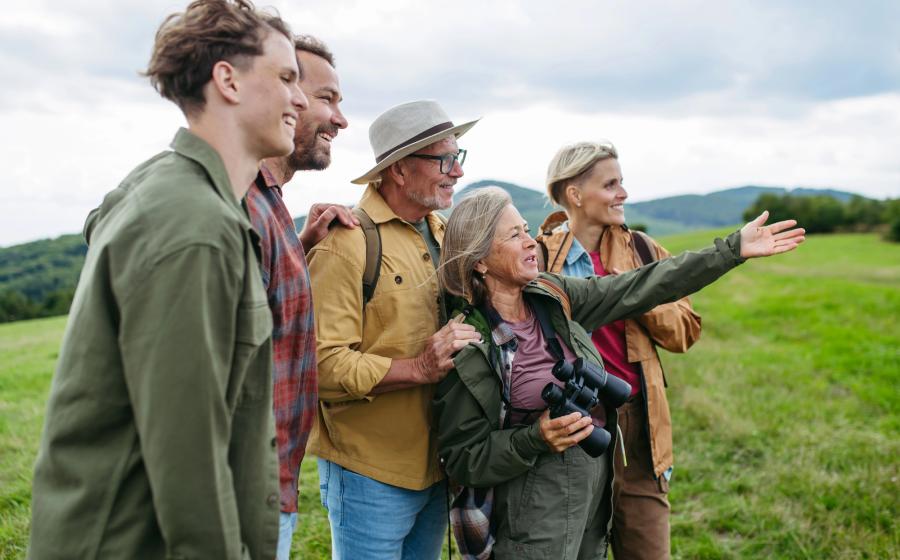

Today, the world is progressing toward legacy travel, trips that three or four generations travel together so that family history can shine with intention.
As a global educator, curious tourist, or a grandma who wants to share your culture with your extended family, these adventures allow your culture to live and thrive past the current oldest generation and live on for more generations to come.
But, hauling your grandparents over the cobblestones of Europe or flying long-haul flights to Southeast Asia will take more preparation than the ticket and a passport.
It requires a mindful approach to health and mobility.

1. Travel Slow – Don't Rush
Even though it's completely normal to take a bunch of young travellers and have them visit five cities in ten days – nothing out of the ordinary – it would be pretty surprising to see the same kind of energy in multigenerational travel. Grandpa and grandma probably aren't that energetic, nor excited to keep up with you.
So the 'less is more' model is a priority.
For senior citizens, slow movement is a physiological necessity. Plan 'buffer days' that only include a leisurely lunch or a stroll through a nearby garden.
Think of getting a 'home base'. Some place that's well connected, or at least close to all the important stuff. This way, you don't have to spend too much time/energy to get where you want to go.
2. The Logistics
If you're sitting for a long period of time with no activity, make efforts to make little movements to move different parts of your body, or take frequent walks to the bathroom just to make sure you do not develop edema and keep your circulation going.
Even while seated, simple ankle rotations and calf stretches reduce the risk of deep vein thrombosis (DVT) and ease the general stiffness that makes getting off tough.
Tell older travelers to check with their doctor and see if it is beneficial to wear medical-grade compression socks to keep blood flow going.

3. Focus on Skin Integrity and Pressure Management
One frequent, and rarely studied, travel health risk for seniors is skin breakdown.
Sure, unless the senior is immobilized (e.g., can't move at all, or is in a wheelchair), you won't really see some extreme cases (e.g., ulcers) as you'd see in a nursing home environment where you have families and/or residents working with a bedsore in nursing homes attorney to get to the bottom of what happened, and then you've got complicated and dangerous treatment, and it's a generally a situation in which you don't want to be in.
But still, even during travels, you should be careful.
Sitting for long periods, sitting inside an airplane, on a tour bus, or in a wheelchair, is a grave threat to skin integrity.
Pressure ulcers can happen while travelling, so be vigilant in checking areas that can be affected, reposition seating position (take a 'repositioning' break every two hours, maintain hydration of the skin, and screen for redness on a frequent basis), and preventing even a small irritation will stop the sore from escalating into a potentially life-threatening sore.
4. Adapt to Local Cuisine and Hydration
A big part of educational travel is learning and tasting the local food.
Visiting local flavors on any trip will be exciting, but a well-balanced diet allows you to function if you have chronic illnesses such as kidney disease or arthritis. Choose your menu items wisely and maybe have a little taste of someone else's plate if you're dying to taste something.
Let me mention hydration here: a serious risk to anyone, but it can affect elderly people with confusion or weakness, which can lead to balance issues and instability.
Also, be aware that salt levels in local cuisines are of particular concern: too much sodium can lead to swelling in the lower parts of the body, making walking painful.
Prioritize bottled water and 'skin-healthy' foods that are high in Vitamin C and Zinc (think Mediterranean citrus or lean proteins) to repair tissue and keep skin supple.
5. Obtain Specialized Insurance to Support the 'Last Mile'
The 'last mile', travel time from airport to hotel, or hotel to museum, often presents challenges with mobility.
Cobblestones, steep stairs, and a lack of elevators can make a dream itinerary a logistical nightmare. Digital tools, such as GoogleMaps Street View, can also be used to 'walk' around your hotel virtually, and check for accessibility before arriving.
Check into specialized insurances that provide medical evacuation, but also ensure your insurance covers pre-existing conditions. If you are financially and legally prepared for a medical emergency, the family can relax and focus on this experience.

Multigenerational travel is one truly beautiful gift.
It guides the younger generation on a path of patience and history while enabling the senior siblings to see the world with the eyes of wonder.
Through the fine-tuning of mobility details, positioning seats, and skin condition, we guarantee these travels are comfortable, inclusive, and transformative for each and every member of the family.