
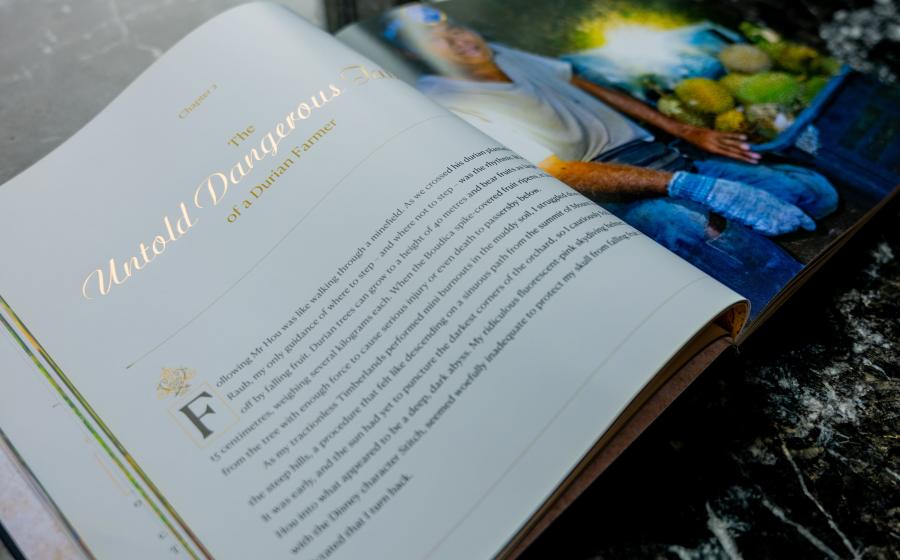
Here at Wandering Educators, we are all about curious learning into people, places, and lives. I'm so excited to share a fascinating book with you that does just that! Focusing on five different topics, Behind The Scenes: Lives of These Unsung Heroes was written and photographed by Ian Poh Jin Tze. This book is a pure delight.

Behind The Scenes: Lives of These Unsung Heroes takes readers through Southeast Asia, where Poh embedded with durian harvesters on treacherous slopes, melon growers hand-pollinating vines at dawn, coffee farmers in Bali, explorers searching for ancient springs in Perak, and the surprising “found family” he discovered in a luxury retreat. It’s an intimate look at the hardworking people who shape the foods and comforts we take for granted, brought to life through original photography and personal essays.
This book is one to read and re-read. The more I dive in, the more I keep discovering layers of people and place.
Ian is an extraordinary storyteller, taking us along with him with all five senses, as well as a sense of curiosity and wonder. I loved learning of new-to-me processes (durian, melon), expanding my knowledge of familiar ones (coffee, one of my favorite things in the entire world!), the gloriousness and beauty of people and place.
In addition to his written storytelling, his photos are extraordinary. One of my favorite things about traveling is the ability to meet, talk with, and learn from locals. This book showcases just that important life and travel ethos by sharing stories of people. It is international education, cross-cultural living, and essence of people and place at its best.
Highly recommended.
Ian Poh Jin Tze is a freelance writer and photographer born in Singapore. He spends approximately 300 days a year traversing the world with his trusty sidekick: his beloved Rimowa. Food, travel, landscape and monochrome photography are his deepest passions. He has been interested in photography since his youth, and over the years, it has evolved from shooting ordinary landscape photos to more introspective monochromatic scenes. This change was inspired by a quote by Ted Grant: “If you photograph people in black and white you photograph their souls, but if you photograph them in colour you photograph their clothes.” His favourite scenes are melancholic and pensive in nature. He is fascinated with juxtaposing scenes of architecture or depictions of people or animals; moments which seem to stand still like the delicate balance of a dancer paused mid-leap, reflecting one’s deepest moods or emotions. Although the techniques and equipment may vary with each project, the emotions, drama and passion are the unwavering constants. His works have appeared on Asian Food Network, Eater, Singapore Airlines’ SilverKris in-flight magazine, Le Cordon Bleu and The Smart Local (Singapore & Malaysia). Additionally, his passion has led to the creation of his own coffee table books. This one captures moments in the lives of both agricultural and hospitality players. The other captures breathtaking moments and scenes deep within the African Savanna titled, The Silent Song of The African Savannah. Find him online at ianpohjintze.com and on Instagram (@throughmyl3ica).

We interviewed Ian about his book, inspiration, photography, and learning more about the people and places in Southeast Asia. Here's what he had to say...
What inspired you to write and photograph for this book?
When I remain in a place long enough, something almost ineffable begins to take hold—something that feels less like experience and more like quiet surrender. The act of looking becomes an act of feeling; the distance between myself and the land dissolves until I can no longer tell where I end and it begins. I do not simply witness a place—I am, in some profound and unnameable way, undone by it. Malaysia undid me.
I arrived as an outsider, carrying the quiet assumptions of a transient observer. But I stayed—five years, through the suspended stillness of the COVID-19 pandemic—and in that stretch of time, the country revealed itself not in spectacle, but in intimacy. It unfolded gradually, in fragments, in whispers, in the slow and deliberate unveiling of its soul. Beneath the unrelenting sun, wrapped in air so dense it felt almost like an embrace, I learned to listen—to the crackle of charcoal fires, to the murmured exchanges of market stalls, to the quiet poetry that lives in the everyday.
In my first year, I wrote The 38 Essential Kuala Lumpur Restaurants for Eater. But even then, I knew I was reaching for something far beyond food. I was trying, perhaps impossibly, to capture a feeling—the ephemeral alchemy of a place that lives not in grand gestures, but in fleeting, sensory moments. The warmth of pastry dissolving in your hands, the intoxicating bloom of spice rising before a single bite, the chorus of voices that gathers at dusk—these were not mere details. They were fragments of a heartbeat I was only beginning to recognise as my own. And then, gradually, my path led me away from what is seen, and toward what is so often left invisible.
I found myself in fields, in the company of farmers and labourers whose lives are tethered to the earth in ways that are both humbling and quietly heroic. There was a stark, unvarnished beauty in their existence—one that demanded not observation, but reverence. I sat with them on soil still damp from rain, close enough to feel the warmth of their presence, to witness the unspoken weight carried in their bodies. Their hands told stories before their voices ever did—stories etched in calluses, in scars, in the slow, unyielding rhythm of work that does not pause, even when the world does.
We shared meals that were not simply food, but offerings—harvested, prepared, and given with a devotion that felt almost sacred. And in those moments, something within me shifted irrevocably. I was no longer documenting a world—I was being entrusted with it. Because there is a rare and fragile intimacy that forms when someone chooses to let you see them—not the version shaped for the world, but the one that exists in its shadows. What they shared with me was not easy. It was not polished. It was lives marked by exhaustion, by sacrifice, by a resilience so quiet it almost escapes recognition.
I loved learning about the people in your book through your sharing of their journeys. What was your ethnographic process like?
There was nothing conventionally methodical about my ethnographic process. I didn’t approach it as something to be studied, categorised, or held at a distance. Instead, I let go of that separation entirely. I stepped into their world not as an observer, but as someone willing to be shaped by it.
I moved between vastly different lives—across hospitality, agriculture, and the quiet, often unseen spaces in between—with no rigid framework except presence. I stayed. I returned. I lingered long enough for formality to dissolve, for guarded expressions to soften, for silence to become something shared rather than avoided. I came to understand that trust is not given freely—it is grown slowly, almost imperceptibly, like something rooted deep within the earth. And it was within that slowness that everything began to reveal itself.
There are moments that remain etched in me with startling clarity—the cool morning air carrying the scent of damp soil, thickened by the unmistakable pungency of durian; the feeling of standing in fields where the ground clings to your feet, where labour is not an idea but a relentless, physical truth written into the body. And then, in sharp contrast, the interiors of the hospitality world—immaculate, composed, where every gesture is precise, yet beneath that polish lies another kind of exhaustion, quieter, but just as consuming.
But what stayed with me was never just the environment—it was the people. We shared time in its most unguarded forms. Laughter that arrived unexpectedly, almost as relief. Long silences that spoke more than words ever could. And, at times, a kind of unspoken sorrow that settled gently between us. Some stories were offered slowly, with care. Others emerged all at once, as if they had been waiting—held in for years, searching for a place to land.
There were moments when the weight of what was being entrusted to me felt almost overwhelming. Moments when I had to lower my camera—not out of hesitation, but out of respect.
Because some truths resist being captured. They ask instead to be felt, to be carried. And somewhere along the way, something shifted. The distance dissolved. The roles blurred. It was no longer about documenting a world from the outside. It was about being allowed, however briefly, to exist within it—to feel its rhythms, to carry its weight, to be altered by its truths. By the end, I realised I had not been studying a culture at all. I had been entrusted with fragments of lives—fragile, resilient, and profoundly unseen. And that kind of trust does not leave you unchanged.

And your stunning photography...what surprised you in documenting these journeys?
My journey often felt like moving through a world that oscillated between the surreal and the elemental—landscapes that seemed almost mythic in their richness. There were melon fields that gleamed like they had been dusted in crushed diamonds under the sun, and kitchens that roared like living furnaces—where flames licked the base of woks in fleeting, almost affectionate bursts of heat, what the chefs call “wok hei,” as if the fire itself were briefly breathing life into the food.
But what truly arrested me—what stayed long after the image faded—was not the spectacle. It was the quiet, unspoken choreography of human devotion.
There was a grace to it all, a kind of embodied rhythm that felt almost balletic in its precision. Every movement, every gesture, executed with a familiarity that came not from ease, but from years of repetition, endurance, and quiet mastery.
I remember one morning in particular—rain-slicked, heavy with humidity—when my traction-less Timberlands betrayed me entirely. I was slipping and sliding like I had no business being there, attempting to follow seasoned durian farmer Mr Hou as he moved ahead with unnerving ease. The terrain felt less like earth and more like a steep, unforgiving ascent—almost like scaling Mount Everest in slow motion.
And yet there he was—humming softly, almost cheerfully—completely unbothered by the weight of the world around him. With effortless precision, he would give each durian a practiced shake, as though listening to its secrets, before casually flinging it—sometimes just centimetres from his face—into a laundry basket strapped to his back, already brimming with the day’s labour. In contrast, I was barely keeping upright.
Camera in hand, slipping on the mud, acutely aware of my own fragility in a world that required no hesitation, no pause, no complaint. And in that dissonant moment—between his ease and my struggle—I understood something that no frame could fully contain. That what I had thought of as hardship was, for them, simply rhythm. Life, lived without spectacle or protest. Just steady, unwavering continuation.
And as I followed him in the rain, drenched and unsteady, something softened in me. Because beneath all the intensity, all the motion, all the fire-lit labour - there was a kind of quiet grace that didn’t ask to be seen. It simply existed. And it was beautiful enough to almost break you.

People, place, craft, food - this book is eminently interesting. What do you hope readers take away from reading it?
I hope readers come away with something both simple and quietly profound—a renewed sense of awareness the next time they hold something as ordinary as a piece of fruit. That moment, so often taken for granted, is in fact the end point of countless unseen hands, long days, and quiet sacrifices. And if the book does anything, I hope it gently lingers in the mind long after the page is turned, reminding us of the invisible labour that sustains our everyday lives.
Through my lens and through the cadence of my writing, I wanted to make those silent realities visible—not in a way that feels heavy or distant, but in a way that feels human. Intimate. Alive. To let readers glimpse the dignity, the resilience, and the quiet hardship that so often exists just beyond our field of vision.
But I also wanted the book to breathe. To play. To have moments of lightness woven through the weight. That is perhaps why the final chapter takes a different turn. Instead of approaching coffee in a traditional, documentary sense, I chose to inhabit its journey from an entirely unexpected perspective—that of the coffee bean itself. To imagine its passage through soil, harvest, transformation, and ritual as a kind of cinematic unfolding, almost like a story told from within the world rather than about it. It allowed me to step away from explanation and into experience.
And in doing so, I hope readers not only understand the labour behind what they consume—but also rediscover a sense of wonder in it. A kind of playfulness, even. A reminder that behind every ordinary object is an extraordinary journey waiting quietly to be seen. Because sometimes, the most profound truths are not just those that move us. But those that make us look again, a little more tenderly, at the world we thought we already knew.

How can people find your work?
The hard-cover edition of Behind the Scenes: Lives of These Unsung Heroes is available for borrowing at outlets of the National Library Board across Singapore, with the luxury edition also available for viewing at the Reference Library.
Both editions are additionally available for sale and viewing at Objectifs – Centre for Photography and Film in Singapore.
They can also be purchased online via Amazon Singapore and through my official website, which also features the limited luxury travel-case edition.
More than anything, I’ve always hoped this work moves fluidly between spaces—libraries, galleries, and personal discovery online—finding its way to readers who are curious enough to look a little closer at the unseen worlds that quietly sustain our own.
Is there anything else you'd like to share?
For those whose curiosity has been sparked and who wish to journey a little deeper, I’ve also created a series of short documentaries that expand on the stories within the book. These films range from five to thirty minutes, each offering a more immersive, lived-in perspective of the people and places that shaped this work.
They are, in many ways, extensions of the book—moving images that allow these worlds to breathe beyond the page. So I invite you to settle in, perhaps with your favourite snack, and step into these moments at your own pace. Here's the playlist, which starts with
The 24 Hours Life of A Durian Farmer:
and includes The Life of a Melon Farmer, The Unseen Realm of A Luxury Serviced Residence – Lanson Place Bukit Ceylon, The Unseen Realm of A Luxury Resort – Banjaran Hot Springs Retreat, and Through The Eyes of A Coffee Bean.
Ultimately, this project has always been about presence—about slowing down enough to truly see the worlds that exist just beyond our everyday gaze. If these stories invite you to do that, even briefly, then they have already fulfilled their purpose.