
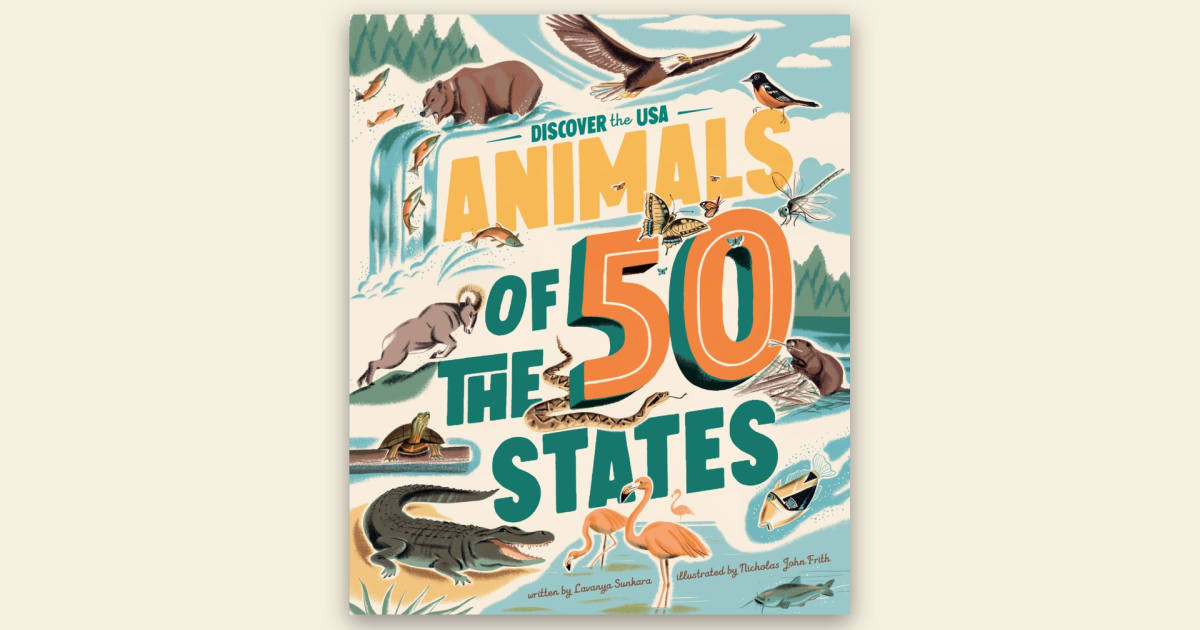

I’ve got a fabulous book to share with you and your young readers today! Animals of the 50 States: 500 Wild Facts, written by Lavanya Sunkara and illustrated by Nicholas John Frith, is a lovely, large book. It measures ten inches by twelve and a quarter. This is important because it means that two children can read a page at once without either of them letting go, or that you can read to your kids/class/library group and everyone can see.
Of course, I immediately did what we all do.

Michigan is on page 31. It tells you that the only wolverines in the Wolverine State live in zoos. (Sorry.) It also gives you Mackinac Island, where horses are still how people get around because cars are banned, the lake sturgeon that has barely changed in over a hundred million years, and the least shrew, which weighs less than a nickel.
That is one page! There are fifty more, plus Washington, DC, each carrying about ten facts. It’s a lovely, colorful, intriguing look at animals all across the US. Every reader will, naturally, flip to the page where they live. It’s so cool to learn more about your own environment. But there’s an educational aspect to this book that is hidden, but teaches much more than you’d think.
The book keeps loss and recovery within sight of each other. On the California page, the grizzly on the state flag is extinct, and a few inches away, we learn that the island fox has come back from near extinction in the Channel Islands. Iowa and Kansas face each other, and bald eagles that had nearly gone from Iowa now draw crowds at winter eagle-watch festivals while the whooping cranes on the facing page are still endangered. The clearest of them is Arizona, where the Apache people helped the Apache trout recover in the White Mountains, the only place on earth it lives. A child who only hears what is vanishing learns helplessness. A child who hears what came back learns that somebody did something. And guess what? They can do something, too!

Lavanya Sunkara is an award-winning travel and nature journalist, animal advocate, and author of Animals of the 50 States: 500 Wild Facts. A two-time recipient of the SATW Foundation’s Lowell Thomas Awards for excellence in travel journalism, she has spent more than 15 years writing about travel, wildlife, conservation, and the natural world, with bylines in The New York Times, National Geographic, Travel + Leisure, USA Today, Fodor’s, Outside, Forbes, Business Insider, and Architectural Digest, among others.
Her love of animals has taken her across six continents and more than 45 countries, from encountering critically endangered northern white rhinos in Kenya to swimming alongside whale sharks in Mexico and walking among century-old tortoises in the Galápagos Islands. With Animals of the 50 States, Lavanya brings that lifelong curiosity closer to home, introducing young readers to America’s remarkable wildlife and inspiring them to approach the natural world with kindness, curiosity, courage, and care.
In this fascinating interview with Lavanya, we asked how she chose which animals made the cut, what she makes of the children who have already changed their own state symbols, and the one fact she could not stop telling people while she was writing. Here's what she had to say...
There are thousands of species across the fifty states, and each spread holds maybe a dozen. How did you decide which animals were represented, and what was the hardest one to leave out?
I wanted to showcase the diversity of the animal world by including a mix of reptiles, amphibians, mammals, birds, and insects. While I added the animals kids already associate with a state or are likely to spot, I also wanted them to turn the page and discover an animal they’d never heard of. This led me to include wildlife that’s often misunderstood, unique to a particular place, or easily overlooked. In Idaho, for instance, there’s the iconic bald eagle, and there’s also a giant salamander that yelps. I love that a kid could come to that page for the eagle and walk away knowing something fun about the salamander.
I can’t point to one animal I wish I’d included, but I did want to make room for more endangered species. As we edited the book, we talked about how much of that to ask young readers to take in. We wanted the book to be a source of joy and a way to instill a desire to help animals, both those that are thriving and in danger.
Three times in this book, children changed a state symbol. Students campaigned to make the Say’s firefly Indiana’s state insect. Elementary students chose the green darner dragonfly for Washington in 1996. And a Girl Scout campaign made the big brown bat the official mammal of Washington, DC. Did you notice that pattern while you were researching, and what do you hope a child does with it?
I love that kids in these states looked at a firefly, a dragonfly, or a bat and decided it was worth official recognition. By emphasizing these facts, my goal was to empower kids with the idea that they too can make a difference if they set their minds to it. My favorite detail is that Girl Scouts helped make the brown bat the official mammal of Washington, D.C. A bat isn't a typical creature kids are drawn to, and here were kids making a case for it to be recognized.
I hope that a reader begins to question what animal in their area deserves more attention, and tells their class, their neighbors, or someone who makes decisions at the state level.
What is the one fact in here that you could not stop telling people about while you were writing?
The wood frog was the one I kept telling people about. In Alaska, it can survive the winter by partially freezing and then thawing out in spring. A close second is the California flag, which still features the California grizzly, even though that bear is extinct.
The index is organized by kind of animal rather than by state: amphibians, birds, mollusks, reptiles, and so on. That is a very different way into the book than the map at the front, and it provides two ways for readers to look for further resources. Who did you have in mind when you built it that way?
I picture two kids opening the same book. One wants to find animals in the state she lives in, so she starts with the map. The other might love monarch butterflies, so she looks under “Butterflies and moths” in the index. In California, she learns that monarchs cluster together in trees in winter. Then she flips to New York and finds out that migrating monarchs pass through Fire Island in the fall. I love that following one butterfly can take a child from one coast to the other.
The book names what is in trouble. The Wyoming toad is the most endangered amphibian in the world, the Hawaiian monk seal the most endangered seal. You’ve set those beside real recoveries, like the gray wolf returning to Yellowstone and Lonesome Larry’s lonely swim to Redfish Lake in 1992. How did you think about how much to tell children about what we are losing? How do you hope your book can help kids change the world?
I wanted to be honest about how close we’ve come to losing some of these species and give kids a chance to see that when we work together, we can bring these animals back from near extinction. In 1992, a single Snake River sockeye salmon made it back to Idaho’s Redfish Lake. He had a name, Lonesome Larry, and I think that makes it easier for a child to picture what “only one” really means.
Lonesome Larry’s story of becoming a symbol for conservation efforts also gives children a reason to wonder what is being done to protect species like salmon and others, like North Atlantic whales. I hope every child finds one animal they care enough about to ask, “What does it need to survive, and who’s helping it where I live?” That question might lead them to a local nature center or get their class talking about how to make the schoolyard or a nearby creek friendlier to wildlife.
If a teacher brought this book into a classroom on Monday morning, what would you most want her to do with it?
I’d love for a teacher to take the class on a quick wildlife safari right outside the classroom. Ask each student to spot some animal tracks, something with wings, and creatures smaller than a penny. Then come back inside, open the book, and see if anything they noticed shows up on their state’s page and learn more about it. I’d love it if a kid said, “I walk past that spot every day, and I never saw that before.”
Nicholas John Frith’s illustrations carry an enormous amount of the information in the book, not just the mood and space. Was there a spread where seeing his art changed how you thought about the state, or sent you back to the words?
The Hawaiʻi page is a good example of how much Nicholas gives a reader to notice. The massive humpback whale draws your eye first, and then there’s this little happy-face spider with a smile on its belly. That sends you straight to the words. Then you can go to the nēnē and look at its feet after you’ve read why it has less webbing between its toes. I love that back-and-forth. A child can notice something in the picture, read about it, and come back to the animal with a better idea of what she is seeing.
How can people find your work?
You can find more about me and my portfolio at nature-traveler.com. Animals of the 50 States: 500 Wild Facts has its own page at ABRAMS, and teachers, librarians, and families can reach me through my contact page on my website. You can follow my adventures on Instagram at nature__traveler.
More from Wandering Educators on books for young readers
- Read This! If You Live on a Farm
- Read This! Apples for All: A Story About Grafting
- Read This! The Red Ear Blows Its Nose
- Read This! There's a Griffin on My Back
- Read This! The World Beneath
Animals of the 50 States: 500 Wild Facts
By Lavanya Sunkara, illustrated by Nicholas John Frith
Magic Cat Publishing, an imprint of ABRAMS
Published October 20, 2026
64 pages, full color throughout, 10 x 12 1/4 inches
Ages 5 to 10
$22.99
ISBN 9781419790218
Jessie Voigts is the founder and publisher of Wandering Educators. She has a PhD in International Education, has lived and worked in Japan and London, and traveled around the world. She is constantly looking for ways to increase intercultural understanding, and is passionate about study abroad and international education.
Note: We received a review copy of Animals of the 50 States: 500 Wild Facts. All opinions are our own.