


You sat down to do one thing.
One article. One lesson plan. One chapter, edited. One email you had been putting off since Tuesday (we all have that email). You opened the AI tool, asked a perfectly reasonable question, and got back something perfectly reasonable in return.
And then you noticed the citation did not look right. So you checked it. And while you were checking it, you found a second thing, and the second thing pointed at a third thing, and ninety minutes later the lesson plan was still not written. What you had instead was six problems you did not know you had (all of them real, all of them worth fixing, and every last one of them yours now!).
And you were SO tired.
Most advice about that wiped out feeling blames the screen. Too much time on it, take a break, walk to the kitchen and back every ten minutes, go look at something green. Go outside anyway, please (it really is good for you!).
But screen time is not what happened with you that evening. Something much more specific did.
It is called AI fatigue, and researchers have finally started studying it.

You find your book. The ones you actually needed are on the three shelves surrounding it.
Richer work, and more of it
This article is not an argument against using AI tools. It is the opposite.
Used well, these tools make your work richer. More depth. Better organization. More impact. The article you publish, the lesson you teach, the chapter you finish is genuinely better than the one you would have made alone (and after a long time publishing, I do not write that lightly).
And it takes considerably more work to get there. Not less. More.
Both of those are true at the same time, and almost nobody talks about the second part. You are not imagining the exhaustion, and you are not doing it wrong. You are paying for something, and what you are buying is worth it.
What this article is about is telling the two apart: which part of the tiredness is buying you the richer work, and which part is just costing you.
Three kinds of tired nobody warned you about
Before we get to what the researchers found, here is what using AI tools actually feels like from inside a week of it. We have lived all three kinds of tired at Wandering Educators, repeatedly (and repeatedly, and repeatedly), and recognizing them has helped me more than any productivity advice ever has.
Decision fatigue
Decision fatigue arises from fifty small choices that each feel free of cost and are not. Which phrasing. Which of the four versions it just handed you. Whether that sentence is yours now or still belongs to the machine. (Our guide on how to make AI writing sound human without losing your voice is all about that one.) Decisions on which direction to go in thoughts, which edits to send, which edits to ignore, which words to use. Each one takes two seconds (!) and takes considerably more than two seconds out of you. By the fiftieth ask, you are making noticeably worse decisions than you made when you started. (Ask me how I know.)
Scope expansion
The task turns out to be bigger than the task. Every single time! You came to write the article and discovered the article needs three internal links, two of which point at pages that have been broken since 2019 (hello, old friends).
Evaluation load
This is the one almost nobody names, and it might be the most impactful of the three. Output now arrives faster than you can possibly judge it, so your judging, learning, and evaluating becomes the bottleneck. Writing a paragraph and assessing a paragraph use completely different muscles, and the second does not feel like work until you have done it eighty times in one sitting. Then it feels like running uphill. In sand.
Picture it this way. You asked for a reading list for a unit. Twelve titles come back in four seconds. Now you have to work out which ones are real, which are age-appropriate, which your library actually has, and which one is the wrong book entirely, by an author with a similar name. Producing that list took the machine no time at all. Judging it takes an entire evening (at best).
If you recognized yourself in any of those: good. Recognizing them is the whole skill, and you are very much not alone. You are doing something demanding that almost nobody has had to do before, and the exhaustion is a completely reasonable response to it.
The library shelf above and below
Now for the part that reframes the whole thing, and (of course) it starts in a library.
In the very first class in my doctoral program, we were taught not to go to the library for the book we came for. You find your book on the shelf, of course. And then you read the shelves above and below it, because the book or books you truly need are almost never the ones you were looking for. The depth and width of the search is what makes the work good. It is also what gives you depth of knowledge on your topic, including the things that are new to you and turn out to be essential, and it is the single most useful habit anyone ever taught me.
(It is also, hands down, my FAVORITE part. Give me a library and an afternoon and I am in alt!)
I run this site exactly the same way. The question is never only whether an article is finished. It branches off to whether anyone can find it, whether it links to the pieces that belong beside it, whether the images still load, and whether the thing it points at still exists (you would be amazed how often it does not), what needs updating, which reference sites are now defunct.
What nobody tells you about the branching
Here is the part that is hard to explain to anyone without this lived experience. You do not get one extra task. You get four (at least). Each of those four branches again, and every branch has to be looked at, solved, and then folded back into the thing you originally sat down to do. I have come to think of it as branching, and once you have a word for it, you start seeing it everywhere.
When writing about a place, I always find so many fascinating things (people, coffeeshops, museums, bookstores, etc.) that I am immediately dreaming of what we will do on our next visit there. That is not a distraction, but the article getting better, and it also takes three more hours.
Here is what branching looks like for a teacher. Say you are building a lesson plan on global citizenship, using our 15 minutes a day starter pack by grade band. Monday’s activity is a book.
Finding the best book for your grade band has its own search. Then you have to read it. Or order it, if your library’s digital collection does not have it, which means checking the library, then checking another library, then deciding whether to buy it, and how fast is shipping. Then you have to adapt that part of the world across the rest of the week’s lesson, so Tuesday through Friday connect to Monday.
That is Monday. One day of one week’s lesson plan, and you have not taught it yet.
It works exactly the same way in a dissertation. You sit down to write one chapter. The tool surfaces a paper you had not seen yet, which turns out to matter, which means reading it, which means reading the two papers it rests on, which means there is now a sub-literature you have to read, include, and account for. The chapter will be better for all of it. It is also a fortnight you had not planned for.
And the same way in a book. You check one fact in chapter three and find that it changes something in chapter one (and the rest of the book!). Now you are not writing any more. You are reframing and editing the whole book, and you cannot move forward until you have.
And in any piece of writing with research under it. One statistic needs a source. The source turns out to be quoting someone else. The someone else published in 2020 and there is newer data. You came to write a sentence and you have spent an hour deciding which number is true. That hour is the difference between a resource you are proud of and one you are not.
This is different work, with an identical shape. That is the complexity, and it is never-ending. It expands exponentially, because every branch has branches of its own, and all of those branches are open at the same time. That is the part I do not think we are built for. Humans are good at thinking about and working on one deep thing, or at many shallow things. Thinking about nine active threads at once, each one genuinely worth following, is a demand that didn’t exist before these tools arrived.

One trunk. Then four. Then every one of those four again, ad infinitum.
And then AI arrived and made the shelf enormous
That expanded shelf is a gift. The AI tool finds things you did not know existed and would never have thought to look for. The connection between two articles you wrote four years apart (!). The broken link you had no reason to suspect. The question your readers are actually asking, which turns out not to be quite the question you had been answering. None of that was reachable, or even known, before. ALL of it makes the work better, and it is thrilling. The exhaustion arrives with exhilaration, and anyone who has stayed up too late because the thing they were making got good will know exactly what I mean.
The exhaustion is not that AI created work out of nothing. It is that you already know to read the whole shelf, and the shelf is now MUCH bigger, and it is full of things worth reading (and including). The standard never changed. The reachable scope did.
This is exactly why the usual screen-time advice falls apart. Telling someone to cut back that kind of tiredness is telling her to read fewer shelves. To go back to not knowing! To have an article, lesson plan, or book that is not as great as it COULD be. It’s hard to fathom, isn’t it? As educators (and as humans), we strive to do the best we can, to dive deep into the ocean of knowledge, and to share what we’ve learned so that others can learn and grow.
Tip: before you start, decide how wide you are willing to go. I suggest the shelf above and below, not the whole library.
What researchers found, and why it should make you feel better
In June 2026, a team at Nanyang Technological University, Singapore Management University, and the National University of Singapore published the first validated way to measure this. Gabriel Lau and colleagues ran four studies with 717 participants and built what they call the AI Fatigue Scale, in Computers in Human Behavior Reports.
Two things in this matter enormously for teachers and families.
The first is that AI fatigue is its own thing. The research team measured it alongside general fatigue, clinical fatigue, screen fatigue, social media fatigue, and technostress. It overlaps with all of them, as you would expect (tired is tired!). But it predicted how much people used AI, and how much they planned to cut back, even after every one of those was accounted for. Their argument for why is the sentence I wish someone had told me about two years ago: using these tools is not like consuming content on a screen. You have to shape the request, interpret what comes back, decide whether it is accurate enough to trust, and judge whether to go again. That loop has no equivalent in scrolling. It is why an hour with an AI tool can leave you more depleted than three hours of answering email.
The second is that educators are specifically named. When the authors discuss where this fatigue is likely to run highest, they point at work that is accuracy-intensive and verification-heavy, and they give constantly vetting AI-generated student work as their example. You are not generalizing from somebody else’s data here. You are in the paragraph!
They found four dimensions, and learning that this is not one undifferentiated fog is incredibly useful:
- Cognitive. You have difficulty processing the volume, interpreting what comes back, and keeping track of what the tools even do now. (If you have ever thought “there is a new model again?”, that is this one.)
- Emotional. You feel frustrated when it misses, irritated at having to correct it, and discouraged when it takes many tries to give you what you actually asked for.
- Behavioral. You start avoiding the tool, limiting how much you use it, ignoring new features entirely, and going back to doing it all by hand.
- Physical. Your eyes strain, your neck and shoulders tighten, you are tired after long sessions, and you sleep worse. (This is the one I am worst at noticing, because my brain is so happy to be learning and exploring and creating.)
Now, let’s put those next to the three from earlier, because the overlap of the two frameworks is where this gets useful.
Decision fatigue and evaluation load are what the researchers are calling cognitive and emotional overload. Same ground, two names. One comes from inside your own week of work, one from a dataset of 717 people. The thing you felt is the thing they measured.
Scope expansion is not in their framework at all. That one is the library shelf, and the researchers did not measure it. They asked how much strain people were under. They did not ask whether the strain produced anything (it usually does!). Scope expansion is the tiredness that bought you something, which is why it is the one to protect rather than cut. Protecting it means three things: you decide how wide you are going before you start, you give the going-wide its own hours instead of stealing them from the task, and you do not cancel it tomorrow because it ran long today.
The researchers also discuss two kinds of tired that you probably have not connected to the tool at all: behavioral and physical. The avoidance that creeps in after a bad week. The neck, the eyes, the sleep. (Go on, roll your shoulders. I will wait. I'll do it, too.) These two are different from the others, because you cannot think your way out of either one. The behavioral kind needs a smaller next session rather than a better plan, and the physical kind needs the thing you already know it needs.
One note on how far this research goes, because this site does not overstate findings. The study is correlational and cross-sectional, which means it shows things occurring together rather than one causing the other, and the researchers state that limitation themselves. People who rarely use AI may report less fatigue simply because they have fewer chances to get tired. The research gives us an excellent description of a real thing. It is not yet proof of what causes it.
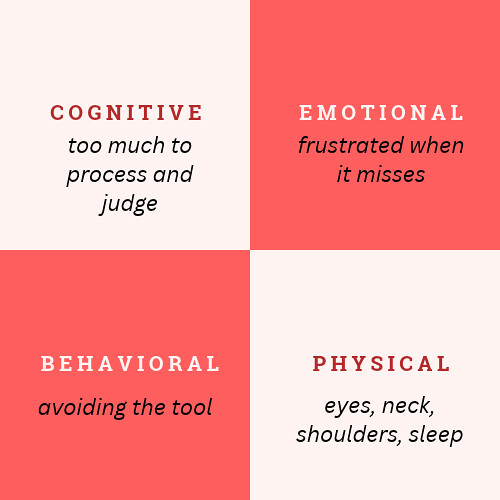
The four dimensions of AI fatigue, from Lau and colleagues, 2026.
The research finding to remember
Higher AI fatigue predicted lower current use AND a stronger stated intention to cut back even further over the coming months.
This sounds sensible, and here is why the research team thinks it is a trap. Backing off preserves your attention in the short run. Over time, it restricts practice, raises the effort of starting again, and feeds a cycle where the next attempt feels harder before you have even begun.
The retreat from tech that feels like self-care can compound without you ever noticing it happening. It also narrows the work itself. Read less widely and the branching stops, and with it goes the knowledge the branching was producing.
Tip: Scale down after a rough session. Try not to go dark entirely.
For students, parents, and new researchers
This is the part I care most about, because students are brand new to research and writing, and most of them have never been given the library shelf advice at all!

Nobody taught most of them how. We can fix that!
What is underneath it, and it is not laziness
Here is what I keep seeing. Students often do not know HOW. How to learn. How to write. How to think critically about the thing in front of them. Nobody sat down and taught them the process, so they are gliding by on instinct, and underneath the instinct is the feeling of being lesser than. Lesser than their classmates, lesser than what is expected, lesser than everyone who appears to know exactly what they are doing.
An AI tool arrives directly into that gap.
Of course it gets used to paper over it. Anyone would. A tool that produces a confident, finished-looking answer is extraordinarily appealing to someone who is not sure they know how to produce one themselves.
When a student goes wrong in one of the two directions below, the useful question is not why they took the shortcut. It is which part of the HOW nobody ever taught them, because that is the part you can actually fix.
The two directions
Too narrow. The student takes the first answer given. It came back coherent and confident, so the question feels closed. They never learn that a plausible first answer is where the work starts, and they never develop that prickle at the back of the neck that says something here is slightly off. It feels quite easy for someone to slapdash and be done. But when reading the final product, it’s important to think critically and assess what it says. This represents YOU! Do your research, verify, read it aloud to hear what is missing and what needs to go.
Too wide. Students ask for everything, receive everything, and drown. There is no way to judge what matters, so the sheer volume becomes the obstacle, and they either give up or hand in the slush pile. You can tell this in the defeated posture, words, and assignment. It’s not a good place to be in, and seems impossible to recover from. The way back is the same as the way out of too narrow: stop collecting and start judging. Pick the three things that actually answer the question and let the rest go.
Critical thinking is the whole skill, and it has to be taught
The shelf teaches it, which is why the shelf matters so much more than it looks. Going wider is only half of it. Think wide, then think critically. Five words, and the second half is the part the tool cannot do for you.
What does that look like in practice? It looks like a student who can say this source is better than that one, and here is why. It looks like noticing that two of your twelve results say the same thing because one copied the other. It looks like asking where a claim came from before repeating it.
We have written about how to teach this, in two places worth digging into. Our AI Literacy for Educators and Families guide has the classroom methods, including my favorite: have students use AI on a subject they already know well, so they catch the errors themselves. Nothing teaches skepticism faster than watching a confident machine get your own specialty wrong. And AI Chatbots: What Parents and Kids Should Know has the questions to ask at home, including the one that does the most work: where did that information come from?
Our piece on how AI will affect your children’s future self-sufficiency goes deeper on why this matters so much for young people.
For parents, one specific thing to watch for
If your child says she hates using AI tools and would rather do it by hand, she may not be being stubborn at all. That is the behavioral dimension the researchers measured, and it tends to follow a stretch of frustration she has not told you about.
Here is what I have seen it look like. The student sits there thinking about the task, and then the phone comes out, and it’s TikTok or a game. That is seeking comfort in the familiar, and it is a completely human response to being overwhelmed.
What makes it so hard to come back from is that the thinking task ahead is not only big, it may be something she has never done before and does not know how to start. The tool is not the problem. Not knowing how to begin is the problem.
Ask about the frustration before you address the behavior.
Which kind of tired is this?
When you are feeling AI fatigue, here is a short self-check you can run in about a minute, built on the four dimensions above. It is well worth doing before you decide what to change, because the four kinds need different responses and most of us apply one blunt rule to all of them (take a break! go outside!) and then wonder why it did not help.
Taking a walk is a fine answer for a full head. It does nothing at all for a task you do not know how to start, and it will not fix your neck.
- Is my head full, or is my patience gone? A full head wants a break and a smaller next question. An empty reservoir of patience usually means the last several attempts failed, and the task may need a different approach rather than another try.
- Am I avoiding the tool, or avoiding the task? These feel identical from the inside, which is why the question is worth asking out loud. If you would happily do this task on paper, it is the tool. If the thought of the task itself makes you tired no matter how you do it, the tool was never the problem, and no amount of tweaking how you use it will help.
- Does my body hurt? Eyes, neck, shoulders, brain, sleep. The physical dimension is measurable, and it is reliably the one we all ignore longest (especially when there’s a deadline).
And then the question that is the most critical:
Did the last hour make the work better, or only longer?
If the work is better, that is the shelf, and the tiredness bought you something. Protect it, and pace it.
If the work only took longer, that is verification load, and it bought you nothing. That is the one to cut, and the next section shows how.
What actually helps
This isn’t a list of apps! Here are the six things that can truly reduce the load.
Decide what “good enough” is before you start, and write it down. Most verification spirals begin because the standard was never set, so every output gets judged against a bar that keeps rising as the evening goes on. One sentence settled beforehand ends most of them (one sentence!). For an article, mine is: every fact is sourced, every link resolves. For a lesson, it is: the lesson plan is good to go. Put it on a post-it on your monitor as a visual reference and reminder.
Cap the AI retries at three. Then stop and either do it yourself or change the question entirely. Discouragement after many retries is a measured dimension of this, not a character flaw, and a cap turns an open-ended loop into a task with an end. I know we want to keep learning and improving. But the truth is that this work will NEVER be done when we use AI tools.
Agree on a stopping phrase, and mean it. Pick words that end the session, say them out loud, and honor them when they arrive. Not a nudge. An ending. Then close the browser window. That one extra step matters more than it sounds, because getting back in now takes a deliberate act, and a deliberate act is usually enough to stop you drifting back in because something was interesting or nearly finished.
Do not go dark after a bad run. This is the withdrawal trap we learned from the research. Scale down to something small and finishable rather than stopping completely, because stopping makes starting again harder each time.
What that looks like for me: when I am overwhelmed and wiped out, I pick one easy task and finish it, so that when I wake up the next morning the list is more doable. Fixing a few broken links. Writing a note that flags tomorrow’s tasks in the order I should do them. Anything that leaves me something encouraging to wake up to, so I view the next morning positively rather than as a stress pile.
Protect the shelf, and set its edges before you start. Read wide! Just decide how wide first, so that going wide is a choice you made rather than a thing that happened to you.
And one more that cuts verification load specifically: get faster at catching things, rather than checking everything. Knowing where a tool tends to fail means you can look there first instead of reading every line with equal suspicion. Our guide to how to catch what AI makes up is the companion piece to this one, because hallucinations are precisely why all that verification is necessary in the first place. The less time the checking takes, the less of this fatigue you accumulate.
Once I learned to set those parameters, everything changed for me. My phrases are bedtime and family time, both worthy stopping points. I know I am curious enough to want everything I do to be better, but real life also needs to be better. I know that when I use the phrase family time, those are real people I love, waiting to be together with me. Closing the window is what makes the phrase true, because the work is no longer one glance away. The AI will wait indefinitely. It is ready to pick back up again whenever I am. It works because it reminds me of my life priorities, which are infinitely more important than my finishing a work task priority.

Entirely visible.
Frequently asked questions about AI fatigue
What is AI fatigue?
AI fatigue is the specific exhaustion that comes from working alongside AI tools, and researchers have now measured it across four dimensions: cognitive, emotional, behavioral, and physical. It is not the same thing as being tired of hearing about AI. It is what happens to you after an afternoon of deciding, checking, and judging output that arrived faster than you could evaluate it.
Is AI fatigue the same as screen fatigue?
No, and this is the part that matters. Screen fatigue is about how long you looked at a monitor. AI fatigue is about how much judging you did while you were looking at it. You could spend the same two hours reading a novel on the same screen and come away fine. The researchers found that AI fatigue predicted people cutting back on AI use above and beyond general fatigue, screen fatigue, social media fatigue, and technostress, which is to say it is doing something those other measures do not capture.
Which is also why the usual advice fails. Take a break, walk around, look at something green: all good for you, none of it aimed at what actually happened.
Does being tired after using AI mean I am using it wrong?
No. It usually means the opposite. Used well, these tools make the work richer, and richer work costs more, not less. The tiredness that comes from following a good lead down three shelves is the tiredness that bought you a better article. What you want to separate out is the other kind: the fifty small decisions that went nowhere, the scope that expanded for no reason, the output you judged and then discarded.
What helps with AI fatigue?
Start by telling the two kinds apart, because they need opposite treatment. Protect the tiredness that made the work better and schedule it deliberately, before anything else gets at your day. Cut the tiredness that only made the work longer. Most people try to reduce both at once, which is why they end up doing worse work and still feeling wrung out.
Is AI fatigue actually a researched thing, or just a feeling?
It is researched. In June 2026, Gabriel Lau and colleagues at Nanyang Technological University, Singapore Management University, and the National University of Singapore published a validated AI Fatigue Scale in Computers in Human Behavior Reports, built across four studies with 717 participants. The work is cross-sectional and correlational, which the authors say quite clearly, so it describes the shape of the thing rather than proving what causes it. But the thing itself is now measurable, which it was not two years ago.
Worth remembering
The tiredness is real, it has a name and a shape and four measurable parts, and researchers are actively studying it. You are not failing at a thing everyone else finds easy. This is something that affects every single person using AI tools.
Using AI tools well makes your work richer. Your work has more depth, better organization, and more impact. It also takes considerably more labor than doing it alone would have, and the reason is that a good tool shows you the whole shelf instead of the one book you came for.
That is a trade, not a trap. And you would make it again, because the finished thing is better and you know it.
What you get to decide is the pace. Find the hour that made the work better, and give it a place in tomorrow’s plan before anything else claims it.
Then cut the tasks that comprised the hour that only made it longer.
Pin for later:

Source
Lau, G. R., Kasturiratna, K. T. A. S., Goh, A. Y. H., Tong, E. M. W., & Hartanto, A. (2026). AI fatigue in human-AI interaction: Conceptual framework, scale development and validation, and associations with AI engagement. Computers in Human Behavior Reports, 23, 101186. https://doi.org/10.1016/j.chbr.2026.101186
More from Wandering Educators on AI, teaching, and learning
- AI Literacy for Educators and Families
- AI Hallucinations: How to Catch What AI Makes Up
- How to Make AI Writing Sound Human (Without Losing Your Voice)
- AI Chatbots: What Parents and Kids Should Know
- The Digital Classroom: AI Tools Every Online Educator Should Use
- Artificial Intelligence Will Impact Your Children’s Future Self-Sufficiency
- Read This: Prompting Originality: The A.I. Handbook for Humans
Jessie Voigts is the founder and publisher of Wandering Educators. She has a PhD in International Education, has lived and worked in Japan and London, and traveled around the world. She is constantly looking for ways to increase intercultural understanding, and is passionate about study abroad and international education.