


After almost two decades of publishing Wandering Educators, I can usually tell by the second paragraph whether a submission was written by a person or created by a machine.
It is rarely one big thing that stands out to me. It’s a series of smaller things, stacked up and causing unease in my brain: the rhythm, tidy paragraphs, sentences that all land at the same length, like fence posts. There is a complete absence of anything you could point at.
I wrote about the telltale signs of AI writing, and that article struck a nerve (it is one of the most-read pieces on this site!). The emails I get now ask the next question:
Okay, I see the signs in my own drafts. How do I make AI writing sound human?
This is an entirely reasonable question! Here's your guide: where AI belongs in your writing process (and where it doesn't), the exact edit pass I use, the prompts that help, and an honest look at humanizer tools and AI detectors. You'll need an hour, your draft, your imagination, and at least one memory that only you have.
Let's roll.

Why AI writing sounds like AI
AI writes toward the middle of everything: content, readership, reading level, verbiage. It was trained on averages, so it produces averages: sentences that cluster between 12 and 18 words, paragraphs in uniform blocks, transitions stitched together with glue words like moreover and furthermore (nobody says furthermore out loud, I promise), and buzzwords like leverage doing laps every third paragraph.
Most of all, it produces writing with nothing to point at: no colorful ripe pear, no storm clouds hovering on the far horizon, no person with a name.
If you want the full diagnostic on why AI writing sounds like AI, start with the signs of AI writing and come back informed. This article is the fix.
Let AI research and outline. Write the finished piece yourself.
Before any fixes, get the actual division of labor right.
AI is a wonderful research assistant and a serviceable architect. Use it to gather background (verify its sources, always!), to summarize what the top articles on your topic already say, to suggest an outline, and to rough out the bones of a draft. This is honest work, and it saves hours.
The finished piece is a different job. It’s YOUR job.
Your creativity and your original thought are TRULY what readers come for. The machine can tell you what has already been written. Only you can say the thing that hasn't: your argument why something is important, your memory of the steam rising off your Irish hot chocolate in Hong Kong, your opinion that might be a surprise. Accept the bones of research, accept the outline if it helps, and then write the sentences yourself. Readers feel the difference, want to learn, imagine themselves there. So will you.
Tip: A clean handoff point helps. Once the outline is set, work in a document the AI never touches. Bones from the machine as your outline, every finished sentence from you.
Making AI writing sound human starts before the draft
You cannot humanize a draft until you know what YOUR human writing sounds like.
So, first: find your voice fingerprint.
Pull up three things you wrote before AI existed in your life. An old blog post, a long email to a friend, a trip report with detail galore. Read them out loud. Notice:
• How long your sentences actually run (mine sprawl, then snap short)
• The words you reach for again and again (I say lovely and explore far too much, and I've made peace with it! Also, coffee seems to surface again and again, no surprise there)
• Where you break rules on purpose
• What you notice first in a place: sound? food? light? smell? Include all five senses!
Write five or more of your quirks down. They are uniquely you…and your editing compass for everything below.

The edit pass: how to make AI writing sound human, fix by fix
While there are many ways to revise a robotic draft, here are five fixes that do the work for you. Go through them in order. Read the draft out loud at every pass (yes, out loud: your ear catches what your eye can’t see!).
1. Vary your sentence length and rhythm
AI sentences march along in order. Human sentences dance gracefully (or awkwardly. It’s all good).
Before:
Travel changes how students see the world. It exposes them to new cultures and ideas. It builds confidence and independence. It creates memories that last a lifetime.
Four sentences, all the same shape and length. Fence posts! No thank you.
After:
Travel changes how students see the world…but not all at once. First it's finding the best loaf of bread, navigating the bus system, the way grandmothers carry their shopping. Then one Tuesday, your quietest student orders dinner in another language, and you realize this intercultural change is happening.
The fix: find any three consecutive sentences of similar length, and make one much shorter. Or much longer. Your ear will tell you which. Find the rhythm of your words and be sure they are ever-present.
2. Cut the glue words and corporate-speak
Highlight every moreover, furthermore, additionally, it is important to note, in today's fast-paced world, and whether you're a beginner or an expert. Delete them. All of them!
You will be SHOCKED at how little you miss these words. Human writers don't announce transitions; we just do it. A new paragraph IS the transition.
Same goes for leverage, utilize, elevate, seamless, and unlock. Swap each for the word you'd use across the kitchen table (use, use, improve, easy, and... just delete the words quietly and unlock entirely).
3. Replace generic claims with details you can point at
This is the big one. The single fastest way to make AI writing sound human is to add one detail per section that only YOU could know.
AI can write “the local market was a feast for the senses.” It cannot write that the Fish Guy at the Kenmare Wednesday Market will set aside hake for you if you ask (and that I still make his fish stew recipe). It cannot write that I smelled Puffin Island before I saw it (as a farmgirl, I recognized chicken coop on the wind!). And it will never tell you about the best pear I've ever eaten, from a sunny day at Marché Jean-Talon, because it wasn't standing there with me at the market.
Go through your draft section by section. Anywhere you find a sentence that could be in any article on the internet, replace it with something you saw, smelled, tasted, heard, or held. I have long been a proponent of five senses writing – you should utilize this technique, too.
Don't have a memory that fits the topic? That's your sign you're writing too far from your own experience. Narrow the topic until your memories can be incorporated.
4. Break the uniform paragraph pattern
AI loves the three-sentence paragraph. Loves it.
Scroll your draft with squinted eyes (truly, squint!) so you only see the shapes. If every block is the same height, readers will feel the machine in their scrolling thumb before they consciously notice a thing.
Let one paragraph run long because the idea needs room. Let another be two words.
Like this.
5. Add the experience AI can't fake
Beyond sensory details, there are whole categories a machine cannot produce: the thing that went wrong, the person who surprised you, the opinion about a place that only you could have.
For instance, I think most “top 10 destination” articles (including some I've published, in the early years!) teach readers almost nothing. The articles that truly teach readers are the ones where the writer was changed by the place.
Your equivalent might be admitting the famous museum bored you, or that your study abroad students learned more at the laundromat than at the cathedral. Say the true thing. AI never will. It has no experience to inform the writing.
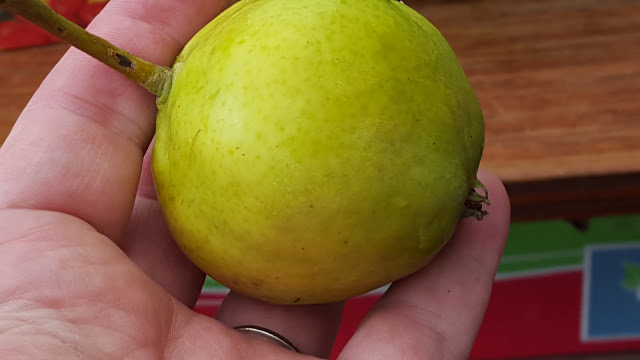
Here's that best pear I ever ate.
Prompts that get more human drafts from the start
A better prompt won't get you all the way home, but it shortens the edit pass (worth it!).
Three things to include:
Feed it your fingerprint. Paste two or three paragraphs of your real writing and say: match this voice, including the short sentences and the asides in parentheses. The draft comes back warmer.
Ask for uneven rhythm. Add: vary sentence length dramatically; include at least one fragment and one sentence over 30 words. This prompt works more often than you'd expect.
Ask it to leave holes. My favorite: wherever a personal story or sensory detail belongs, insert [YOUR STORY HERE] instead of inventing one. The machine drafts the bones; you supply the life. This single prompt prevents the worst AI habit, which is confidently inventing experiences you never had!

What about AI humanizer tools?
Honestly? They swap synonyms and sand the writing’s edges smooth. What comes out is a different flavor of generic (beige paint over gray paint). No thank you.
A humanizer cannot add your pear, your Fish Guy, your opinion. It doesn't know them! Use one for a quick de-stiffening first pass if you like, then do the real edit pass above. There's no shortcut around being a person.
Do AI detectors matter?
Less than you think, and differently than you fear.
Detectors are unreliable in both directions. They flag earnest human writing (especially from multilingual writers), and they wave through lightly-edited AI text. Chasing a detector score is chasing fog.
The reader is the only detector that counts. Readers can't always name what's wrong, but they FEEL it, and they leave.
One important note for educators and students: if you're working on an assignment for school, follow your institution's AI guidelines and cite AI assistance honestly. The fixes in this article make your writing genuinely yours. Use them that way. (Your professors were students once. They know.)
A working checklist before you hit publish
Run down this list with your draft open:
1. Did AI stay in its lane: research and bones only, with every finished sentence written by me?
2. Did I read the whole piece out loud?
3. Is it interesting? Would a tired reader keep going past the first screen?
4. Does it say something a reader can't get from any other article on this topic?
5. Do my sentence lengths vary on every screen?
6. Did I delete the glue words and buzzwords?
7. Is there one detail per section that only I could know?
8. Do my paragraphs make different shapes on the screen?
9. Is there one opinion here that is new online?
10. Does each section end somewhere worth arriving, with a reason to read the next one?
11. Did I check every fact and every invented-sounding detail?
12. Would the people who know me best recognize my voice?
13. Did I cite my AI use where my school or publication requires it?
Thirteen yeses? Publish with joy.

FAQ: making AI writing sound more human
How do I make AI writing sound more human, fast?
Read it out loud and fix everything that makes you wince, delete the glue words, then add one real detail per section. Twenty minutes can make a massive difference.
What's a good prompt to make AI writing sound more human?
Paste a sample of your own writing and ask the AI to match it. Then ask it to leave [YOUR STORY HERE] placeholders wherever a personal detail belongs, and fill those in yourself. Have fun with filling those in!
How do I make an AI-written essay sound human?
Use AI for the research and the outline, follow your school's AI policy, cite your use, and write the essay itself by yourself, with your examples, your argument, your conclusion. The voice follows the thinking!
Writing that sounds human is just...you, showing up on the page.

Have you found a fix that works in your own drafts? What caught the machine in your writing?
Click through to read more of our articles about AI (and how to use it):
Read This: Prompting Originality: The A.I. Handbook for Humans
AI Travel Planning: How to Use It Well on Your Next Journey
Top Signs Your Writing Was Generated by AI (and How to Fix It)
Jessie Voigts is the founder and publisher of Wandering Educators. She has a PhD in International Education, has lived and worked in Japan and London, and traveled around the world. She is constantly looking for ways to increase intercultural understanding, and is passionate about study abroad, family travel, and international education.
Find her online via Instagram, Facebook, or LinkedIn.