
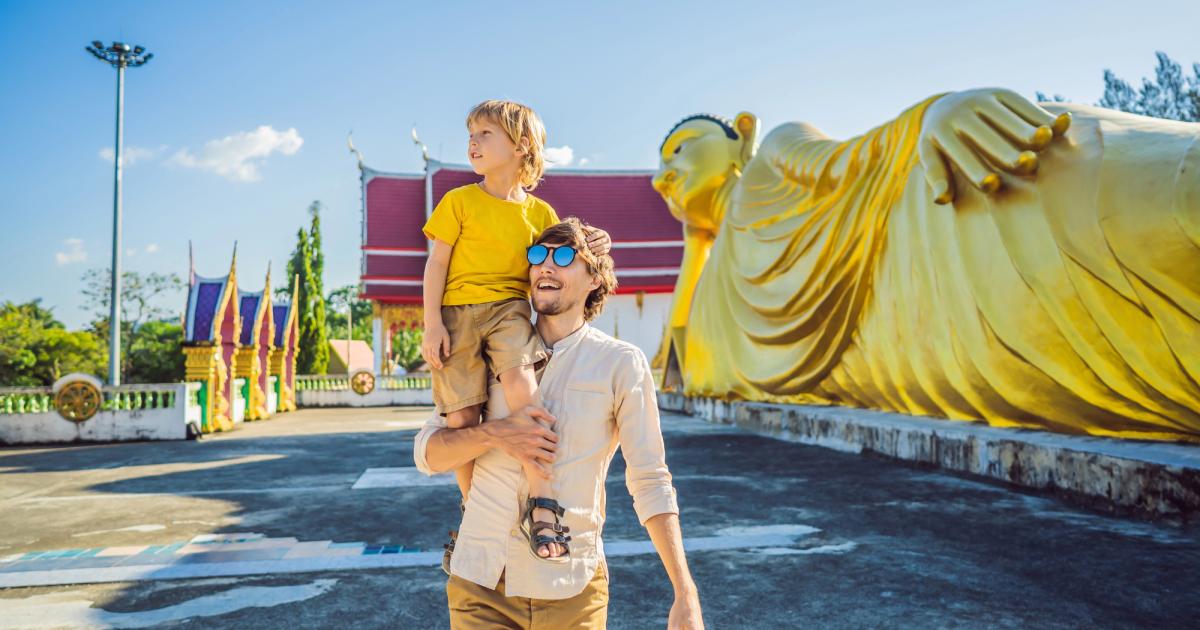

Bangkok rewards families who like their sightseeing with a learning bonus. Temples become lessons in symbolism, markets turn into real-world economics, river rides explain how cities grow, and science centers make STEM feel hands-on instead of homework-like.
This guide focuses on educational things to do in Bangkok with kids that are practical, memorable, and easy to adapt. You can match activities to your child’s age, the weather, the setting, and even the time of day — including evening options — without building an exhausting hour-by-hour itinerary. Remember: in Bangkok, education is everywhere!

Hands-On Science and Discovery Museums
Bangkok’s indoor learning stops do not all teach in the same way. Some are built for free play and maker-style exploration. Others use structured exhibits, scheduled shows, story-driven galleries, or physics-and-illusion interactives that bend perception.
The best approach? Pick one or two based on your child’s attention span and curiosity style rather than trying to pack every museum into one day.
Children's Discovery Museum
Best for / what kids actually do:
• Sensory play stations → build observation vocabulary. Ask: “What does that feel like? Can you describe the color before you touch it?”
• Movement and physics play with ramps, pulleys, and water tables → cause-effect reasoning. Ask: “What happens if you push it harder? Why did it stop there?”
• Mini experiment and maker corners → inquiry-based learning. Ask: “What do you think will happen if we try it a different way?”
This hands-on learning approach is the highlight. Kids are not just looking at exhibits; they are testing ideas with their hands, which is exactly the kind of interactive exhibit experience that sticks.
Planning shortcut: Budget 1.5–2.5 hours for a satisfying visit. Bring a water bottle and closed shoes for climbing and movement zones. Check onsite signage for stroller access since exhibit layouts can be tight in play areas. Entry to Children's Discovery Museum Bangkok is free, and it is designed broadly for children aged approximately 2–12, so siblings across that range can explore together without one feeling left out.
Culture, History, and Temple Learning
Bangkok’s temples and palaces work like a living classroom. History, art, religion, and architecture often appear on the same wall, roofline, or courtyard.
The key is not to see everything. Pick one anchor site, such as the Grand Palace or Wat Pho, then add one smaller stop if your child still has energy. This keeps the day focused without compromising curiosity.
Grand Palace and Emerald Buddha
Best ages/attention span: Ages 6 and up tend to engage best. Younger kids aged 3–5 can usually manage 30–40 focused minutes before the heat and crowds win.
What kids learn: How a royal palace differs from a religious temple, and how symbols — not just words — communicated power and protection in Thai culture.
The palace vs. temple distinction is worth explaining before you walk in. The Grand Palace grounds were the working and ceremonial home of the king, a place for governance and royal ritual. Wat Phra Kaew, the temple housing the Emerald Buddha inside those same walls, is a sacred religious space for worship and Buddhist teaching.
One is about earthly rule. The other is about spiritual life. Seeing them side by side gives kids a concrete, non-date-heavy way to understand monarchy and religion as two connected but separate systems.
Spot-it details on-site:
• Golden guardian statues, known as yaksha, at entrances
• Mythical half-bird, half-human figures, known as kinnari
• Repeating gold and glass mosaic patterns
• Color-coded roof tiles in orange, green, and blue
• The small, high-seated Emerald Buddha itself

Nature, Wildlife, and Sustainability Learning
Bangkok also offers excellent nature-based learning, even in the middle of the city. Each stop teaches through a different lens: marine habitats and adaptations, conservation and animal behavior, life cycles and pollination, or food systems and soil science.
Choose the learning frame that fits your child’s curiosity. One strong nature activity done well beats four rushed ones without compromise.
SEA LIFE Bangkok Ocean World
SEA LIFE Bangkok Ocean World is built around a 270-degree glass tunnel and houses roughly 8,000 animals, giving kids a dense, walkable cross-section of marine biodiversity without needing a wetsuit.
A tank full of fish only becomes a lesson if you are pointing at the right things. Use this compact habitat decoding framework as you walk:
1. Body parts → adaptation. Ask: “What does that body part help the animal do?” Fins may help with speed, flat bodies with hiding, and bright colors with warning or camouflage.
2. Exhibit design → habitat needs. Ask: “Why do you think this tank looks like this?” Rocky, open-water, and sandy-floor exhibits all signal different habitat requirements.
3. Food chains → predator/prey. Ask: “Who would eat this animal, and what would this animal eat?” Size, teeth, and hiding spots are all clues.

Free, Budget-Friendly, and Rainy-Day Educational Planning
Three things derail even the best-planned Bangkok itinerary: sudden rain or heat spikes, the narrow window between naps, and a budget that does not stretch to another ticketed attraction.
The practical rule is simple: pick one indoor public learning stop, one outdoor reset, and one low-cost transit experience. With that, you have a full day of informal learning without overspending.
Free Museums and Public Learning Centers
Bangkok has a strong lineup of free-entry venues that double as field trips without the field trip price tag. Each one teaches differently, so match the venue to the lesson.
• Bangkok Art and Culture Centre — core learning outcome: how exhibits tell a story through contemporary arts center galleries that rotate regularly. Micro-activity: a 10-minute “design a poster title” game, where your child picks one artwork and invents a short, punchy title for it before checking the real one.
• Bank of Thailand Museum — core learning outcome: how money moves, taught through a financial and economic history museum setting that traces currency and banking over time. Micro-activity: a 5-item “notice and name” checklist. Have your child spot and name five objects related to money they did not expect to see in a museum.
• Queen Sirikit Museum of Textiles — core learning outcome: how Thai textiles are made and used, covering weaving techniques and royal patronage of craft. Micro-activity: a sketch-and-label prompt, where kids draw one pattern or weave they see and label what they think it is made from.
• Rotating public exhibitions at smaller community galleries — core learning outcome: how curators organize and sequence information for an audience. Micro-activity: ask your child to arrange the exhibits in the order they would choose if they were the curator, then compare it with the actual layout.
Exact exhibit content changes often, so confirm current displays on each venue’s official site before you go.
Age-Specific Activity Planning
Matching a Bangkok outing to the right developmental stage comes down to three variables: session length, learning mode, and energy management.
Get these right before leaving the hotel, and you will spend far less time negotiating meltdowns and far more time watching real age-appropriate learning happen.
Tweens and Teens
Tweens and teens are ready for self-directed exploration. They respond best when you hand over real autonomy rather than narrating every stop.
This is the age where child development shifts from “tell me” to “let me figure it out.”
Best activity types in Bangkok:
• Interactive and illusion-based exhibits that reward independent exploration
• Temple and heritage sites approached through a decoding framework rather than a guided tour
• Nature/sustainability stops with a conservation or ethics angle to debate
• Evening experiences that feel more grown-up and less like a kid itinerary
What they learn best at this age:
• Independent research and evidence-based reasoning
• Cultural literacy and comparative observation
• Self-assessment and critique, including forming and defending an opinion
Winning time window: 2–3 hours per stop, often working well in the late afternoon into evening. Older kids tolerate heat and crowds longer and benefit from flexible scheduling.
Questions to ask:
• “Pick two of these three options. Which one are we doing first?”
• “Give this place a rating out of 10 and tell me why.”
• “Find one sign or menu item in both Thai and English. What is different about them?”
Avoid this mismatch: Do not hand a teen a fully open-ended “What do you want to do today?” Too many options with no structure often leads to decision fatigue rather than independence.
Give them the mission: Assign a concrete task that puts them in charge:
• A photography challenge: “Capture five examples of old meeting new.”
• A short review rubric: rate the stop on authenticity, value, and interest.
• A mini-research task: find and explain one historical fact the exhibit does not fully spell out.
Pair this with a choice-architecture rule: offer 2–3 vetted stops rather than an open planning session. Independence works best with guardrails. However! Our main travel tip is always leave time for serendipity! It's often the best memory of the trip.
Language and culture engagement also works better as a real-world literacy task than a lecture. Have tweens and teens compare Thai and English signage side by side, hunt for English loanwords embedded in Thai menus or shop names, and infer meaning from transit map icons and exhibition symbols before checking the translation.
That turns ordinary wayfinding — reading a BTS map, decoding a food stall menu, parsing a museum placard — into active cultural and linguistic practice.
All of this runs on a working data connection. Setting up an eSIM Bangkok data plan before the trip means your teen can navigate BTS routes, run translation apps, and research stops independently — which is the whole point of self-directed learning abroad.
Evening and Nighttime Educational Experiences
Evening in Bangkok is its own learning mode. Cooler air means longer attention spans, and the city switches on a second layer of lessons: illuminated signage, glowing transport nodes, riverfront crowds, and the visible rhythm of a nighttime economy.
Rather than cramming in three evening activities, pick one anchor experience. A riverfront walk, a night market, or a river cruise is enough. Close the night with a simple debrief ritual: one photo, one sentence of takeaway from your child.
Night Markets and Thai Food Learning
Night markets can collapse into pure snacking fast unless you give the visit structure. This four-step Thai food learning loop keeps the focus on learning without taking away the fun.
Step 1 — Pick a topic. Choose one dish or ingredient to focus on for the visit. There is no need to track down a specific stall or market by name.
Step 2 — Run the 5-senses challenge. Have your child score the chosen food on smell, texture, sound, temperature, and color using a simple 1–5 card. This is place-based education in miniature: the lesson only exists because you are standing right there.
Step 3 — Do a menu math moment. Count how many items are on a stall’s display, compare portion sizes or prices between two stalls, and estimate a rough total cost before paying.
Step 4 — Ask the cultural reasoning question. Close with: “Why do you think this food is popular at night?”
Let your child reason toward ideas like heat, commuting, and social eating. Outdoor cooking is more comfortable after sundown, people eat on the way home from work, and night markets double as gathering spots.
