

October is the great lie of national park travel.
Everybody tells you to go in fall, and they all say the same three things. There will be fewer people. The air will be cooler and the light will turn gold. The summer lines will be gone.
And then you drive into Great Smoky Mountains in the third week of October and spend forty minutes on Newfound Gap Road behind eleven thousand other people who read exactly the same advice.
Nobody seems to mention that the National Park Service says plainly that October is the busiest visitation month at Great Smoky Mountains. Shenandoah’s own website calls fall “the park’s busiest season,” and warns that campgrounds and lodges are usually fully booked for every September and October weekend months in advance. Yellowstone hosted 346,025 recreation visits in October 2024, which was sixteen percent more than the October before it. The shoulder season has grown a crowd of its own, and we are all welcome to it.
So the advice is not wrong. It is simply pointed at the wrong parks.

skip the crowds. go in October.
Which is a real shame, because October in the right park is the best thing going all year. You step out of the car at seven in the morning and the cold lands on the back of your neck like a hand (brr!). Somebody two loops over has a fire going, and the woodsmoke reaches you before the coffee does. Frost crunches under your boots for the first half mile of trail and then melts off by ten, so you hike out in a parka and back in your shirtsleeves. And all day, overhead, the aspen leaves make that dry papery clatter that sounds like nothing else on earth and that you will hear in your head for weeks afterward.
There are national parks in fall that genuinely empty out, and they are wonderful, and almost nobody writes about them because they do not photograph like Half Dome. Which is GREAT news for you!
Here are ten of them, with what closes and when, and the fee changes that caught a great many travelers off guard this year.
Come along with me.

nobody. On purpose!
First, the three things that changed in 2026
I want to get the logistics out of the way before we get to the peaceful part, because all three of these are new and most fall park articles still have them wrong.
1. There is now a $100 surcharge for non-US residents at eleven parks. This is live and in effect. It took effect on January 1, 2026, it is $100 per person aged 16 and over, and it is charged in addition to the regular entrance fee. The eleven parks are Acadia, Bryce Canyon, Everglades, Glacier, Grand Canyon, Grand Teton, Rocky Mountain, Sequoia and Kings Canyon, Yellowstone, Yosemite, and Zion. The America the Beautiful annual pass now costs $80 for US residents and $250 for non-residents. Passes bought before January 1, 2026 stay valid under their original terms, so it is worth checking the purchase date on the one in your glove box before you assume you owe anything.
2. Two of the big parks dropped their reservation systems, and one did not. Yosemite has no timed reservation system at all in 2026, and Glacier does not require vehicle reservations in 2026 either. Rocky Mountain, however, still runs timed entry well into fall. Standard timed entry runs through October 12, and Timed Entry+, which covers the Bear Lake Road corridor, runs through October 18. Acadia still requires a $6 vehicle reservation for the Cadillac Summit Road through October 25. Most articles you will find have at least one of these backward.
3. Two fee-free days remain in 2026, and both of them fall midweek. October 27 is Theodore Roosevelt’s birthday and lands on a Tuesday, and November 11 is Veterans Day and lands on a Wednesday. A free entrance day that also happens to be a low-traffic weekday is a genuine gift, especially for homeschooling families and for anyone whose calendar bends. Free AND peaceful! One change matters here, though, so please note it: beginning in 2026, fee-free days apply to US citizens and residents only, and non-residents pay the regular fee.
Tip: the 2027 fee-free dates have not been announced yet. They usually are announced in late autumn or early in the new year, so it is worth setting yourself a calendar reminder.
As always, check our national parks website at https://www.nps.gov for current information.
Ten national parks in fall that actually stay peaceful
1. Great Basin National Park, Nevada
The nearest town of any size is Ely, about seventy miles off, and there is no gateway resort economy here at all. No shuttle, no entrance line, no souvenir strip. The park is simply not on the circuit, and that is beyond marvelous.
You notice the smell before anything else, because the high desert after a cold night smells like sagebrush and pinyon pine, sharp and resinous and faintly medicinal, and it gets stronger as the sun warms the ground. Fall color starts around the second or third week of September, when the aspen go yellow and red and gold in long vertical ribbons up the mountainside. The park’s own page markets autumn as having “fewer crowds than summer,” which is not a sentence the Park Service writes about Zion.
Then there is the thing most people do not expect. Up on Wheeler Peak grow some of the oldest living things on this planet, bristlecone pines that have been standing here for thousands of years, and their wood is so dense and weather-polished that running your hand along a trunk feels more like touching stone than bark.
The real draw, though, is overhead. Great Basin is an International Dark Sky Park, and it runs free ranger astronomy programs with no reservations required, continuing into October. There is telescope viewing, there are solar scopes, and there are constellation talks out on the Baker Access Trail. You will stand in the dark with a dozen strangers while somebody points out Andromeda, and the cold will come straight up through your boots, and nobody will want to leave. Bring the good coat, and bring a second pair of socks!
One practical matter before you go. Water is unavailable in the campgrounds except at the Lehman Caves Visitor Center, and most campgrounds close with the first winter weather, sometimes as early as September. Lower Lehman Creek is the only year-round campground. As always, double check before going: https://www.nps.gov/grba/planyourvisit/lehman-caves-tours.htm
2. Capitol Reef National Park, Utah
This is the least-visited of Utah’s Big Five, and it is bypassed for a structural reason rather than a scenic one. Nearly every Utah itinerary ever written runs Zion to Bryce to Arches, and Capitol Reef sits just off to the side of that line.
The park and its campgrounds stay open year-round. The historic Fruita orchards (founded in the 1880s) hold roughly two thousand fruit trees, including cherry, apricot, peach, pear, apple, plum, mulberry, almond, and walnut, and you are allowed to pick in season. In a national park! You can stand in an orchard in the middle of the Utah desert, in the shade, with red cliffs going up on every side and the Fremont River making small noises behind you, and eat a warm pear with the juice running down your wrist. Tell me that is not worth the drive. (YUM.)
The cottonwoods along the river turn in October, and the gold of them against that red rock is the single most photographed thing in the park for good reason. Underfoot, the orchard grass is cool and damp in the morning even when the air above it is dry enough to crack your lips.
The Gifford House store and museum runs from Pi Day (March 14) through late November, from 9:00 a.m. to 4:30 p.m. daily.
Capitol Reef is another International Dark Sky Park, so pick up the night sky charts at the visitor center on your way through.
3. Theodore Roosevelt National Park, North Dakota
The summer road-trip traffic bound for Yellowstone and Glacier simply evaporates after Labor Day, and North Dakota sits a long way from any major airport. The park stays open 24 hours a day, year-round, and October is the last month you can reliably count on the scenic drives, because portions of the South Unit Scenic Loop and the North Unit Scenic Road may close in winter for snow and ice.
What gets you here is the sound, or rather the near-absence of it. The badlands are so open that wind becomes the only thing you hear for long stretches, moving through the prairie grass with a dry rushing noise, and then a single meadowlark cuts across it and the silence afterward feels twice as deep. At dusk the coyotes start, first one and then six, and if you are in a tent you will lie there listening and grinning.
You will smell the bison before you see them, a thick warm barnyard smell that carries surprisingly far on a cold morning. The bison rut runs August into September, so by October the herds have settled, and what you get instead is elk bugling and cottonwoods gone entirely gold along the Little Missouri.
One quirk will absolutely surprise you if nobody warns you, so consider yourself warned. The North Unit runs on Central time and the South Unit runs on Mountain time, in the same park. Check twice before you plan a sunset.
4. Voyageurs National Park, Minnesota
This is a water-based park, so when the boating season ends, the crowd ends right along with it. There is no entrance fee at all here. It is open and free year-round!
October on these lakes is a sensory experience that the summer visitors never get. The water goes black and glassy and cold enough that dipping a hand in it hurts within about four seconds (ask me how I know). Loons stage up before migration and call across the open water at night, which is a sound that will reorganize something in your chest the first time you hear it. The pine and cold water and wet granite combine into a smell that Minnesotans will recognize instantly and that everyone else will spend years trying to describe.
And the sky. On a clear October night this far north, with no moon, the stars come down to the waterline, and the northern lights are a real possibility rather than a travel-brochure promise.
This one does come with a genuine caveat. The Ash River, Kabetogama Lake, and Crane Lake visitor centers closed after September 27, 2026, and the Rainy Lake Visitor Center runs through October on reduced hours of 10am-4pm before it closes too. October here means you are largely on your own, so come self-sufficient or come another month.
5. Black Canyon of the Gunnison National Park, Colorado
Black Canyon is small and vertical and genuinely startling, it has no marquee day hike funneling everybody into one trailhead, and it sits in the shadow of Rocky Mountain three hours north. These three things are ever in your favor.
You walk up to the rim through pinyon and Utah juniper, and then the ground simply is not there anymore. The canyon drops away more than two thousand feet, so narrow and so steep that sunlight only reaches the bottom for a few minutes a day, which is how the place got its name. The Painted Wall, the tallest cliff in Colorado, is streaked with pale pink bands of pegmatite running through nearly black rock like veins through marble.
Stand at the rail and the first thing you register is that you can hear the Gunnison River, faintly, from two thousand feet up. The second thing you register is that your hands have gone tingly and you have stepped back without deciding to. That is the whole experience, and it takes about four seconds...and you will think about it for years.
The park is open 24 hours year-round. The South Rim Road is usually open to vehicles from late April to mid-November, and the North Rim typically closes to vehicles in mid-November and reopens in May. As always, check the NPS site for up-to-date information.
6. Mesa Verde National Park, Colorado
The rule for Mesa Verde in fall is simple. Go in the first three weeks of October, or wait until spring.
Wetherill Mesa Road closes after October 21, 2026, and cliff dwelling tours end mid-to-late October. The entry gate opens at 8:30am with last entry at 2pm, and Far View Lodge, Morefield Campground, and most of the dining close for the winter.
Go while the tours are running, because the tours are the whole point. You climb down a ladder into an alcove in the cliff face, and the temperature drops ten degrees the moment you are under the overhang, and the stone you put your hands on is cool and chalky and smooth where eight hundred years of people have touched the same places. Smoke from a thousand winters has blackened the ceilings, and you can still smell dust and cold rock and, faintly, juniper. Somebody’s handprint is pressed into the mortar above a doorway. Your kids will go completely silent, and then they will not stop asking questions for three hours.
For teachers, these ranger-guided cliff dwelling tours are the most directly curriculum-relevant thing on this entire list, covering Ancestral Puebloan architecture, archaeology, and the long unsettled argument about why people left. It is worth building the whole trip around them while they are still running.

eight hundred years of handprints
7. Lassen Volcanic National Park, California
Lassen is perennially the least-visited of California’s national parks, and the park highway is snow-gated, which compresses the whole season into a short window and sends most people elsewhere.
What nobody tells you is that Lassen smells. The hydrothermal areas run hot all year, and the sulfur hits you from the parking lot, QUITE eggy and sharp, and then you get close enough to hear it, because boiling mudpots make a thick gulping sound and the fumaroles hiss like a kettle that will not quit. Steam drifts across the road in the cold morning air and smells like the inside of the earth, which is more or less what it is. Fifty feet away there will be a stand of fir trees and clean pine-scented air, and the contrast is wonderful and faintly unsettling.
Kohm Yah-mah-nee Visitor Center is open year-round, from 9:30am to 4:30pm. The Loomis Museum runs May 21 through November 2, 2026, Thursdays through Mondays only, which means it is closed Tuesdays and Wednesdays, and that is exactly the sort of detail that ruins a Wednesday. Manzanita Lake campground has full service through October 7. Summit Lake North and South closed in late September, Juniper Lake is closed for renovations, and Southwest Campground stays open year-round as walk-in.
Before you go, PLEASE check their website: https://www.nps.gov/lavo/planyourvisit/fall.htm
8. North Cascades National Park, Washington
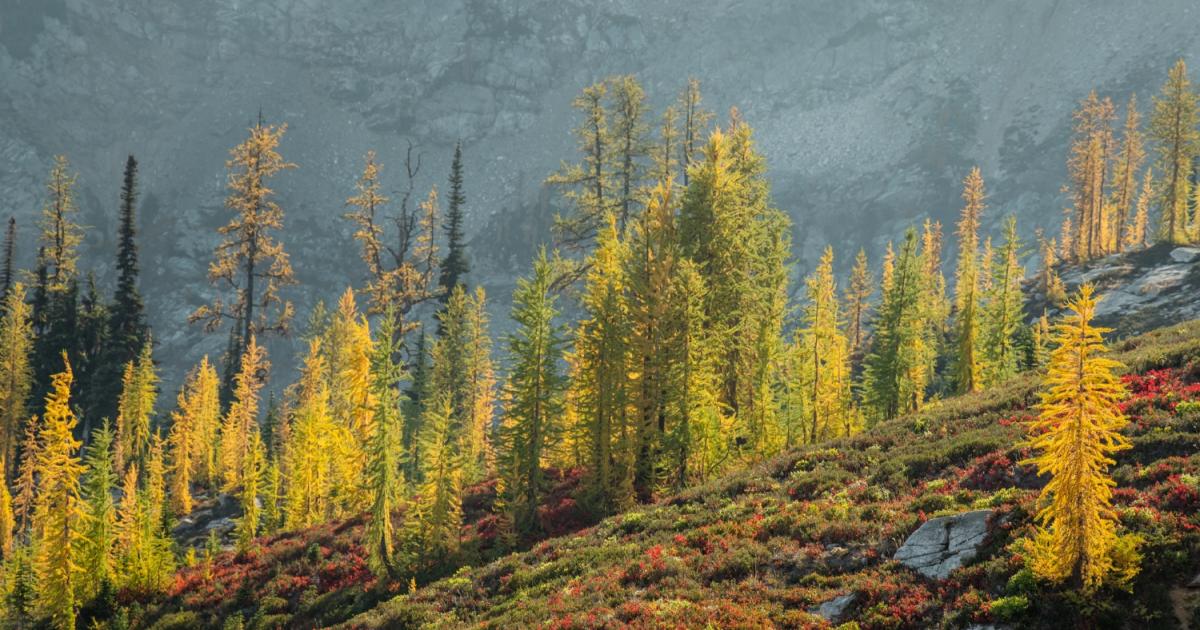
North Cascades is an early-October park and a spectacular one, and the reason to come is larch season, roughly late September into mid-October.
Larches are a deciduous conifer, which sounds like a contradiction and looks like a miracle. For about two weeks every autumn whole mountainsides of them turn a gold so saturated it reads as artificial, and then the needles drop. Hiking through a larch stand in October means walking on a carpet of soft gold needles that gives slightly underfoot and smells faintly sweet, like resin and rain.
Below you, Diablo Lake sits an improbable milky turquoise, which is glacial flour, rock ground to powder by ice and suspended in the water. It does not look real in photographs and it does not look real in person either.
The North Cascades Visitor Center closed for the season on September 27, 2026. The Wilderness Information Center ran through October 10, 2026, and the Skagit Information Center runs through November 1, 2026.
One thing matters more than any of those dates. Highway 20’s winter closure is called by WSDOT, not by the Park Service, and it is entirely weather-dependent, so check WSDOT rather than nps.gov and do not trust any specific date you read anywhere, including here.
9. Pinnacles National Park, California
California condors! That is the hook for visitors (bucket list!), and it is a very good one. These birds have wingspans approaching ten feet, and the species was brought back from the very edge of extinction by one of the most determined recovery programs in American conservation. When one passes overhead you hear the air moving over the wings before you understand what you are looking at.
Pinnacles also has talus caves, which are not caves in the usual sense but passages roofed over by boulders that fell into a narrow canyon and wedged there. You go in with a headlamp, the temperature drops, water drips somewhere ahead of you, and bats shift around overhead. Above ground the chaparral bakes all day and gives off a dusty herbal smell, like sage and hot stone, that stays in your clothes.
The park’s own page notes that “extremely high visitation” happens on weekends, holidays, and in favorable weather, especially in the spring, which is a polite way of saying that fall is easier. The east side offers 24-hour trail access, while the west gate runs 7:30am-8pm and is day use only. The Bear Gulch Nature Center is “open intermittently due to staffing,” a phrase now appearing on official Park Service pages that is worth researching carefully before you drive somewhere counting on finding a ranger.
10. Congaree National Park, South Carolina
Congaree is small, flat, free, and carries no fall foliage reputation whatsoever, which is precisely why nobody is there.
It is also, without making any fuss about it, one of the strangest and loveliest places in the eastern United States. This is old-growth bottomland hardwood forest with one of the tallest deciduous canopies anywhere in the world, and the boardwalk takes you through it at eye level with water that is tea-black from tannins and so still it mirrors the whole canopy back at you. Bald cypress knees push up through the muck in clusters like a congregation. The air is thick and smells of wet leaf litter and green decay in a way that is not unpleasant at all once you stop fighting it. Barred owls call back and forth in the afternoon, which is unusual and unnerving and marvelous.
The bald cypress and tupelo turn rusty gold late here, more like November than October, and the famous mosquito meter drops down to something civilized (ifyky).
Learn more: https://www.nps.gov/cong/planyourvisit/hours.htm
And three to skip, if crowds are what you are avoiding
Everyone who loves these three parks loves them for excellent reasons. But if what you are after is an empty trail, you should know what you are driving into.
Great Smoky Mountains is at its busiest in October, by the Park Service’s own account. Shenandoah calls fall its busiest season outright. Acadia carries heavy foliage traffic straight through the Cadillac reservation window, which runs to October 25.
If you are going anyway, the Park Service has published its own crowd advice for Shenandoah, and it is good advice. Go on a weekday, and enter from the southern entrances, because Front Royal and Thornton Gap are the congested ones and Swift Run or Rockfish will save you an hour.
At Acadia, the joy can be found at Schoodic. The Schoodic Loop stays open year-round, it sits on the mainland side, and it is almost deserted compared to the island. The Park Loop Road, for what it is worth, stays open until December 1, so October works fine there too if you can stand the company.
What actually closes, and why this matters more in fall than you think
Here is the thing that will save your trip. In fall, the park stays open and everything that makes visiting the park easy closes.
Glacier puts this more bluntly than any other park, warning on its own site that “most business and services in and near the park are closed from early October through late May.” That is not only the park facilities. That is the gas station, the diner, and the one shop in town that rents you a jacket when yours turns out to be inadequate.
A handful of specifics to note:
• Glacier’s Going-to-the-Sun Road alpine section typically closes “on or before the third Monday in October,” which falls on October 19 in 2026. It already closed once this season, on September 6, for heavy rainfall. The Logan Pass shuttle ended on September 7 and is not coming back this year. Once the road closes, the water and the toilets at Logan Pass go with it. You can text GNPROADS to 333111 for road alerts.
• Rocky Mountain’s Trail Ridge Road closes to through travel “mid-October to late May.” To give you a sense of the range, in 2024 it closed on October 25 and Old Fall River Road closed on October 8. Please do not trust any specific date on this one. The recorded status line is (970) 586-1222.
• Yosemite’s Tioga Road and Glacier Point Road typically stay open “until sometime in November,” and the Park Service publishes no average closing date for either. The road status line is (209) 372-0200.
• Zion’s shuttle runs September 13 to October 24 with the last bus at 6:00 p.m., and Zion Canyon Scenic Drive is closed to private vehicles during shuttle season, so in October you will be riding the bus.
• Great Smoky Mountains seasonal roads in 2026 run as follows. Kuwohi Road and Roaring Fork Motor Nature Trail stay open through November 29, Heintooga Ridge Road through October 31, and Parson Branch and Rich Mountain through November 9. Straight Fork Road remains undetermined because of Hurricane Helene impacts.
• Mount Rainier has the most serious disruptions of any park on this page. The entire Sunrise area, including the visitor center, the day lodge, and the road, is closed until further notice because of the Grand Park 2 Fire, and Ohanapecosh is closed for all of 2026. Verify everything before you go anywhere near this one.
All of it comes down to the same three facts. Water gets shut off, ranger programs thin out, and the people who would otherwise tell you what to do instead have gone home for the season. Download your maps before you lose signal, assume you will have no cell service at all, and bring considerably more water than you think you need.
The best fall wildlife on the calendar
The elk rut is the great October show, and Rocky Mountain is the place to see it. The elk come down from high elevation into the montane meadows to breed, and the bulls bugle. It is a sound that manages to be both a whistle and a scream at the same time, rising and then cracking at the top, and it carries across a frozen meadow at dawn in a way that raises every hair on your arms. You will never forget the first one. (Goosebumps. Every single time!)
The best viewing is at Horseshoe Park, Moraine Park, Upper Beaver Meadows, Harbison Meadow, and Holzwarth Meadow, early in the morning and again in the evening.
Two rules govern this, and both are critical to know. Several meadows restrict foot travel and fishing from 5pm-10am daily during the rut so that the elk are not harassed, and you must stay at least 75 feet away, which is roughly two bus lengths.
Tip: the Park Service’s “Rule of Thumb” makes a wonderful teaching tool for kids. Extend your arm, put your thumb up, and close one eye. If the animal is not completely hidden behind your thumb, you are too close. It turns an abstract distance into something a seven-year-old can actually do, and they will police the whole family with it for the rest of the trip.
Fall is also when bears feed hard before denning, so bear activity near trails and berry patches runs high, and the food storage rules stay fully in force long after the summer staff have gone home.
And then there is the stargazing, which I think is October’s most underrated gift. Longer nights arrive weeks before the deep cold does, so you get genuine darkness by dinnertime without February temperatures and without standing outside until midnight waiting for it. Great Basin and Capitol Reef are both Dark Sky Parks, and both are on this list for a reason.

seventy-five feet. two bus lengths. use your thumb.
For teachers and families
Every Kid Outdoors is running, and the timing right now could not be better. US fourth graders, including homeschool equivalents, get a free pass that covers the whole family, good for the 2026 to 2027 school year and expiring August 31, 2027. A fall 2026 trip sits at the very front of that window, which means you have the entire school year ahead of you.
Educators can request one paper pass for every one of their fourth-grade students. That is the strongest teacher benefit in the entire park system, and it is CONSISTENTLY under-applied, year after year. Teachers, please use this! The site is everykidoutdoors.gov, and it is not .org and not .com.
Junior Ranger runs at more than 400 Park Service sites, it is free, and it is open to all ages “regardless of ability.” You visit, you complete the booklet, you take the pledge, and you get the badge. My own experience is that the booklet is the thing that turns a kid from a passenger into a participant, because suddenly they are the one looking for the answer.
One fall caveat is real and worth planning around. Junior Ranger booklets are found at visitor centers, and visitor centers are precisely what closes in October. The North Cascades main center closed on September 27, and Voyageurs closed three of its four. Download the booklet ahead of time, or call and confirm that somebody will be at the desk.
And if you cannot travel at all this season, Shenandoah publishes a Fall Color Report, live webcams, and Thursday fall videos all autumn long. They are free, and they make a lovely thing to put up on a classroom screen!

fourth graders get in free. all of you.
When the color actually peaks, and why nobody will tell you
The Park Service refuses to forecast peak color, and they are entirely right to refuse. Shenandoah explains the problem better than anyone, pointing out that the park runs more than a hundred miles across wildly varying elevations, so “fall color conditions can vary dramatically from area to area, and weather affects the color from hour-to-hour.”
What you can plan around instead is elevation. At Great Smoky Mountains, above 4,000 feet the change can begin as early as mid-September and peaks early to mid-October, while below 4,000 feet the best displays run mid-October into early November. The color descends the mountain over several weeks, which means that if you miss it up high you can often catch it lower down a fortnight later. At Great Basin, color starts around the second or third week of September.
Anyone booking a foliage trip six weeks out is gambling, and I would far rather tell you that than hand you a confident peak-date map that turns out to be wrong. Use the live trackers (here in Michigan, I rely on Michigan Storm Chasers for color reports), build in a flexible day if you possibly can, and go anyway! The shoulder of peak is very often lovelier than peak itself, and it is always emptier.
Peaceful is closer than you think
You do not have to fly anywhere for any of this.
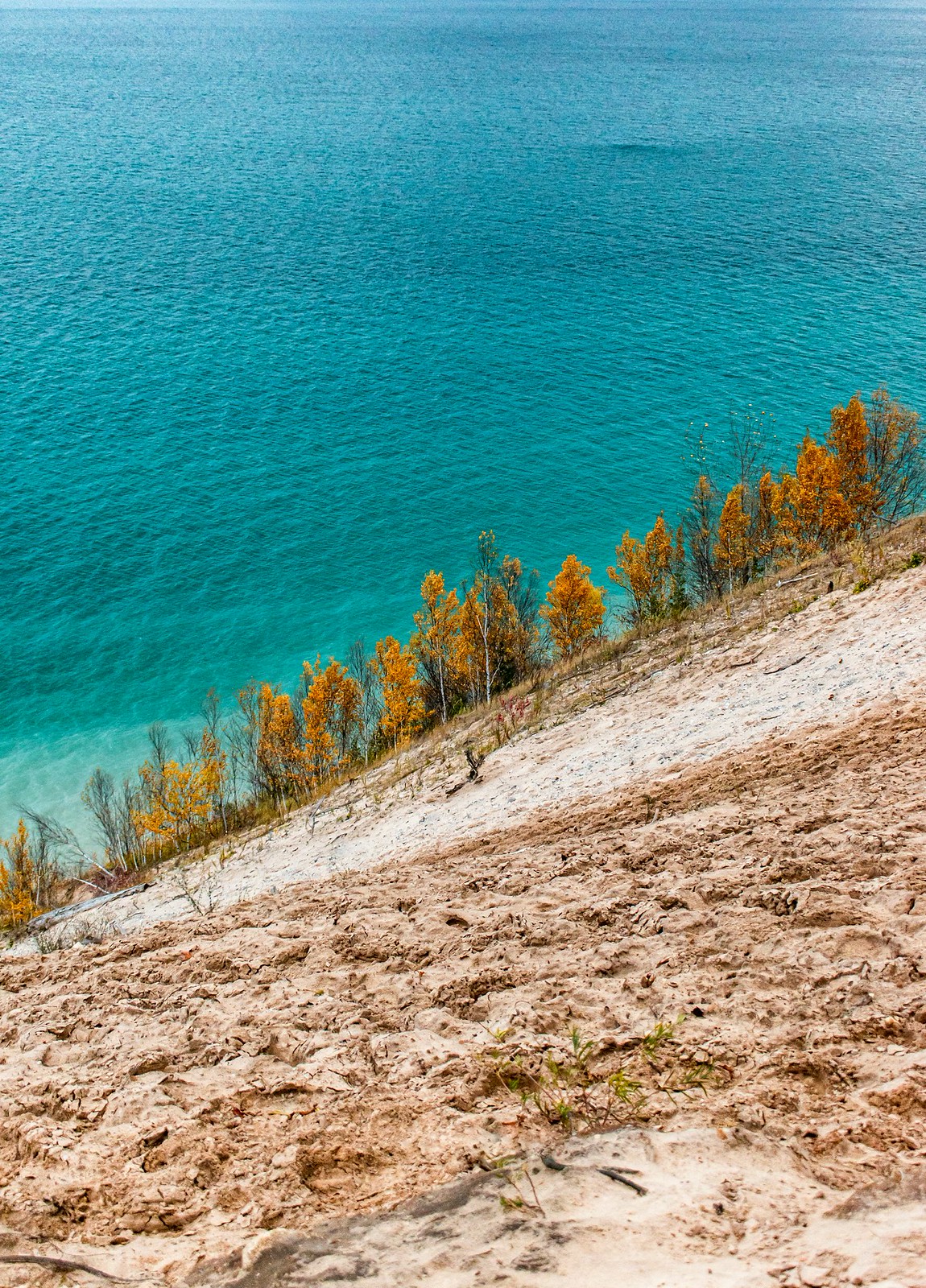
The big one for our family has always been climbing Sleeping Bear Dunes National Lakeshore, right here in Michigan. One year, Ed, a five-year-old Lillie, and my parents huffed their way up that ENORMOUS sand dune from the parking lot, and then went overland to the edge where you can finally see Lake Michigan clearly (before her first time climbing, Lillie had been firmly advised not to climb down to the water, because rescues there are expensive and dangerous.). The vistas were immense, and yet the climb itself was small and focused, one step at a time up a seemingly endless dune, with the sand sliding back half a step under every boot. They came down hot and sweaty and absolutely elated at having conquered such a summit.
Three generations on one sand dune, and it was nothing more exotic than a Michigan weekend! Extra bonus: the fall colors along M22 are extraordinary. Be sure to stop at Arcadia outlook for a bird's eye view of trees and shore.
The National Park Service runs more than 400 sites. Sixty-three of them have the words “National Park” in the name, and those sixty-three absorb the crowds and the Instagram posts and the traffic on Newfound Gap Road. The other three hundred and forty are lakeshores and monuments and historic sites and preserves, nearly all of them are peaceful in October, and a great many of them are located within a half-day drive of wherever you happen to be at right now.
Skip the crowds this year, and go stand somewhere gold.
Where are you headed this fall, and which park are you finally going to see without a line?
Related reading on Wandering Educators:
Historical Train Rides: Fall Foliage on America's Oldest Rails
Expert shares Top 5 Tips to Avoid the Crowds in National Parks
Fall Weekend at Sleeping Bear Dunes
Ten Places Not to Miss at the Sleeping Bear Dunes National Lakeshore
An Unexpected Encounter in Acadia National Park
The First National Park In The World
Camp for Free at a National Forest!
Fall Colors - and more - in the Adirondacks
The Ultimate Accessible Road Trip Guide
Lassoing the Sun: A Year in America's National Parks.
Jessie Voigts is the founder and publisher of Wandering Educators. She has a PhD in International Education, has lived and worked in Japan and London, and traveled around the world. She is constantly looking for ways to increase intercultural understanding, and is passionate about study abroad and international education.