


The locomotive at Lake Linden, in the Upper Peninsula of Michigan, is a twelve-ton narrow-gauge Porter. It was ordered new in 1915 by the Calumet and Hecla Mining Company, which was then pulling more copper out of the Keweenaw Peninsula than anyone was pulling anywhere on earth. The locomotive's work was to shuttle materials around the stamp mills on Torch Lake, the great crushing works that ran day and night and left the red sand that still lines that shore.
Calumet and Hecla gave the engine to the Houghton County Historical Society in 1969.
It runs today on a four-tenths-of-a-mile loop across the society’s grounds, which are the old milling site, past the foundations of the Hecla and Calumet mills themselves. This small hardworking engine spends its retirement hauling not copper, but people...in slow circles around the ruins of the industry it was built to serve, on ground it worked when the mills were running.
The Porter shows the history of American excursion railroading compressed into four-tenths of a mile.

Lake Linden and Torch Lake Railroad, Keweenaw Peninsula. Photo: Houghton County Historical Museum Complex
A railroad was driven into difficult country to bring out the one valuable thing that country held, whether copper, silver, coal, lumber, or paper pulp. Then the ore body pinched out, or the timber was gone, or the highway arrived, and by every commercial logic the line should have been lifted and sold for scrap. A few were not, and the reasons they survived are quite fascinating stories.
You can ride those historical railroads in the fall, when the same valleys the surveyors chose for their gentle grades happen to fill with color.
This is historical time travel at its most colorful.
Which fall foliage train rides are actually worth the drive?
Here is our guide to eleven historical train rides, including what each line was built to haul, how it came to survive, and how to get yourself a seat this season.
There is a long stop in Michigan along the way, because that is where I live, and because Michigan encompasses both the most common mistake travelers make about autumn rail journeys and the single most satisfying answer to it.
Why the best fall color runs on freight track
The beauty of these freight routes is extraordinary - and not the purpose of the journey. It is a consequence of nineteenth-century engineering economics. Once you understand the mechanism, you cannot look out a coach window the same way again.
Engineering meets nature, with often surprising (and magnificent) results.
Did you know that a loaded freight train cannot climb? That single limitation governed everything: a surveyor laying out a line had to find a route that gained elevation so gradually that a locomotive could drag tonnage up it without stalling, which meant following water. He ran his line up the river valley, took the long way around the shoulder of the mountain, crossed and recrossed the creek to stay on the gentlest ground, and accepted three miles of curvature to avoid two hundred feet of climb. Fifty years later, highway engineers came through with dynamite, a larger budget, and no such constraint, and they went straight over the ridge.
The result of these very different feats of transportation engineering is that the railroad lies down in the bottomland where the sugar maples grow, while the road runs the ridge among the pines.
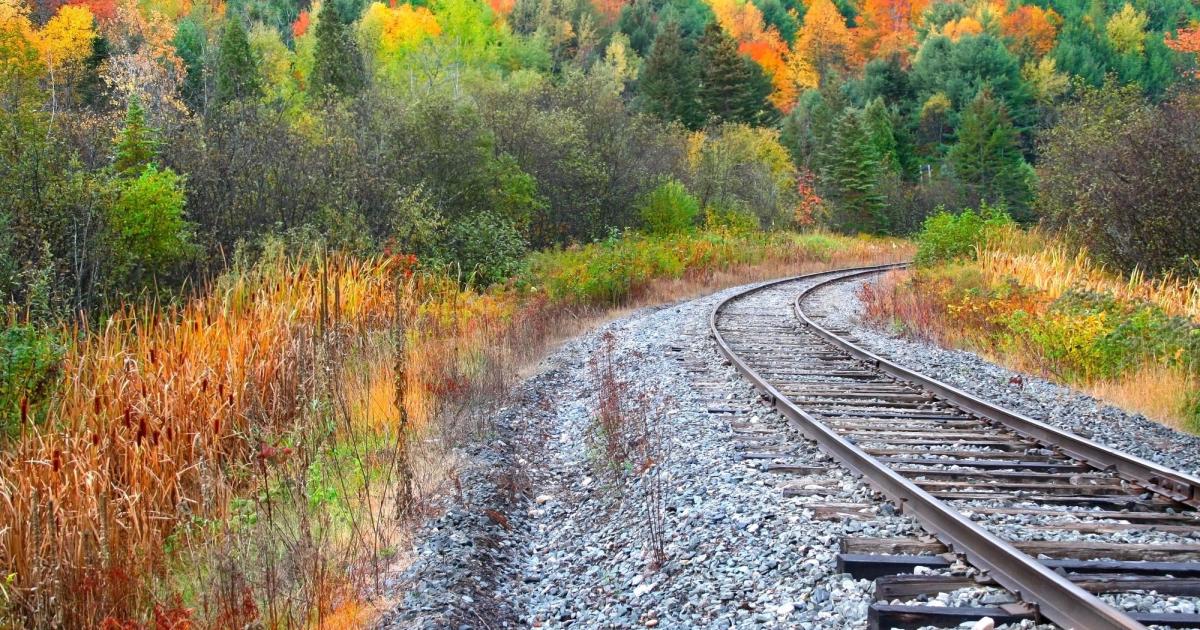
Autumn showcases this distinction perfectly. Along the water, you'll see the silver maples and cottonwoods going a soft, buttery yellow; on the slope above them, the sugar maples burst in scarlet and burnt orange, layered so that from a coach window the color stacks vertically, rising from the creek bank up through the hardwoods to whatever evergreen holds the ridgeline. On a mountain line that climbs in earnest, such as the run to Bald Knob in West Virginia, you gain enough elevation in a single afternoon to travel through two or three weeks of the season, leaving a valley still half green and arriving somewhere the show has already peaked and begun to drop.
And then there is the sumac. Every railroad embankment in the eastern half of this country is thick with this thriving plant, which turns a deep arterial red weeks before anything else in the landscape has started changing colors. You will see that vibrant brilliance first from the train, often close enough to the window to touch, while the hillside beyond is still summering.

Yes, please. Red sumac is so visually delightful!
These freight lines are not an American peculiarity, of course. I have stood under the Glenfinnan Viaduct in Scotland, the one every Harry Potter reader knows on sight, twenty-one arches raised between 1897 and 1901 to carry herring down from Mallaig to the markets that would pay for them. The scenery was never the reason for the journey. It is simply what was left over once the freight stopped.
Most lines like these did not survive, of course. For every excursion railroad running today, there are dozens of branch lines that went to the scrappers during the war, or were unobtrusively lifted in the seventies with no one left in town who cared enough to object. That scarcity is what makes the surviving railroads worth understanding before you board one.
Every railroad in this guide was saved by somebody, usually at the last possible moment, and usually by people who had far more conviction than money.
If you love history tours worth taking, consider this type of history tour: it travels at twelve miles an hour, it is upholstered, and on the better runs, you get lunch.
The rescues: railroads that were days from the scrapper
Cumbres & Toltec Scenic Railroad, Colorado and New Mexico
This is my favorite acquisition story in American railroading, and the remarkable thing about it is that it comes with an actual, physical receipt.
The Denver & Rio Grande drove its San Juan Extension across the high country in 1880 to bring silver ore down out of the mountains, laying narrow-gauge track over Cumbres Pass because narrow gauge could turn tighter and cost less in that terrain. The silver eventually gave out, as silver does. The Interstate Commerce Commission approved abandonment in 1969, and the line, the locomotives, and the entire working yard at Chama were headed for the scrapyard.
What happened next has no real parallel. Colorado and New Mexico, two state governments with no particular history of joint enterprise, bought sixty-four miles of the railroad together in 1970 for $547,120. The purchase included nine steam locomotives, more than a hundred and thirty freight and work cars, and the entirety of the Chama yard, with its coaling tower and its machine shop and its accumulated century of grime still in place. That is why Chama today feels like a working railroad rather than a museum arranged to resemble one: nobody ever cleared it out, because two states wrote one check before anyone could.
The line crosses the Colorado–New Mexico border eleven times, works a four percent grade out of Chama with the exhaust cracking off the rock walls, and stops for lunch at Osier, an old section point where the aspens run in bands of pale gold across the hillsides above the right-of-way. In late September and early October, those aspens are the whole reason to be there; they do not blaze so much as glow, and the light coming through them turns the inside of the coach yellow.
Plan on a full day, and bring a heavier coat than the forecast suggests, because it is high country and the wind up there has gusty opinions.
Tickets and the season calendar can be found at cumbrestoltec.com; the six Galloping Goose excursions on October 2–4 and 9–11 run $210 on Friday and Saturday and $185 on Sunday, and they sell out well ahead of the regular departures.
Our advice: book as early as you are able.

$547,120 for all this, in 1970
Cass Scenic Railroad, West Virginia
Cass is not a town that happens to have a railroad. Cass is the railroad, and the distinction is quite a tale.
The West Virginia Pulp and Paper Company founded the town outright in 1901 and built the line at the same time, for the single purpose of bringing spruce and hemlock down off Cheat Mountain to the mill. Everything in Cass existed because of that traffic: the houses on the hillside, the company store, the schedule of everyone’s day. Mower Lumber took over the operation in 1942. Then the accessible timber ran out, and in July of 1960, the mill and the railroad shut down within weeks of each other, taking the entire economic reason for the town’s existence with them.
West Virginia brought the railroad into the state park system in 1961. Not a decade later, once the loss had become picturesque, but the following year, while the buildings were still warm. The company town itself was added in 1977, which is how you can now walk past workers’ houses that were never converted into anything else.
The climb to Bald Knob covers eleven miles and 2,390 vertical feet in roughly five hours round trip, and it is worked by geared Shay locomotives, including Western Maryland No. 6, the last Shay ever constructed and the largest one still in existence. A Shay is an arresting piece of machinery to see in motion: the boiler is offset to one side of the frame to make room for three vertical cylinders that hammer up and down like a piston pump, driving a shaft that runs the length of the locomotive and turns every wheel through bevel gears. It was designed for exactly this work, hauling weight up bad track on a steep grade, and it goes about the business slowly, loudly, and quite successfully.
The train climbs out of hardwoods into red spruce, so you watch maple and beech and birch give way to evergreen as the air cools and the color behind you spreads out below.
Fall rates, ten dollars above the summer fare, take effect September 16; adult tickets are $85, seniors $83, and children four through eleven $65. A cold-cut lunch is included.
Find the schedule and booking at mountainrailwv.com. The Halloween train runs October 30 and 31 (woohoo!).

Cass Scenic Railroad with Shay no. 6
Essex Steam Train, Connecticut
The Valley Railroad Company received its charter on July 17, 1868, began construction in 1870, and ran its first ceremonial train over the forty-five miles from Hartford toward Saybrook Point on July 29, 1871. In its working life, it moved four passenger trains and a mixed train each way daily, calling at fifteen stops, carrying merchandise and supplies to the factory villages strung along the Connecticut River.
Then the automobile did to the Valley line what it did to countless others. Bankruptcy came in 1961. The New Haven’s successor abandoned the route in March of 1968, Penn Central had it marked for removal, and volunteers secured a temporary lease in 1969 and a formal state lease the year after.
The revival train ran from Essex to Deep River on July 29, 1971: one hundred years to the day after the first. How cool is that?
I find that detail almost unbearably moving. Instead of a marketing department’s creative timing, it is somebody sitting in a volunteer meeting in 1970, surrounded by rusted rail and borrowed equipment, who had read the company’s charter closely enough to look up and say, wait ... do you know what next July is?
The Connecticut River valley turns color late and turns quite beautifully, and the fall schedule is rubust: Thursday through Monday, October 1 through 25, with departures at 11:00, 12:30, and 2:00.
An hour on the train alone runs $29; the train paired with the riverboat, which puts you out on the water among the color, is $49 in coach and $65 in first class (I always recommend anything that adds water).
Details are at essexsteamtrain.com, and reservations are non-refundable, though transferable with two days’ notice and a small fee.

Essex Steam Train, Connecticut
Steamtown, Scranton, Pennsylvania
This historic railroad is the only one of these in the care of the National Park Service. Steamtown occupies the former Delaware, Lackawanna & Western yard in Scranton, roundhouse and turntable and all, preserving not a scenic line but an industrial facility: the place where locomotives were serviced, rather than the place they went.
There are three 2026 fall excursions now posted: October 3 to Tobyhanna, October 11 to Cresco, and October 24 to Delaware Water Gap, the last of these departing at nine in the morning with an optional waterfall hike at the far end.
Adult fares run $25 to $55 depending on the trip. Short rides around the yard operate Friday through Sunday into November for six dollars. Learn more at nps.gov/stea.
Also get your historical fix for Steamtown with The Iron Horse Society, a 501c3 corporation, which was formed to promote the knowledge, education, & preservation of railroad heritage at Steamtown National Historic Site for generations to come.

Steamtown National Historic Site
The survivors: lines that were never abandoned
Durango & Silverton Narrow Gauge Railroad, Colorado
The Rio Grande reached Durango on August 5, 1881 and pushed on to Silverton by the following July, hauling gold and silver out of the San Juans. What distinguishes this line from every other railroad in this guide is that it was never abandoned and never had to be revived. The Silverton branch came close to the end in 1947, and it has been shut down temporarily since by wildfire and by the pandemic, but no one ever pulled up the rail and no committee ever had to buy it back. Passengers began outnumbering the ore not long after the first tourists looked up at the walls of the Animas River gorge, and that traffic has sustained the railroad ever since.
The gorge in autumn is a particularly stunning kind of spectacle; the aspen stands run in vertical ribbons up the dark spruce slopes, following old avalanche paths, so the gold arrives in stripes against near-black.
The full Silverton round trip is a nine-hour day: three and a half hours each way with two hours in town. Fares run $108 to $313 depending on class and date. The steam season closes November 1; booking is at durangotrain.com.

Strasburg Rail Road, Pennsylvania
Chartered in June of 1832, Strasburg is the oldest continuously operating short line railroad in the United States. It is not the oldest railroad in America( the Baltimore & Ohio was chartered five years earlier, in 1827).
The railroad was built out of pure civic irritation. The Philadelphia & Columbia main line had bypassed the town, threatening to strand its commerce, so Strasburg laid its own track out to meet the main line rather than accept the insult. By the late 1950s, the little railroad was nearly finished; local enthusiasts bought it on November 1, 1958, and ran the first tourist excursion on January 4, 1959.
Five steam locomotives are in working order today (!!), among them No. 475, a 4-8-0 built for the Norfolk & Western in June 1906, and No. 31, a 0-6-0 from 1908 that holds the distinction of being the first steam locomotive in this country ever returned to revenue passenger service. The line runs through Lancaster County farmland, which is a gentler autumnal view than the mountains offer: corn shocks, tobacco sheds, and old hedgerow maples turning at the field edges.
Events and tickets are at strasburgrailroad.com. Note that Pumpkins in Paradise is a September 26 date rather than an October one.

Absolute beauty
Mount Washington Cog Railway, New Hampshire
Here’s the outlier in this guide, and the one I would recommend to a science teacher and their class to without hesitation. Field trip!
Sylvester Marsh was caught by weather near the summit of Mount Washington and nearly died of it, and his response was not to avoid the mountain but to build a railway up its western flank. It opened on July 3, 1869, the first mountain-climbing cog railway in the world, and it is the one line in this article that was built for passengers rather than freight. No ore, no coal, no lumber ever moved on it. It only carried people, from the first day.
The two coal-fired steam engines still in service are more than a century old and have visibly slanted boilers, canted on their frames so that the water inside sits level while the locomotive is pitched nose-up on the grade. It is a lovely, visual piece of engineering: a twenty-second physics lesson standing on the track in front of you, and once you have noticed it, you will never again look at a photograph of a cog engine without checking.
The climb passes through three distinct climate zones on the way to 6,288 feet, which in early October means leaving hardwood color at the base, running up through spruce and fir, and arriving in alpine tundra that has already gone brown and windburned above treeline. It is roughly three hours round trip with an hour at the top.
Summit season ends October 25. The cancellation terms are unforgiving inside fifteen days and there is a fee for missing your train, so arrive early. Details at thecog.com/tickets.

View of The Mount Washington Cog Railway and distant ridges
The hard history: Great Smoky Mountains Railroad, North Carolina
The Murphy Branch reached the town of Murphy in 1891, running 116 miles west from Asheville and opening mountain communities that had until then possessed no road worth the moniker.
Part of it was built by convict labor. In December of 1882, near the Cowee Tunnel, a raft that was ferrying prisoners across the Tuckasegee River capsized, and nineteen shackled men drowned because they could not swim free of one another.
That account is published on the railroad’s own history page. Thank you for educating us with honest history. It’s important.
Southern Railway ran the last scheduled passenger train on July 16, 1948. Excursion service began forty years later, in 1988. Two hundred thousand people a year now ride the line, most of them through the Nantahala Gorge, where the rhododendron stays glossy and green beneath hardwoods that turn as beautifully as anywhere in the southern Appalachians.
The Nantahala excursion covers forty-four miles in about four and a half hours with a stop at the Nantahala Outdoor Center; the season runs through October 31, with October priced as its own tier and coach fares in the mid-eighties. Steam locomotive 1702, a restored 1942 Army engine, works select dates only, and those dates go first.
The railroad does not publish its October steam assignments on the schedule page, so call before you buy if steam trains are your jam: gsmr.com/tickets.

Just...wow
Riding the rails in Michigan
Now, home.
Michigan’s excursion railroads are modest when compared to such mountain operations. Most of them are diesel, most of them run under two hours, and none of them will climb two thousand feet with you. They are also, to my mind, entirely worth your time, and there is one thing about their geography that catches people out every single year. I will come to it, but I want to start in the Keweenaw in Michigan’s Upper Peninsula, because that is where the season, colors, and the schedule line up perfectly.
There is absolutely nothing like the adventure of riding a railroad here. The anticipation, the landscape that is a leading character, the passionate people who run them, and the extraordinary views and colors you’ll experience. Add to it Michigan’s particular brand of Midwest nice, and you’ve got a journey that encompasses both beauty and community. Make new friends, learn new words (ope!), and marvel at the riches our state has.

Such extraordinary beauty
Lake Linden and Torch Lake Railroad, Keweenaw Peninsula
The engine I opened this article with, the 1915 Porter that Calumet and Hecla donated to the county in 1969, is No. 3, and it is the northernmost working steam locomotive in Michigan. Brian Keeney, who runs it, put the appeal about as well as anyone could when a reporter asked him this summer: “You don’t see steam locomotives operating steam machinery too much these days.”
The practicalities for your visit: It runs Saturdays, noon to four, weather permitting, through the end of September, with a Plymouth gas engine covering Wednesdays.
The fares tell you everything about who is running the place: adults $6, students $4, children three to five $3, under three free.
The museum occupies the old mill office, which offers three floors of Copper Country history; the campus sits at 53102 M-26 in Lake Linden, and the telephone number is (906) 296-4121. Details can be found at houghtonhistory.org. We also loved a story about this experience on HeritageRail.org.
And this is why a four-tenths-of-a-mile loop is equally important as a sixty-four-mile mountain railroad. The Keweenaw begins turning in mid-to-late September, and peaks through the first three weeks of October, moving from the interior outward toward the big water; the maple and birch standing against Lake Superior up there make the finest fall color in Michigan, no contest. This small train is running Saturdays straight through the front edge of that peak, which makes it the one place in the state where the excursion season and the color season genuinely coincide.
Go on the last Saturday in September, take the loop twice, and give the rest of the day to the Canal Colors festival in Houghton. That is a weekend well worth the drive north.
Foodie Tip from this Michigander: Find your favorite pasty on the Keweenaw Pasty Trail. Absolutely delicious!

retired to the ground it used to work
Photo: Houghton County Historical Museum Complex
Coopersville & Marne Railway
This railroad runs ninety minutes out of Coopersville and back, running on trackage that traces to the Oakland & Ottawa of the 1850s. This was once the main line to Grand Haven, feeding the Lake Michigan car ferries, before it was demoted to a branch and largely forgotten; the present railway was incorporated in July 1989 to run excursions over what remained. It still hauls lumber for a freight customer, which I find quite satisfying.
The Pumpkin Train runs weekends in October through the fruit belt of orchard country west of Grand Rapids, which is a domesticated, agricultural kind of autumn: apple rows, roadside stands, and old windbreak maples going orange along the section lines.
Prices: Coach is $35 for anyone thirteen and up and $30 for children; premium is $45 and includes locally pressed cider and a themed doughnut, which enters you directly into apple cider pancakes territory (IFYKY). A wheelchair seat is a separate $40 ticket type and should be booked as such. I absolutely appreciate when history and accessibility meet – it’s rare, and valued.
One correction the railroad has been making patiently across social media all season: there is no pumpkin patch, and the train does not stop. It is a continuous ninety-minute ride. Artificially generated videos suggesting otherwise have been circulating, and the railroad would like you to believe the railroad. The journeys sell out early, and they ask you to arrive half an hour ahead. Learn more at mitrain.net.

cider at the depot, obviously
Photo: Wikimedia Commons, Joe Ross
Southern Michigan Railroad, Tecumseh to Clinton
This is the old Palmyra & Jacksonburgh, which the railroad society describes as the first branch rail line into Michigan, and which some accounts credit as the state’s first railway outright. Public rides began in 1985 as track-speeder motorcar trips during the Clinton Fall Festival, which is about as Michigan an origin story as one could ask for.
The run goes forty-five minutes down the River Raisin valley, past Red Mill Pond, with a half-hour layover at Clinton (with freshly pressed apple cider waiting), then forty-five minutes back. It runs Saturdays and Sundays through October and into early November, departing at 10:00, 1:00, and 3:30.
Prices: Adults $25, seniors $20, children three to fifteen $20.
The equipment is half the pleasure: a Chicago South Shore & South Bend commuter coach, an open-air Penn Central gondola, and a New York Central bay-window caboose. A private caboose for a party of eight runs $200, which is a very good birthday option. Three practical warnings the railroad publishes and I will repeat: there are no restrooms aboard, there is no parking on site, and the train is not wheelchair accessible. Find the schedule and more information at southernmichiganrailroad.com.

Southern Mi RR line - isn't it stunning?
Photo: Southern Michigan Railroad Facebook
Little River Railroad, Coldwater
This one is steam, and the major reason to make the drive. No. 110 is a 4-6-2 Pacific built by Baldwin in November of 1911, and she is a genuinely handsome machine, small enough to take in whole from the platform. Photo op!
The Pumpkin Train dates this year are September 27 and October 4, 11, 18, and 25, all departing at 1:00, running about an hour and a half from Coldwater to Quincy with a layover long enough to buy pumpkins and eat something you should not.
Prices: Adults $22, children three to eleven $15.
They mean the departure time, and they say so: we will not hold the train for you if you are running late. Arrive thirty minutes early. The coach is not air conditioned, which in late October is not the problem it could be in, let’s say, the humidity of August. If you need the accessible coach, ask for car 5205 when you buy.
Details at littleriverrailroad.com.

Little River Railroad No. 110
Photo: Wikimedia Commons: Joetography LLC
Huckleberry Railroad, Flint
This railroad is narrow gauge, running the countryside around Mott Lake at Crossroads Village, which turns fifty this year. A coal-fired steam engine No. 152 works Saturdays and Sundays, and diesel No. 12 covers Thursdays and Fridays, though the railroad does not restate that arrangement for the Halloween event, so phone ahead if steam matters to you.
The October program is Halloween Ghosts & Goodies, and here are the 2026 dates: October 3–4, 9–11, 16–18, 22–25, and 29–30, with weekday hours from five to nine in the evening and weekend hours from noon. The Ghost Train Express runs forty minutes. Village admission alone is $17 and the village with the train is $27, in both cases for anyone twelve months and older; only infants under a year ride free. Trains sell out quickly, and the village is located at 6140 North Bray Road. More info at geneseecountyparks.org.

Huckleberry Railroad
Photo: Wikimedia Commons: Drew Jacksich
Nickel Plate Road 765, Pleasant Lake, Indiana
Michigan-adjacent! (Hi, neighbors.) This is the largest steam operation within reach of Michigan this fall, and worth the drive to/from Indiana.
October 16–18, the Indiana Rail Experience runs its Fall Color Steam Special out of Pleasant Lake, Indiana behind NKP 765, a 2-8-4 Berkshire built for fast freight and entirely capable of reminding you what that meant. These are all-day excursions across northeastern Indiana and into southern Michigan, over the Indiana Northeastern.
Prices: Coach starts at $75 and first class at $249.
Two other dates in the same neighborhood: the Hillsdale Railroad Festival on October 10 and 11, with fall-themed rides into Hillsdale, Michigan and a downtown block party, and the Autumn Limited on October 23–25, a diesel run of about two and a half hours from Pleasant Lake to Reading, Michigan, from $45. All three at indianarailexperience.org and great photos at https://www.facebook.com/fortwaynerailroad/
When Michigan’s color actually peaks
Here is the thing that catches people out, and it is the reason some travelers come home from a Michigan color train disappointed.
Every one of the Lower Peninsula railroads shared above sits in the southern third of the state: Coopersville, Tecumseh, Coldwater, Flint, and the Indiana operations just below the line. Southern Michigan does not reach peak color until somewhere between roughly October 15 and 30.
The color you have seen in photographs, the color that made you want to book a train in the first place, is usually taken in northern Michigan and the Upper Peninsula, and it peaks two to four weeks earlier than that. The Upper Peninsula Travel & Recreation Association places the show from mid-to-late September through the first three weeks of October, moving west to east and reaching the interior before the shoreline.
We recommend looking at Michigan Storm Chasers for updated fall color dates and graphics. Find them on Facebook or via their app – useful for weather while you’re visiting, too.
Our practical advice on timing splits the fall colors calendar neatly. If you want a southern Michigan train, book the second half of October and you will (probably) get what you came for; book the first weekend and you will ride through green trees wondering what went wrong. If you want the color first and the train second, go north in late September, when the Keweenaw is turning and the Lake Linden engine is still running Saturdays.
One correction to anything you may read elsewhere, including some listings still circulating: the Toonerville Trolley at Soo Junction, which for decades ran narrow gauge and a riverboat to the Upper Tahquamenon Falls, is not operating. The business was listed for sale after forty-two years, its website now redirects to an unrelated company, and the only active effort around it is a campaign to relocate and restore the equipment. Do not plan a trip around it.
Note: Lake Linden is the Upper Peninsula’s only working steam train this year.
How to book a fall foliage train ride without getting burned
How far ahead to book
Six to eight weeks is the right window for October weekends, and longer than that for anything involving steam, a dome car, or a meal. The limited-seating mountain trips go first and by a wide margin: Bald Knob, the Cumbres & Toltec specialty runs, and every steam date on a railroad that also runs diesel.
If your dates are fixed and the train is the point of the trip, book the train before you book the hotel. Lodging can be improvised. A sold-out Saturday ends the trip in your planning stages.
Steam or diesel (and why it matters)
Steam is loud, dirty, slow to gather itself, and unforgettable. You smell it before you see it, a mix of coal smoke and hot oil that gets into your coat and stays there for a day. Diesel is dependable. Most railroads own both and assign them by date, but the assignment is not always printed on the calendar.
Ask before you buy. Western Maryland runs No. 1309 on most 2026 weekends with diesel midweek, but the railroad has posted that the engine is undergoing a routine FRA inspection, which makes steam a reasonable expectation rather than a promise. Great Smoky Mountains does not publish its October steam dates on the schedule page at all. A phone call resolves both quickly, and every one of these railroads would rather answer the question than read the review.
Open-air car or enclosed coach
The open car wins for photographs and wins with children, and you will be colder than you expect. A train moving at thirty miles an hour on a forty-degree morning is not a forty-degree morning; dress for fifteen degrees below the forecast and bring something for your hands. The enclosed coach wins for warmth, for proximity to a restroom, and for anyone who needs to stay seated and settled.
On accessibility, which is important in our family: most heritage railroads have exactly one accessible car, and it nearly always has to be reserved separately, sometimes only by telephone. Cass requires advance reservation of its designated wheelchair car, which is also the only car with a restroom. Little River asks you to request coach 5205 at purchase. Coopersville sells a wheelchair seat as its own ticket type. Southern Michigan is not accessible at all and says so. Call ahead rather than trusting a booking page to know.
What happens if the color is late?
Nothing colorful happens; enjoy the green. That is our truthful answer, and it is worth remembering before you build a trip around a forecast.
Foliage is not a refundable condition on any railroad in this guide. Essex tickets are non-refundable, though transferable with forty-eight hours’ notice and a ten-dollar fee, which is about as accommodating as this gets. Mount Washington refunds nothing for weather, charges you for a missed train in peak season, and stops issuing refunds entirely inside fifteen days. Great Smoky Mountains cuts off refunds five days out.
Book the middle of the predicted window rather than its leading edge, and treat the leaves as the bonus riding on top of the railroad. The railroad will be there regardless, and the railroad is the older and more unique attraction anyway.
Riding with kids and across generations
A train is one of the very few trips where a four-year-old, a fourteen-year-old, and a grandparent are all enjoying themselves at the same moment, and nobody has to walk. Anyone who has tried to move three generations up a trail understands exactly how rare that combination can be. This is multigenerational travel at its finest.
The short rides we’ve shared are the sweet spot for smaller children: Lake Linden’s loop, Huckleberry’s forty minutes, Coopersville’s ninety, Essex’s hour. Save Bald Knob’s five hours and the Cumbres & Toltec’s full day for older children who have the curiosity (and endurance).
What I love most is how naturally the history winds itself around a color tour, in a way it stubbornly refuses to do inside a museum. You are not looking at the artifact; you are riding in it, smelling it, feeling the wind, seeing the inclines and colors and how time can, indeed, seem endless.
The grade the locomotive is working is the reason the town at the bottom of the hill exists. When a child asks why the tracks keep crossing the same creek, that is a real engineering question, and you can answer it by pointing out the window at the answer. These are trips that teach without anyone having to announce that they are teaching. As our daughter has said her whole life, “I love learning!” Make it easy for them by being curious and open, yourself. It's important to raise kids that love to learn while traveling!
Give yourself an hour in the depot town afterward, too. Nearly every one of these towns exists because of the railroad, and a historic walking tour will show you the whole layout pattern in about twenty minutes: the hotel facing the tracks, the grain elevator, the main street that runs parallel to the right-of-way rather than perpendicular to it. This is where history comes alive.

Mount Washington Cog Railway base station
Frequently asked questions
When is peak fall foliage for train rides?
Color moves north to south and high to low, running roughly from late September through late October. New England, the Upper Peninsula, and the high Rockies turn early; southern Michigan, the mid-Atlantic, and the southern Appalachians turn mid-to-late October. Check the region the railroad actually runs in rather than a national map, since a single state can hold a three-week spread.
How far in advance should I book a fall foliage train?
Six to eight weeks for October weekends, and longer for steam dates, dome seating, and dinner trains. Limited-seating mountain excursions such as Cass to Bald Knob can sell out months ahead.
Which fall foliage train rides use real steam locomotives?
Cumbres & Toltec, Durango & Silverton, Cass, Strasburg, Essex, and Mount Washington’s two coal-fired engines.
In the Midwest: Little River’s 1911 Baldwin, Huckleberry’s No. 152 on weekends, Lake Linden’s 1915 Porter, and NKP 765 on October 16–18.
Great Smoky Mountains and Western Maryland run steam on selected dates only, so confirm the assignment when you book.
Are tickets refundable if the leaves are not peaking?
No. Foliage is not a refundable condition on any railroad here, and several stop issuing refunds for any reason within five to fifteen days of departure. Book the middle of the predicted window rather than its front edge. Miss the color? Revel in the green! There’s always so much to see and experience when you travel.
How long are fall foliage train rides?
Anywhere from twenty minutes to a full day. Michigan’s local excursions run forty minutes to two hours; the NKP 765 excursion is an all-day trip; mountain excursions run four to nine hours.
Are historical train rides good for young children?
Yes! Choose forty to ninety minutes for children under five, bring layers, and sit on the side the color is on if the crew will tell you which that is. Prepare by reading all kinds of train books, acquiring the gear (LOVE those little kid conductor hats!), and talking about trains. If your kid is anything like mine, that’s a pretty standard (and always expanding) family topic. This will be a journey they always remember.

Pure happiness, right there
Which of these railroads are publicly owned?
Cumbres & Toltec belongs jointly to Colorado and New Mexico, Cass to West Virginia State Parks, the Adirondack corridor to New York State, and Steamtown to the National Park Service. Lake Linden’s engine and campus belong to a county historical society, which is public ownership of a different and more local kind.
There is a moment on nearly every one of these trips, usually about fifteen minutes out, when the whistle sounds for a grade crossing and every single passenger looks up from whatever they were doing.
We have been doing that for a hundred and fifty years, and we have not gotten tired of it yet.
Which one will you ride first?
Jessie Voigts is the founder and publisher of Wandering Educators. She has a PhD in International Education, has lived and worked in Japan and London, and traveled around the world. She is constantly looking for ways to increase intercultural understanding, and is passionate about study abroad, accessible travel, and international education.
Find her online via Instagram, Facebook, or LinkedIn.