

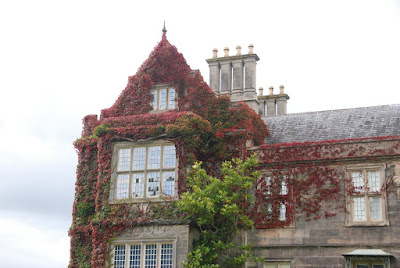
The first time I sat across from a docent who knew the name of every Herbert who had ever lived at Muckross House, I understood the gap.
She had stories about the (seemingly endless) basement bells, for the Irish Elk antlers in the entry hall (more than ten feet across, from a species that died out more than 6,000 years ago), for the ten long years the Herbert family spent preparing for a royal visit that financially ruined them. Instead of reading from a script, she read the room and adjusted, expositing on what we kept asking about. We walked out at closing knowing more about 19th-century Anglo-Irish life than most of us had picked up in college or our readings.
That is what an educational travel adventure is supposed to do. The bus that pulls up to the Cliffs of Moher for forty minutes is doing something else.
After almost two decades of publishing Wandering Educators, I get a steady stream of questions from adults asking how to choose an educational travel program that is actually worth the time and the money. The market is crowded; the marketing is loud. And the difference between a strong program and a glorified tour is usually only obvious in retrospect (we've all been there).
Here is how to tell the difference before you book.
Why adult educational travel is worth doing
The case for adult educational travel rests on something simple: travel is one of the best learning opportunities any adult can get. The best part? It gets better with age, as you bring more context...and understanding. You ask better questions. You notice things you would not have noticed in school.
A well-chosen program adds two things you cannot easily get on your own: subject-matter expertise embedded in the trip, and a group of fellow travelers who are also showing up to learn. Both are important! The right docent or guide will teach you in a few days what would take three months to learn on your own. The right small group will turn dinners into a second (and, perhaps, more laughter-filled) curriculum.
The principle behind adult educational travel is the same that our theory of education through travel has always been about, and the same reason traveling is the best form of education for many adults. The place and people teach you. A brochure or quick bus drive by does not.

Four categories of educational travel adventures for adults
Most adult educational travel falls into four functional categories. Knowing which you want to experience can quickly help narrow the field.
Expert-led trips
A scholar, a curator, a working artist, or a recognized practitioner leads the trip. The itinerary is built around their access, vast knowledge, and their experience of the place. You spend evenings hearing them think out loud. Road Scholar is the dominant provider in this category in the United States, but the category includes museum-sponsored trips, archaeological digs, literary tours, and small-group programs run by university faculty.
Choose this category when you want a topic taught well by someone who knows it.
University alumni and continuing education travel
Universities run their own travel programs, often through their alumni offices or continuing education divisions. The faculty traveling with you may be active researchers. The other travelers could be alumni of the same institution. The intellectual register is high (and the cost is often higher). Some of these educational travel opportunities are open to non-alumni.
Choose this category if you have an institutional affiliation, or if you want the trip to feel like a moving graduate seminar.
Skill-based trips
This type of trip is exemplified by a cooking school in Tuscany, a Spanish-language immersion week in Oaxaca, a photography workshop in Iceland, or a watercolor course in Provence (en plein air, of course). The trip exists so you learn the skill. You leave with the skill (and, usually, a small group of people you now associate with the place).
This trip is worth picking when you want something concrete to take home and keep practicing.
Service-learning and citizen science
Earthwatch-style programs put you directly on a research team. You spend the trip helping with field work, data collection, restoration, or community projects. Your learning comes from doing the work itself, as well as from the researchers running it. It can be an extraordinary working and learning experience.
This trip is a good fit when you want the trip to be useful to someone besides you (and you love giving back).

Eight to fifteen is the optimal number here
What separates a strong program from a glorified tour
The filter we use to assess educational travel programs is the ratio of expert time to bus time.
A strong program puts you with the scholar, the docent, the practitioner, or the researcher for hours each day. You eat with them. You walk with them. You ask questions and get real answers in real time. You get your hands dirty (in a pottery class in Japan, at an archaeological dig in Greece, mudlarking on the Thames). A glorified tour has the expert on stage for forty minutes a day and you spend the rest of the time following a flag through a parking lot (or napping on the bus).
Time with locals matters almost as much. A program built around a place lets the location shine: the market, the workshop, the family-run restaurant, the neighborhood librarian who knows the regional history because she has lived there her whole life and is SO happy to share it. An itinerary that moves you through a place without ever putting you in conversation with anyone who lives there is called sightseeing.
Your guide will also know local festivals, concerts, art fairs, events, times, and tides. This is an invaluable (and rare) introduction to a culture’s rhythms and calendar.

Look at this cool local festival in Kyoto, Japan!
Room for serendipity (and exploration) is often the most decisive filter of all. The best adult educational travel programs build in mornings, afternoons, or whole days where nothing is on the schedule. That is when you approach the place deeply instead of skimming it. A program that fills every hour does not trust the place (and locals) to teach you. Perhaps you spend hours with the research librarian at an author's archive, or explore the musical meanderings of a local band. It's all up to you to discover, engage, and learn.
Tip: Ask the program for the daily itinerary of a recent trip. Count the hours actually spent with experts and with locals. Divide by total trip hours. If the number is under thirty percent, look at another program.

Spending time learning from locals is such an excellent thing
Six questions to ask before you book
These are the questions that will get you the most useful answers in the shortest time:
1. Who are the guides, and how long have they been doing this? If the program cannot tell you the name and background of the person who will lead your trip, the program does not know yet. That is a bright red flag.
2. How many travelers will be on the trip? Eight to fifteen is the sweet spot where everyone gets attention and the people in the group still bring enough perspectives. Over twenty is a bus tour wearing the educational badge.
3. How much time will I actually spend with locals? Add up the hours. If the answer is under ten hours over a two-week trip, the program is more sightseeing than education.
4. What is the daily rhythm? Look for blocks of unstructured time. A program with no slow time does not respect the place, people, or the learner. And, honestly? It's exhausting.
5. What do alumni say six months after the trip? Ask the program for contact information for a few participants who are willing to talk. A program that cannot offer this either is too new or has reasons it cannot.
6. What happens if I cannot finish the trip? Travel insurance, refund policies, and medical evacuation matter more for trips that take you far from home. The answer reveals how seriously the program takes the practical side. Let’s face it: life (and travel) are unpredictable.

How much time and money to plan for
A realistic time frame for a meaningful educational travel adventure for adults is eight to ten days on the ground. Shorter trips do not give the place enough time to teach you anything. Two-to-three week trips earn a depth that justifies the cost.
Cost ranges vary widely. A Road Scholar week in the United States can run two to four thousand dollars all-in. International expert-led trips often start at four thousand and go to ten thousand or more for two-week programs. University alumni programs often sit higher. Skill-based trips and service-learning programs vary by destination and duration.
The fiscal number worth tracking is cost per hour of meaningful learning. A six-thousand-dollar trip with fifty hours of expert and local contact is better value than a three-thousand-dollar trip with ten. Save up! It's worth it.

Meaningful (and delicious) learning in a cooking class in Kenya
How to self-design your own educational adventure
You do not have to have thousands of dollars, or book a program. Some of the best educational travel adventures are the ones you build yourself. It’s 100% customized!
Pick a topic you want to learn (a regional cuisine, a period of history, a craft, a watershed). Choose a place where you can learn it from working practitioners (a market town, a museum city, a research institution, a workshop hub). Stay long enough that the locals start to know you. Take a class or two from local experts. Read local authors and talk with experts on the trip itself. Keep a working notebook.

Designing your own educational adventure requires imagination (and caffeine?)
Pre-planning resources
Reading our five tips for making any travel experience educational provides foundational knowledge for your self-designed version. The principles are the same as the program version. You are just the one running the program.
If you are an educator, the Wandering Educators teacher's guide to education travel adventures covers the funding and program landscape built for the school calendar.
For adults more broadly, the life skills travel teaches and what travel does for educators are the primary reason why your time and money are worth it.

Explore at your own pace
Frequently asked questions
What are educational travel adventures for adults?
These are trips built around learning a place, a skill, or a subject, led by an expert and structured so the learner actually has time to absorb what they are seeing. They differ from regular tours in the depth of expertise and the time built in for the place to teach you.
How do you choose an educational travel program?
Pick the category that fits what you want to learn (expert-led, university alumni, skill-based, or service-learning), then run the program through the six questions above. The ratio of expert and local contact time to bus time is the strongest single filter.
What is the difference between a tour and an educational travel adventure?
A regular tour offers sightseeing. An educational travel adventure puts you in sustained conversation with experts and with locals. The hours you spend with the people who know the place are the structural difference.
How much do adult educational travel programs cost?
A week-long United States program from a mid-priced operator runs roughly two to four thousand dollars. International expert-led trips of two weeks can run four to ten thousand. The number worth tracking is cost per hour of meaningful learning rather than the headline price. The cost of this, when utilized as continuing professional education, could also be covered by grants or PD funds.
Can I do educational travel as an adult without a program?
Yes, and many adults do. It can be extraordinarily rewarding. Your self-designed adventure is often cheaper and sometimes deeper. It also allows you to include side passions, and let serendipity lead the way.

Learning and laughing together can lead to friends for life
Have you taken an adult educational travel adventure? What program or self-designed trip taught you the most?
Jessie Voigts is the founder and publisher of Wandering Educators. She has a PhD in International Education, has lived and worked in Japan and London, and traveled around the world. She is constantly looking for ways to increase intercultural understanding, and is passionate about study abroad, family travel, and international education.
Find her online via Instagram, Facebook, or LinkedIn.