
After almost two decades of publishing Wandering Educators, I get the same question from teachers more than any other.
Where do I find an education travel adventure that is actually worth the time and money?
It is a reasonable question. Search the phrase, and you will find tour companies first, marketing copy second, and very little real guidance written by someone who has actually traveled with educators, watched what works, and seen what falls flat.
This article is your guide.

My PhD is in international education. I have spent decades on the road with my own family, including the years our daughter was at the age when travel teaches the most. I have written about teacher travel programs, family travel as education, faculty-led study abroad (including my own experiences directing a summer study abroad program for a Big Ten university), and the art of learning that travel can facilitate.
Here’s what I tell educators when they ask about the best education travel adventure for them.
What education travel adventures actually are
The phrase covers three different kinds of trips; which one fits depends on what you teach, who you teach, and what you want the trip to do.
The first kind is the organized education travel program built specifically for teachers. Think GEEO (Global Exploration for Educators Organization), Fulbright's Teachers for Global Classrooms, or other educator trips. These are designed by people who understand the teacher's calendar (summer, spring break), the teacher's budget (modest), and the teacher's goal (bring real material back to the classroom). Most include graduate credit or professional development hours.
The second kind is faculty-led group travel that you (or your university) organize for your own students.
On the high school level, organizations like EF Educational Tours, Worldstrides, EA Tours, and all support teachers who want to lead a trip but do not want to handle every logistical detail. You set the destination and the learning goals. They handle the travel insurance, the hotels, the buses, and the safety protocols.
The third kind is the one that teachers, students, and parents often forget is an option: the self-designed (or researched) education travel adventure. You pick a place. You set the learning goal. You plan the trip yourself, often with your family. Most of my own rich educational travel has been this kind. It is the cheapest (you set the budget), the most flexible (you set the dates), and the most demanding of preparation (yes, it is all on you!). It is also where most interesting forms of learning come from.
If you prefer to travel with a group, there are options. For teens who want to experience educational travel adventures with (or without) their high school teachers, we recommend digging into our favorite global education site, Transitions Abroad, for recommendations. On the university level for study abroad (in addition to their university’s study abroad office), research organizations like the Institute for International Education (IIE), CIEE (Council on International Educational Exchange), IES Abroad, IISEP Study Abroad, and CEA CAPA Education Abroad.

All that curiosity...
How education travel adventures actually teach
The best education travel adventures share three features, whether you are joining an organized program or planning your own.
They are slow enough that the place can teach you something.
A bus tour with eight cities in ten days is travel. It is not education travel. Genuine learning needs at least a week in one place, time to walk the same streets twice, time to be recognized by the woman at the bakery and the docent at the small museum.
School trips take students away from the pressures of daily life. This liminal time is packed with a unique kind of bonding (that of experience and place), as well as learning opportunities around every corner. It might be different from what anyone on the trip expects; education happens in the smallest of moments, as well as the largest. One of your students might discover their favorite new treat from the corner boulangerie, while another might lose track of time with a painting at an art museum. It is the very best kind of learning.
For one of our many self-designed educational adventures, our family stayed at Pier Cottage in Co. Kerry for a week. By the second day, the pharmacist one town over knew our names and we learned different names for medicines, as well as some age-old tips (seawater cures a great deal of ailments!). By the time we left, our daughter could tell you the difference between a Carnegie library and a regular one because we kept ending up in Kenmare's, comparing Gaelic picture books with English ones. She learned about tides and shrimping from new local friends, experienced the joy of having a favorite pub where they learned to bring steaming hot fish chowder to us without even asking our order (although they did note where and by whom each day’s catch came from), and climbed still-sturdy ancient fort walls, imagining battles and people those walls protected.
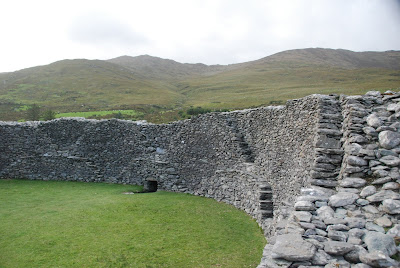
Yes, we climbed all over these!
Brochures, websites, and books are not teachers. A program is only as good as the guides, hosts, scholars, and locals it puts you in conversation with. When we experienced the (indeed spooky) St. John's Haunted Hike with Dale Jarvis, the Newfoundland folklorist who founded these history-focused walks in 1997, my then-13-year-old daughter spent half an hour after the tour asking him about how true folklore actually gets preserved.
Our National Park Service has an enormous program about Parks as Classrooms, including fieldtrips, lesson plans, and virtual visits. Highly recommended!
When we visited Culloden on a grey, misty morning, we arrived early in the day, and hours and hours later, had to be told that they were closing. We wandered the paths, avoided slugs stretched out, listened to history, and FELT the spirit of Culloden surrounding us. We teared up at the Clan grave markers, gazed at the wet marsh off the path (wondering HOW those soldiers were able to fight there), and honored those that had fought so hard for their country and beliefs. Our daughter stretched her time out, going back to certain parts of the long battlefield, looking off into the hills while listening hard. She did NOT want to leave. We closed the place down, the very last ones to leave – and we had a difficult time exiting. Culloden had a firm hold on our souls. Our daughter was absolutely entranced by the living history and spirit of the battlefield. From the movie in the visitor centre to the guides who shared so much of the history of place, she was all in. My husband and I finally found a place to sit while she meandered in and out, asking questions and then going back to the battlefield (and Leanach Cottage).
These are the kinds of conversations and experiences that turn a trip into an education.

A lonely history at Leanach Cottage, Culloden
They give you something to bring back.
If the trip changes only you, it was a vacation that taught you something. If the trip changes how you teach your unit on Celtic history or Atlantic ecology or visual art – or influences your kid’s entire educational focus, it was an education travel adventure.
If the trip changes how your students or kids feel about a location and its people and history, it is an educational travel adventure.
The best programs build this into the design. The best self-planned trips build it in, too. Decide before you go what you want to bring back into your classroom…and the lives of your kids and students.
Tip: Leave time and room for both serendipity and inspiration. The rewards for this are endless.

Learning at the feet of giants
How to fund an education travel adventure
Cost is the part that stops most teachers before they begin. It does not need to.
Grants for teacher travel are real, available every year, and under-applied. The Fulbright Teachers for Global Classrooms is fully funded by the U.S. State Department, covers the international trip plus pre-departure professional development, and accepts new cohorts each year. IREX administers international travel grants for U.S. teachers across multiple programs. The Fund for Teachers grant lets you design your own learning sabbatical and applies for several thousand dollars per teacher.
Beyond grants, there are programs designed to be no-cost or near-no-cost for teachers. Educator scholarships from GEEO and faculty leader compensation from EF Tours can make a trip more than free if you bring student groups along.
For self-designed travel, the rules change. The cost here is time and willingness to plan carefully. Shoulder season (May and September in most of Europe, October in Quebec, late spring in Scotland) drops prices by 30 to 50 percent, although you will have to take into account the school calendar. Vacation rentals split among a small group of teaching friends or your family can come in under what a hotel costs solo. Shopping for groceries (an education in and of itself) and cooking at home instead of eating out saves the food budget.
Three simple things make any type of funding work: apply early, plan around the school calendar, and stack savings (grants, off-season pricing, shared accommodations). Teachers and families who do all three regularly can experience affordable international education travel adventures.

What an adventure!
How to know if a program is the right fit
Before you sign up for any organized education travel adventure, ask the program five questions. The answers will tell you more than the brochure.
1. Who are the guides, and how long have they been doing this? If they cannot tell you the name and background of the person who will lead your trip, that is a flag. Names and tenure matter. Check reviews judiciously to corroborate.
2. How many people will be on the group trip? Eight to fifteen is the range where everyone gets attention and the group still has enough perspectives. Over twenty starts to feel like a bus tour with a name change.
3. How much time will I actually spend with locals? Add up the hours. If the answer is fewer than 10 hours over a two-week trip, the program is selling tourism, not immersion and true intercultural learning.
4. What credit or PD hours come with the trip, and from which institution? Real graduate credit transcripts from real accredited institutions hold up on a teacher's professional file. PD hours from unnamed providers do not. Similarly, university study abroad programs should have transferrable credits.
5. What do alumni say six months after the trip? Look up online reviews. Ask the program for contact information for two or three past participants who are willing to share their experiences. A program that cannot or will not provide this is hiding something.

Proper planning…
The self-designed education travel adventure
If you are self-designing your education travel adventure, the questions are different. What do you want to know that you cannot learn from a book? Who lives in the place who could teach you about it? What would you bring back to a future class, a future conversation, a future curriculum? Write the answers down before you book the flight. The trip is only as educational as the questions you bring.
The best teachers I know travel for the same reason they teach: to learn, to be changed by what they learn, and to bring that change back home to the people they teach.
An education travel adventure, planned with care, is one of the most powerful professional development tools a teacher will ever use.
Go. The world will teach you. Your students and kids will be the ones who benefit most.

Time travel moments at the Palenque ancient Mayan ruins in Chiapas
What education travel adventure has stayed with you? Where did you go, and what did it teach you?
Jessie Voigts is the founder and publisher of Wandering Educators. She has a PhD in International Education, has lived and worked in Japan and London, and traveled around the world. She is constantly looking for ways to increase intercultural understanding, and is passionate about study abroad and international education.
Find her online via Instagram, Facebook, or LinkedIn.