
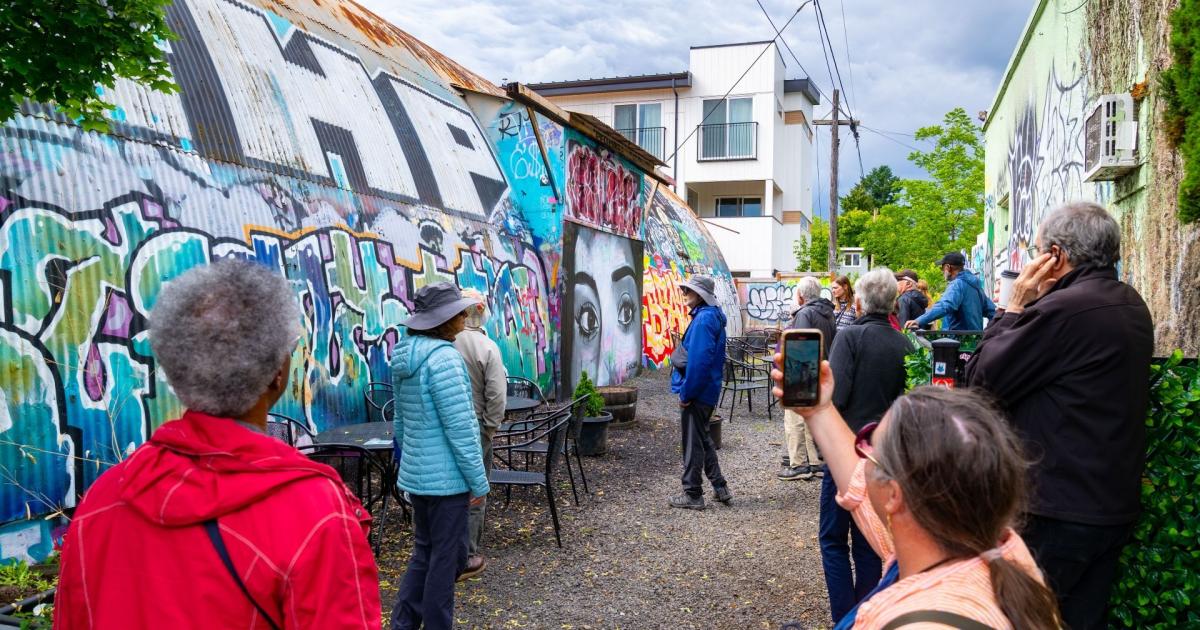

One cool evening in St. John's, Newfoundland, we stood in the dark outside the Anglican Cathedral with about 40 strangers, waiting for a folklorist named Dale Jarvis to begin. For the next hour or so, we walked (and wheeled) the old streets while he unspooled story after story. By the end of the haunted hike, the whole city looked different to us. Streets we'd traversed all week had secrets!
A great historic walking tour gives you a new way to see a place (and the world).
I have taken historic walking tours on both sides of the Atlantic, with a young kid, with a teen (and now an adult), and with my parents.
Here's your guide: how to find the good ones, how to choose your style, and how to savor every step.

Every street has a story. Listen.
Why a Historic Walking Tour Beats the Bus
A bus tour can show you a city; a walking tour brings that city to life.
On foot (or your wheels), you move at the pace of curiosity (and the tour guide). You can stop and ask questions the WHOLE time. You feel the cobblestones underfoot, run your eyes up the architectural details only seen from ground level at a certain spot, smell the rain on old stone, and hear your guide's voice bounce off buildings that were standing long before any of us arrived. When the tour passes a chocolate shop or a coffeehouse, you ask the guide’s opinion, take note, and come back (we always do!).
Walking is also how history actually happened. People walked these streets to school, to work, to meet friends, to protest.
Exploring them yourself is the closest thing to time travel we've found.
How to Find a Historic Walking Tour Worth Taking
Every city has walking tours galore. Finding the one worth your morning takes about fifteen minutes of research…if you know where to look.
Start with the national park, historical society, visitor center, or library
Local historical societies run some of the best-researched tours anywhere, often for a few dollars.
And you won't be surprised to learn my favorite move: when you arrive somewhere new, visit the local library. It is the social hub of any town, and librarians know which tours are treasures and which ones to skip. They have never steered me wrong!
Our National Parks offer a plethora of fascinating walking tours (such as Boston’s Black Heritage Trail). Official visitor / tourism centers provide excellent, tailored advice for travelers – they, too, are in the know, and ready to help when asked.
Look for the storyteller-guides
The best tours are led by people with deep roots or deep training (ideally both). In Stratford, Ontario, Stratford Walking Tours is led by Lauri, a guide with a Master of Arts in Public History, and it shows: the town's architecture and community stories open up block by block. In Boston, architectural historians lead walks through the city's layers. In St. John's, ours is a professional folklorist.
Before you book, read the reviews. Storyteller-guides get named in reviews, every single time (because we love them so!).

One of our favorite guides: Lauri, of Stratford Walking Tours
Seek out the free and almost-free options
Some of the best historic walking tours cost nothing! Paris Greeters will match you with a local volunteer who walks you through their own neighborhood, showing you their favorite things (I love them). Many cities have greeter programs like it. US National Park Service rangers lead free historic walks in dozens of cities. And free walking tours (tip your guide well!) run in most major cities, like Barcelona's Gothic Quarter tour we've covered..

ask a librarian. always.
Guided or Self-Guided? Choosing Your Style
Both are wonderful. They're just different tools, and your circumstances will lend themselves to this decision.
Choose a guided tour when the history is complex, painful, or contested; when you want the stories a plaque won't tell; when you love stories, and learning together; or when your curiosity loves asking questions. A guide who grew up in this town, or studied it for their degree, will tell you what the textbook left out, and add in all kinds of local flourishes.
Choose self-guided when you're traveling with small kids or mobility needs and want to set your own pace, or when your schedule doesn’t match up with tour times. Most historical societies publish walking maps, and many cities offer free audio tours through apps (the NPS App is excellent). Self-guided also means you can linger twenty minutes at the building that grabs you and skip the one that doesn't. Bliss!
We do both, often in the same city: guided first for the stories, then self-guided the next day to revisit both what intrigued us and to explore new routes.
Tip: Book a guided tour for your FIRST morning in a new city. Everything you see for the rest of the trip will build upon those stories.
Extended Historic Walking Tours
Sometimes, an afternoon isn't enough. If history is your jam (as it is ours), consider an extended history tour, such as those offered by trusted organizations like Road Scholar. We are impressed by their 5-6 day tours that cover many aspects of a city's history. Imagine such a richly textured educational experience, filled with new friends, knowledgeable guides, and essence of place. For instance, on their Signature City tour of St. Augustine, Florida (the oldest, continuously-inhabited city in America), you'll learn via presentations, a tour on a trolley, monuments, museums, and walking and learning amidst living history.

Photo: Glenn Webb, Road Scholar
Bespoke Historic Walks and Curated Tours
A great way to experience a city or town on a deeper level is with a bespoke walk or curated tour, tailored to your travel experiences and personal tastes. You can often find them on websites run by people who live in the place they write about or have visited numerous times over many years. They’ll be able to show you genuine off-the-beaten track places and help you understand local culture in a new light. Long-term residents of a place where they weren’t born, in particular artists, photographers and writers, see their new home towns differently from people born there.
Author and cultural guide Lisa Morrow is one of them, an Australian-born Istanbul resident of more than 15 years, a veritable outsider looking in. As a sociologist, author, and travel writer (we LOVE her books), she has a unique perspective on what she’s come to see as the unexpected treasures to be found in the everyday extraordinary of Istanbul life, beyond the popular tourist sights.
Drawing on her years of exploring the city and fascination with all things Turkish – the people, food, culture and history – she creates special interest author walks that reveal living Istanbul, where the tourists aren’t.

Photo: Lisa Morrow
Accessible walking tours
When we were in Quebec City, I so wanted to explore this marvelous city, yet I can't walk very far (or for very long). We needed to learn the history of the city in a more accessible way than a traditional walking tour. We found Michelle, an incredible guide who taught us much about the area (and was extraordinarily patient with me seeking stories from her about all Quebec City's magnificent, historic doors - and what was behind them).
She mixed history with art (and lots of laughter), is a Quebecois who flawlessly switched between French and English, and became a new friend that loved to laugh and regaled us with the vivacity of life in Quebec City. We explored via car, foot, and cablecar...and, always, with our laughter ringing out against the historic buildings and wide open spaces, delighting ourselves (and, to be honest, all that heard us). It was entirely accessible to me, guided by a local both in the know and excellent at finding accommodations, no matter what I was interested in (doors! murals! coffee! art!).
We ended up with an idyllic afternoon (and meal) on Île d’Orléans - a culmination of living history, essence of place, food, friends, and truly learning a city from a knowledgeable guide.

Two new friends, bonding over history and place
How to Get the Most from Any Historic Walking Tour
Read something first
An article, chapter, children's book, newspaper, magazine. A little context beforehand means you recognize what the guide is showing you; recognition is half the joy. (Here's the history we love in Chicago.)
Wear comfortable, stable shoes
Always. Historic districts mean cobblestones, brick sidewalks, and hills that predate the invention of the sidewalk ramp.
Check accessibility honestly
I travel with disabilities and mobility considerations, so I ask ahead: how far, what terrain, how many stops with places to sit? Good operators answer immediately. And there is joy in the alternatives: at Muckross House in Ireland, we toured the estate by jarvey cart, and our driver sang the whole way! In Istanbul, I reframed from feeling sad about not seeing the historic sights toward truly, deeply learning about a people and culture. It was incredible.
Stand at the front
Near the guide. You'll hear everything, and you'll become the person they tell the extra stories to.
Ask the guide this one, real question:
Not a quiz question. A real one: "What do you wish visitors understood about this place?" Then watch the tour get better for everyone.
Stay after
The best ten minutes of many tours happen after they end, when the group thins out and the guide has time to chat. Ask how they got into sharing places via tours. Ask where you should go next. Ask them where to eat lunch (or, if you're like me, the best coffeeshop and roastery). They ALWAYS know the best places around. Plus: photo opp!

After a tour with Stratford Walking Tours - look at all those smiles!
Historic Walking Tours with Kids and Students
Kids are built for walking tours. They are low to the ground, endlessly curious, and delighted by things adults walk past (carved faces on buildings, old boot scrapers, dates chiseled over doorways, cats).
Give them a job: spotting trail markers, counting gas lamps, finding the oldest date on any building. Let them ask the guide questions themselves (one surefire way to raise kids who love to learn while traveling). And choose shorter tours (an hour is plenty for young kids), with a treat stop built in afterward. History plus ice cream is a formula that has never failed us (extra bonus if they serve an affogato, let’s be honest).
Our daughter is fascinated by haunted hikes. We have been on many, many haunted tours, and been spooked by many a ghost story (maybe that was just me?). If I mention that a destination has a haunted tour, she’s ALL IN. She will research beforehand, help me book the tour, and eagerly await the day. During the tour, she is quiet – taking it all in, listening with intent. Her questions are incredibly thoughtful. She amazes me with her perspicacity, her noticing of physical details (did you see what that tall gravestone said? Did you see the actor hiding behind a tree? Did you notice, see, hear…) and the storyteller’s cadences.
For teens, hand them the map and let them lead. One of the best things about traveling with teens is how much they want to follow their own interests, and a walking tour built around their passion (theatre, food, ghosts, architecture) beats a general tour every time.

low to the ground, standing tall with curiosity
Favorite Historic Walking Tours from Our Archives
We have been collecting these for years. Of special note:
Stratford, Ontario: history, architecture, and community stories beyond the stage, led by a public historian.
London: a city made for walking; our roundup of the best walking tours in London covers history from the Romans onward.
St. John's, Newfoundland: the Haunted Hike, ghost stories with real history underneath, told by folklorist Dale Jarvis.
Boston: The Black Heritage Trail's free NPS ranger walks, right there in the midst and bustle of a thriving city with deep roots.
Istanbul: Stepping Back Through Chalcedon: Kadiköy Walk Audio Tour
Paris: Paris Greeters, a free walk through a local's own neighborhood.
Quebec City: A Savory Stroll of the Marché Jean Talon
Sydney: Hidden history, in plain sight.
San Francisco: An array of fascinating tours - free!
Frequently Asked Questions
How long does a historic walking tour take?
Most run 1.5 to 2 hours and cover a mile or two at a gentle pace. Plan for a coffee or a treat afterward; you'll want to talk about what you saw.
How much does a historic walking tour cost?
Anywhere from free (greeter programs, NPS ranger walks, tip-based free tours) to about $10-$50 for guided tours from historical societies and professional outfits. Themed private walks run higher. Please remember to tip on the free ones, if you are able.
What should I bring?
Comfortable, stable shoes, water, a layer for weather, and a small notebook or a phone for photos of the details you'll want to remember. That's it. Pack light; you're walking!
Are guided walking tours worth it?
When the guide is a storyteller, absolutely. You'll learn more in ninety minutes than in a day of wandering with a guidebook. Plus, new friends.
How do I find historic walking tours near me?
Ask the historical society, the visitor center, and the library, in that order. Check for a greeter program and NPS sites nearby. Your town has more history than you think! It's always fun to travel your home.
Let’s roll! Where has a walking tour changed how you see a place?
Further educational travel resources I've written here on Wandering Educators:
History Tours Worth Taking: An Educator's Guide to Traveling Through the Past
Places to Travel with Family: Nine Trips That Teach Your Kids Something Real
Educational Family Trips: How to Raise Kids Who Love to Learn While Traveling
10 Ways to Raise an Intercultural Child
Why We Love Traveling with our Daughter
The Importance of International Experiences
Cultural Travel: A Guide to Trips That Teach
Cultural Immersion Travel: A Guide to Being Welcomed In
Jessie Voigts is the founder and publisher of Wandering Educators. She has a PhD in International Education, has lived and worked in Japan and London, and traveled around the world. She is constantly looking for ways to increase intercultural understanding, and is passionate about study abroad and international education.
Find her online via Instagram, Facebook, or LinkedIn.
Feature photo: Ian Upton, Road Scholar