
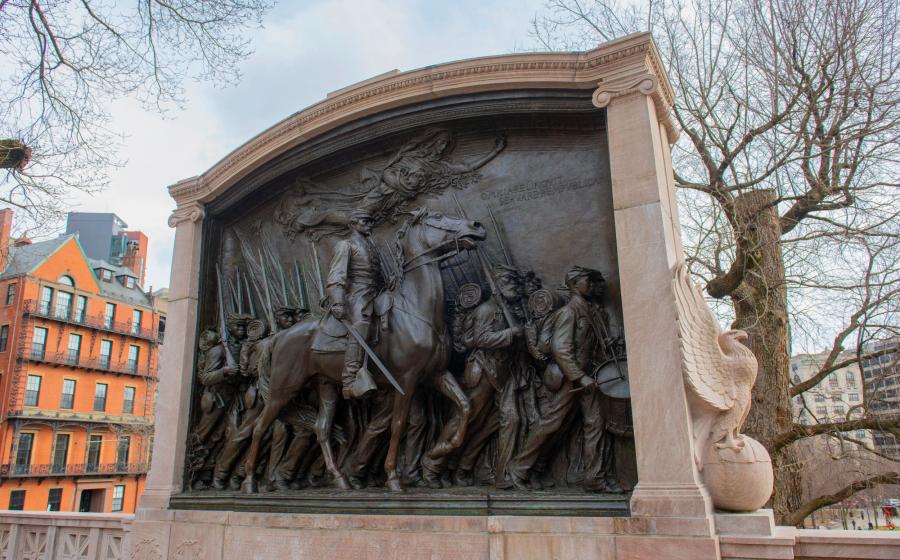

Across from the Massachusetts State House, at the edge of Boston Common, stands a bronze memorial that stops people mid-stride. It honors Robert Gould Shaw and the 54th Massachusetts Regiment, one of the first Black regiments recruited in the North during the Civil War (if you've seen the film Glory, this is that regiment). Above all, look at their faces. Artist Augustus Saint-Gaudens spent fourteen years getting them right, and every soldier is an individual, a particular man with a particular face.

Robert Gould Shaw and 54th Massachusetts Regiment Memorial. Wikimedia Commons: Ethan Long
Here is where the Black Heritage Trail begins.
After almost two decades of publishing Wandering Educators, we can tell you that the places that teach best are the ones where the history happened right under your feet.
This trail is exactly that: about 1.6 miles through Boston's Beacon Hill, 10 sites, and some of the most important American history you can walk in an afternoon...right where the history happened.
Here's your guide: what the trail is, the stories behind it, and how to visit well.

What Is the Black Heritage Trail?
The Black Heritage Trail is a walking trail through Beacon Hill's north slope, linking the homes, schools, churches, and meeting places of the free Black community that flourished here in the 1800s. It is part of the Boston African American National Historic Site, and the National Park Service leads free guided tours along it.
The Freedom Trail, one neighborhood over, attracts the crowds. The Black Heritage Trail tells a story just as central to American freedom, with a fraction of the foot traffic. You'll walk brick sidewalks under gas lamps, duck into narrow Smith Court, and stand in rooms where the fight against slavery was planned out loud.
The History Beneath Your Feet
Massachusetts ended slavery in 1783, after enslaved people including Elizabeth Freeman and Quock Walker took the ideals of the American Revolution into court and won. Think about that for a moment: they used the state's brand-new constitution, with its "free and equal" clause, as the legal ground for their own liberty.
In the decades that followed, the north slope of Beacon Hill became home to one of the most organized free Black communities in the country. Leaders like Prince Hall (c. 1735-1807) built institutions: schools, churches, aid societies. Through the nineteenth century, this neighborhood organized for abolition, sheltered freedom seekers escaping slavery, and pushed Boston toward integrated schools.
The buildings still stand. You can walk into some of them. Very few American neighborhoods offer that firsthand experience with history.
What You'll See on the Black Heritage Trail
There are, in total, ten sites, marked and mapped. Of special note:
The Robert Gould Shaw and 54th Regiment Memorial
The trail's traditional starting point, and worth ten minutes of standing still before you take a single step. The 54th's story (including the assault on Fort Wagner) is one your whole family should know.
The Abiel Smith School
Built in 1835 as the first building in the nation constructed to be a public school for Black children, and later a rallying point in the fight to END school segregation in Boston. For any educator, this small building carries an enormous charge.
The African Meeting House
Built in 1806, this is the oldest extant Black church building in the United States. Frederick Douglass spoke in this room. Abolitionists organized here. It is now part of the Museum of African American History, and stepping inside accesses the heart of the entire trail.

African Meeting House. Wikimedia Commons: African Meeting House ajay_suresh
Homes of abolitionists and freedom seekers
The Lewis and Harriet Hayden House was a documented Underground Railroad station; the Haydens, who had themselves escaped slavery, sheltered freedom seekers in the years before the Civil War. The George Middleton House (1797) is the oldest standing home on Beacon Hill built by Black Americans; Middleton was a Revolutionary War veteran. And the Phillips School was one of Boston's first schools with an interracial student body.

Hayden House, NPS facebook
Tip: Go in the morning, before the neighborhood wakes up. The empty streets are hushed, the light glows beautifully on the brick, the rich aroma of coffee drifts out of the Charles Street cafés, and you can hear your own footsteps on the sidewalks that carried this history.
How to Visit: Tours, Hours, and Practical Details
Free NPS ranger-guided tours
The National Park Service leads guided walks of the trail (about 1.5 hours) in season, roughly late spring through mid-October. They are free, and the rangers are marvelous storytellers! Days and times vary by season, so check the NPS site for the current schedule.
Self-guided, any day of the year
Download the NPS App and search for Boston African American National Historic Site; there's a free self-guided audio tour. Can't get to Boston yet? The NPS also offers a virtual Black Heritage Trail tour online (wonderful for classrooms!).
A few practical notes: Beacon Hill is steep, and the brick sidewalks are charmingly uneven (your ankles will notice), so wear comfortable, stable shoes. The trail itself is free. The Museum of African American History charges admission for its galleries; check their site for current hours and rates. And if you're making a day of it, head to Charles Street afterward for a well-earned treat, or pair the trail with more of our favorite corners of Boston.
Visiting the Black Heritage Trail with Kids and Students
You won't be surprised to learn that we think you should absolutely bring the kids. But this is weighty history, and the way you lead them into this space is important.
Prepare before you go
Dig into the Google arts and culture page on the Black Heritage Trail, which provides a clear and illustrated history. Read a picture book together, listen to a podcast (we recommend learning about Boston’s Underground via the National Park Service), or watch an age-appropriate film about the Underground Railroad or the 54th Regiment. A little context beforehand means your kids recognize what they're seeing (and their questions get so much better!).
Let them lead on the trail
Kids are wonderful at finding the trail markers (they will spot every single one before you do!), and the Abiel Smith School can make a powerful impact with school-age children. A school, for kids like them, and a fight over who was allowed to learn is a conversation starter that allows kids to draw their own conclusions from their life experiences and from learning this history.
Make room for the heavy parts
When I took our daughter to the United States Holocaust Memorial Museum in Washington, DC, we learned that children can hold more than we think, when we talk together before, during, and after. The same is true here. Answer questions honestly. Then talk about it again, weaving it into lesson plans, discussions, books available in your family or classroom library.

Small street, big history
Black Heritage Trails Beyond Boston
Boston's is the best-known, but it is not alone, and that is a good thing. You can find more via the National Park’s Network to Freedom resource. The Black Heritage Trail of New Hampshire tells stories across the state from its home base in Portsmouth. Florida's Black Heritage Trail maps sites statewide. New Jersey's Historical Commission maintains one, and New London, Connecticut has a wonderful walking trail of its own. Each one names people and places the textbooks too often skipped. If there's one near you, go!

African Burying Ground Memorial Park, Portsmouth, NH. Wikimedia Commons: LibSEEE
Frequently Asked Questions
How long is the Black Heritage Trail?
About 1.6 miles with 10 sites. The guided tour runs about 1.5 hours; self-guided with a museum stop, give it a half day. If your kids are smaller and you have a few days in Boston, break it up into kid-friendly chunks of time throughout your visit.
Is the Black Heritage Trail free?
Yes! The trail and the NPS ranger tours are free. The Museum of African American History charges admission for its buildings; check current rates.
Where does the Black Heritage Trail start?
At the Robert Gould Shaw and 54th Regiment Memorial, across from the Massachusetts State House at Boston Common.
When is the best time to visit?
Shoulder season, on a weekday morning. You’ll find smaller groups, softer light, and rangers with time to chat.
This trail is worth building a whole Boston trip around! Have you walked it? What stayed with you?
Further educational history travel and educational family travel resources here on Wandering Educators:
History Tours Worth Taking: An Educator's Guide to Traveling Through the Past
Historic Walking Tours: How to Find (and Savor) the Best in Any City
Educational Family Trips: How to Raise Kids Who Love to Learn While Traveling
Three Museums in Boston For Families With Young Kids
Stratford Beyond the Stage: A Walking Tour Through History, Architecture, and Community
Education Travel Adventures: A Teacher's Guide to Programs, Funding, and Self-Designed Trips
Ed Forteau is the co-founder and co-publisher of Wandering Educators. For almost two decades, he has traveled the world alongside his wife and co-publisher Jessie Voigts and their daughter, always in search of the stories that make a place impossible to forget. You can find him on LinkedIn.